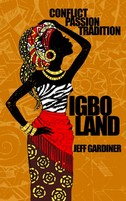
A tale of passion and conflict, set in West Africa.
A new life begins for her thousands of miles from home.
Lydia and Clem Davie arrive in an Igbo village in Nigeria in July 1967 just as civil war breaks out, but Lydia has trouble adjusting to life in West Africa: a place so unfamiliar and far away from everything she truly understands.
Initially, most of the locals are welcoming and friendly, until one or two begin a frightening campaign of anti-white protests.
Lydia’s life is changed irrevocably after she meets enigmatic Igbo doctor, Kwemto, and war victim, Grace. Through them Lydia learns about independence, passion and personal identity.
Conflict and romance create emotional highs and lows for Lydia, whose marriage and personal beliefs slowly begin to crumble. Will this house in a Nigerian bush village ever seem like home?
Excerpt
1
‘Can I see the map again?’ I asked Clem. He took it out and unfolded it himself, as if unwilling to let anybody touch his prized possession. ‘Ngkaluku’ had been hand-written next to a felt-tip dot in the middle of nowhere. Our home for the next few years would be in the West African bush amongst the Nigerian Igbo people. In my mind I could never imagine such a strange-sounding place ever becoming my real home.
Through the dusty glass of the train window I saw thick, lush vegetation and very little open space. Every now and then a small village slipped past, surrounded by grained crops and then hours and hours and miles upon miles of trees.
During our third day on the train, we stopped at Oturkpo. The presence of many soldiers surprised us both. They all carried rifles. Whilst the train waited in the station, Clem went out to buy some fruit and groundnuts. He looked pleased with himself on returning.
‘I found some batteries for the wireless.’
It was a brown Roberts transistor radio, which worked intermittently and usually best after being struck sharply on the side. He eventually found BBC World Service, which pleased him greatly. We were desperate to hear the latest about the recent military coups in Nigeria.
An intense migraine took slowly took control of my entire being and I couldn’t be bothered to find the aspirins. I drifted in and out of consciousness only vaguely aware of the voices on the radio until Clem abruptly prodded my shoulder.
‘Lydia, you need to hear this.’
‘...the Nigerian Federal Government has declared that the country is officially in a state of civil war. Major hostilities continue in the border regions, as the federal troops continue to advance towards Biafra. Clashes have occurred in towns such as Kano, Kaduna, Oturkpo and Enugu between Northern Muslims and the Igbos in the Southeast. Southern rebels are seeking to gain independence from the Nigerian federal government with the aim of creating their own republic of Biafra. Yakubu Gowon, the head of state declared that Nigeria would stay united, whilst the Igbo military leader, Colonel Ojukwu, has promised to 'Fight fire with fire'...’
Professional Reviews
A passionate exploration of personal discovery...
Igboland is a tender portrayal of change and growth, set in Nigeria, during the Biafran War. From ripples of uncertainty to scenes of devastation and despair, the civil war erupts currents of social unrest, as the missionaries encounter, and even fall prey to becoming, its victims. Social unease is delicately reflected in the spiritual dialogue, relationships and experiences of the key characters, whose resilience, often inspired by the suffering they encounter, allows them to evolve and unite on a level that reflects their personal growth. The sensitive interweaving of spiritual, personal and political issues invites comparison between British and Nigerian cultures, without forcing harmony where differences and questions remain. In the same vein, though characters exit ‘hand-in-hand’, the complexity of their relationship is not veiled, as the ‘formal end’ of the civil war leaves the country in chaos and bloodshed, rather than an over-simplified phoenix-style reconstruction. Poignant, yet uplifting, this novel opens the mind to ourselves and the world beyond.
A sensitively written story
Such an interesting book, offering an insight into the turmoil of the Biafran war of the 1960's through the eyes of Lydia, a naive English girl. Alongside the bloody fighting, the young missionary couple attempt to teach and heal, but while a story of love unfolds across the races, Lydia's faith falters. The book grew on me as I read on, and the ending of this sensitively written story is remarkably credible and satisfying.
There are questions available for Book Clubs, and extracts from the diary of the author's mother, although Jeff Gardiner emphasises that this is a novel, and NOT the real story of his missionary parents in Nigeria.
Through the freedom of fiction, a number of issues are tactfully aired and addressed. An immensely worthwhile read.
War and passion
I am old enough to remember the TV coverage of the Biafran War and the tragedy that unfolded every evening in our living rooms as innocent civilians were displaced and died in their thousands, mainly from famine and disease. TSome have estimated the death toll at 3 million people and it was the first famine to be covered in any depth on the news. The scenes of starving innocents were truly shocking. There was however a prevailing view in Britain at the time voiced frequently by those who favoured British imperialism, that the Nigerians wanted their independence, now they must live with the consequences. Fortunately, there were others with more enlightened views who were prepared to try and do something to alleviate the suffering, however small a contribution that might be. In part, this is their story.
Despite the suffering and individual tragedies that unfold, this is a book based on hope on a number of different levels. The writer communicates his belief in a better future and the ability of love to overcome any difficulties, no matter how insurmountable they may seem at the time. It is a strong story with good characterisation and evidence of detailed research. We are told about the culture and beliefs of the Igbo with a sense of pride and it seems as if the writer is trying to re-dress the balance away from our ignorance about West African culrure to show us there is something really worth learning about. Anyone who has seen the Benin Bronzes in the British Museum will understand there is a level of sophistication we in the West have under-estimated for centuries.
Igboland is a cracking tale that would translate to the medium of film extremely well. Recommended reading.
'Better Without You'is a compelling narrative that explores the complexities of an affair, hidden secrets, and abuse. It also highlights a daughter's heartfelt journey as she cares for her mother who is battling dementia.
The Wholly Book of Exodus is humorous adult literature that features adult language, situations and content. It is the companion book of Jay Dubya's The Wholly Book of Genesis that satires the entire first book of the Bible.
The Wholly Book