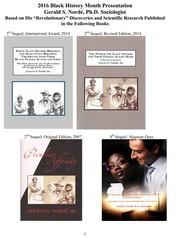
This book is a monograph on the U.S. South's white slave owners breeding themselves with their black female slaves and girls.
This book is a scholarly monograph and the second sequel in a series of four publications, the Ph.D. dissertation, University of Delaware (1985), being the first sequel. This book presents two significant discoveries of U.S. slavery in the South. These discoveries are: (1) the peculiar affinity and (2) the nexus of sex and reproduction. At the micro-level of southern society, the peculiar affinity appeared as sexual and reproductive relations between a commodity producer and his commodity, the slave owner and his female slave or girl, respectively. At the macro-level of southern society, the peculiar affinity transforms to the nexus of sex and reproduction, and it having appeared as sex and reproduction only among and between all of the South's slave owners themselves with their black female slaves and girls. These discoveries are very significant findings related to slavery in the South.
. The subject matter of this second sequel is the U.S. South's white slave owners' two or more sets of children and families with their black female slaves and girls, the peculiar affinity. At the same time, this monograph's subject matter is on the South's white slave owners' two or more sets of children and families with their white women, white girls, white mistresses, white concubines, their little white girls, and their white wives, the nexus of sex and reproduction. This book's science, including the author's Notes, an extensive Appendices (A-F) of data and documentary materials, and an extensive Index, provide the evident proof that the South's white slave owners' children from the two or more sets of families with all of their black female slaves, colored girls, white women, white girls, and their white wives were children who were exactly brothers and sisters to each other all at the same time, siblings.
This world made between the South's white slave owners and their black female slaves and girls was actually, in reality, a world of family, family ancestry, family heritage, and family lineage between commodity producers and their own commodities, the world the slave owers and their female slaves made.
Excerpt
"Norde's research leads him to three major conclusions...the world the slave owners was a unique and perhaps and unprecedented cultural definition of family and kinship...Norde discusses the peculisr afffinity that led to the definition of race in terms of skin color." Professor William Chambliss (deceased), the Department of Sociology and Criminal Justice, George Washington University, Washington, DC
Professional Reviews
Professor Cornel West
This book has been endorsed by Professor Cornel West, Princeton University, NJ. Refer to Amazon.com for the endorsement.
A detailed study of the origins of the New Alienation. The author labels it normative or postmodern ennui and traces its rise to cultural power over the last two centuries.
A detailed study of the origins of the New Alienation. The author labels it normative or postmodern ennui and traces its rise to cultural power over the last two centuries.