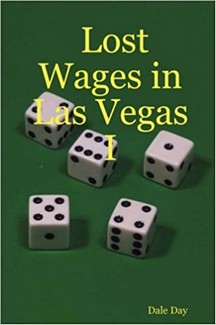
A Taxidriver's Guide to - Slots- Gambling- Sin City
A basic guide for anyone visiting Las Vegas - or Reno for that matter.
Written by someone who was a professional slot machine player and Vegas cabbie, it gives a bit of history and many bits of information to make ones' stay enjoyable - and less costly.
Excerpt
* Now to Slot Machines, something I know a little bit about.
The “how” of slot machines is easy. Each machine's controlled by a “Random Number Generator”. It constantly “shuffles” the numbers/ objects/symbols. When you drop in the first coin or hit the “play” button, the shuffle stops and the results are set.
IT MAKES NO DIFFERENCE WHETHER YOU HAND-FEED COINS OR USE THE CREDIT BUTTON.
You just sit there and wait for the reels to stop spinning or the cards to appear on the screen.
Some say there’s a difference because the chip has a “timer” and the time between plays may change the outcome.
Some people feel the machine controls the cycle by the amount of money put into the machine. That could not be further from the truth because each deal's totally new and has nothing to do with the previous combination.
There are other chips on the motherboard depending upon the manufacturer. They all perform the same functions - totally separate from the Random Number Generator.
One identifies the combinations and announces them on the screen; i.e., one pair, three of a kind, etc. When the spin or draw's complete, it assigns the payoff indicated on the front of the machine.
The other keeps track of all cash going into and out of the machine, including bill and coin denominations, all pays, and other information to be reported to The Gaming Control Board.
That's why, if anyone tells you they can tell where the machine's in a cycle, they don’t know what they’re talking about. (What did I say about the so-called pros? In truth, they’re “blowing smoke!”)
As I sit and play, I hear/see other players wondering what cards to select. Then, when the next deal comes out, they comment on how their card was or wasn't there. It doesn't work that way! Remember, every time you drop in a coin or hit the “play” button, a whole new deal’s made.
According to a spokesman for International Game Technology (IGT), on their current machines, the shuffle stops as soon as you drop in the first coin or press the “Deal” button, and the top five cards are dealt. They appear on screen in order. The “shuffle” continues. When you‘ve selected the cards you want to discard, the cards being shuffled are stopped and the next five are dealt, in order from left to right, with the cards being placed, in order, in the vacant spots. The chip continues to shuffle the entire deck until you start the process all over again.
On some non-IGT machines, the chip does basically the same thing, but deals all ten at the start of the game. The remaining five are there, in order and not visible. If you select a pair and throw three cards away, the next three cards, in order, appear in their place. It means nothing as to where the cards were that you discarded or how long you wait to hit the draw button.
The biggest “secret” in playing video poker's to under-stand possible results in comparison to the payout schedule. You are not playing against another person but against a machine based on mathematical principals. Each and every hand's different but you need to understand the long range possibilities/probabilities. You need to make the decision based upon the most probable results.
Which machines should one play? As stated elsewhere, the 100%+ machines are Deuces Wild Video Poker, some Double-Bonus, and Double-Double Bonus machines. Each has a different strategy and you must know the correct payoff schedules. The deuces machines should pay 5 for four of a kind and nine for a full house. The Double bonus must pay 7 for a flush and eleven for a full house. You must know how to play them and be patient.
Remember, it takes approximately forty thousand plus plays to go through a Royal Flush cycle.
And, here’s another “secret” - there’s no way of knowing where in “the cycle” the machine is and the jackpot can show up anywhere in the cycle … at the beginning, middle, or end. Any book or video that tells you different is just another way to get your money.
Better yet, what machines NOT to play?
If it's a gimmick, the house has the edge. Here are some examples:
Double Deuces machines - sure they pay you double for four deuces. But, they reduce the number of coins you get for four of a kind. With thousands of fours of a kind in a cycle, you are losing five coins every time you hit one. That's exactly how the house has the edge.
Any special bonus or multi-coin machines. Here they get you in the payout of one coin for two pair. They also suck you in by getting you to think you should break up otherwise winning hands to go for the bonus.
As far as other pull-the-handle slots go, there's simply no way to know what their payoffs are and progressive banks don't give you any help either. If you win, it's a pure matter of luck.
How to pick a winning machine?
Maybe it talks to you, “Play me! I am going to win!” Or, it reaches out and pulls you into the seat. Maybe it's your “lucky number” on it. If the machine gives you credits, play it. If it doesn't, get off and try another.
To reiterate, there are plenty of books and websites that will help you learn how to play the various games. Give yourself a break and check them out before you throw your money away.
When people think of Madagascar, what may come to mind is a Pixar film, a lemur paradise, or the source of 80% of the world’s vanilla beans. In A Taste of Madagascar: Culinary Riches of the Red Island, Emmanuel Laroche—a Flavor Explorer and Culinary
An account of adventures in Scandinavia that involved flying dragons, Russian and German submarines, old WW2 era battlefields, Finnish foxes (female kind), Finnish-Mexican cuisine and much more. Written for the most part with a light touch, it ends o