Tom Garrison, click
here to update your pages on AuthorsDen.
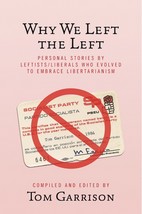
Why We Left the Left: Personal Stories by Leftists/Liberals Who Evolved to
by Tom Garrison I edited compiled and edited stories from 23 people (including my own story)
Category: Political Science Publisher: Create Space
ISBN-10: 1492279570
Type: Non-Fiction
Pages: 240
Copyright: July 4, 2012
ISBN-13: 9781492279570
Price: $3.99 (eBook)
One political question intrigues almost everyone who studies, participates, or is interested in politics: “Why do people identify with a certain ideology and/or political party?”
One political question intrigues almost everyone who studies, participates, or is interested in politics: “Why do people identify with a certain ideology and/or political party?” Numerous scholarly and popular books examine political ideology/party identification and why certain ideologies attract certain individuals. This book examines that question in two separate, yet joined phases. Why do people initially identify with the Left/liberalism and why do these same individuals abandon that ideology to evolve into libertarians? This inquiry is unique in its focus on former liberals/leftists who become libertarians.
Included are 23 stories from Americans and one Irishman, baring at least part of their souls to answer these questions. All contributors at one point identified with the Left/liberalism. Each explains what originally drew them to the left part of the political spectrum. Virtually all mention some version of the popular stereotype of liberals/leftists “caring for the average person.” And all came to see that as a wispy apparition, based more on intention than fact.
One popular conception of libertarians is that they are, for the most part, disgruntled old white guys. While that group is represented, more than 25 percent of the stories are from women and more than two-thirds are by people younger than 50. This gender and generational diversity extends to occupations—contributors include college students, law students, an attorney, a professional artist, public school teachers, a chemist, writers, a filmmaker, a law professor, a stay-at-home mom, a firefighter, the CEO of a $40 million company, a TV reporter, an editor, the CEO of a free market environmental think tank, and a research engineer.
Excerpt
Around this time, the mid- to late 1990s, I began to reconsider my commitment to socialism. I, and most of Santa Barbara socialist group, advocated New Left decentralized power. Marx’s idea of the withering away of the state and voluntary cooperation among empowered citizens was our goal and guideline for action. For me, accepting free markets was simply applying my end state to current actions. And since I was always a Libertarian on social issues—such things as supporting gay rights, pro-choice, gun ownership via the 2nd Amendment, legalizing personal drug use—the evolution into a classical liberal/libertarian was not as drastic as one may think. As I began to read libertarian thinkers and magazines (Reason and Liberty) I came to see that the decentralized aspects of New Left ideology fit well with free markets and free minds. By the late 1990s I considered myself a libertarian and joined the Libertarian Party.
Professional Reviews
Unique personal perspectives offer insight into our limited political landscape
The last Libertarians I remember seeing in the flesh were a couple of college students shouting humorous but unprintable things about Dick Cheney while they handed out leaflets. That was obviously a few years ago. "Spirited but extreme" was the thought that went through my mind.
So I was curious to get a more balanced perspective on this political viewpoint.
This collection of short essays from two dozen former self-proclaimed leftists who came to embrace Libertarianism did just that. From college students to businessmen, plainspoken to eloquent, these pieces reflect opinions that are accessible to Democrats like me who think it's important to see the other guy's POV.
Although I'm still a (disgruntled) Democrat, I came away with a deeper understanding of a position not unlike my own. Living in the People's Republic of San Francisco, I found myself sharing many of the sentiments of these everyday people looking for a voice in a limited political landscape.
Tom Garrison's compilation of these stories is thoughtful and thorough and his piece and foreword some of the most insightful. If you want a quick deep dive into a political stance different from your own, you won't go wrong with this collection.
Everyone should read this book--especially libertarians needing a mental boost
Disclaimer: I am a contributor
FYI to the disclaimer: I received no compensation for my contribution, nor will I receive any in the future.
I wrote my essay in a bubble of my own reality and experiences. I wondered how Tom Garrison--this name on an email and picture on a Facebook page--could possibly organize all of the contributors into a cohesive book. Based on my own experience, I knew he was not heavily editing the essays. For the average political book reader, this may sound like a negative. However, I am someone that hates poor editing, and I didn't notice it with this book. I was too involved in reading about normal, everyday people that wrote about their experiences and their reality from their bubbles.
I found myself wanting to meet many of them (I haven't). Every single person was real. They weren't some talking head on TV or a picture above a syndicated news column. They were neighbors. As a Libertarian that feels civil rights are just as important as limited government, it's rare that I can find someone that sees life from a similar perspective. Even within the Libertarian party--as with all political parties regardless of how organized--there are schisms. This book is so optimistic about the future that I shake my head in disbelief that somehow 23 of us, independent of one another, and having no idea what the others were writing...we all managed to sound so POSITIVE about the future.
Libertarians are not known for being optimistic. At least, I've never felt like the group gave off that feeling. Republicans and Democrats shake their heads at our "stubbornness" and try and convince us (every 4 years) not to waste our vote. Sadly, many Libertarians (card-carrying and just leaning) are swayed to the right or the left so that their vote won't be lost.
Read more ›
Libertarians are people too
I'm a contributor, but I have not had the opportunity to read the other contributions until now. This collection of essays, as the forward suggests, is not a collection of angry white guys complaining about taxes. These essays run the gamut of the socio-political spectrum and serve to remind the reader -regardless of political persuasion- that libertarians are not potheads who like guns. These are people who are deeply concerned about the issues affecting education and business, foreign policy and domestic policy, family and country.
I highly recommend reading this as it provides insight into another side of politics, the personal side. It is not a collection of arguments promoting austrian economics or laisse faire capitalism. It is who we are as libertarians: deeply concerned citizens and deeply passionate about our beliefs and love of country.
This is a political treatise that deals with the China issue from a completely new perspective. Disparaging as he may sound, from page to page, toward "the old system" and the Communist Party's various wiles, the author demonstrates his mysteriously