Kindle Edition
Amazon
Amazon
Category:
Historical Fiction
Publisher: Inge H. Borg
ISBN-10: 101481041959
Type: Fiction
Pages: 461
Copyright: Dec 24, 2011
ISBN-13: 139781481041959
Price: $5.99 (eBook)
First Egyptian Dynasty beset by violent storms from within and without. A young princess pays the price for her transgression against Ma'at.
The joyous birth of Nefret, Royal Daughter of Ancient Egypt's First Dynasty, is overshadowed by her mother's death and King Aha's suspicion he may not have fathered her.
The education of the young princess is left to Ramose, High Priest of Ptah, who vies for control over his weak Horus-King--as does the vile Vizier. Each man takes full advantage of the Two Lands' warfare with its southern African neighbors.
Nefret becomes the prized pawn in their dangerous intrigues. Her forbidden love for the surgeon priest Tasar and a deadly feud with her half-brother thrusts her into conflict with the powerful priesthood as well as the strict laws of ma'at, a transgression punishable by death.
As the khamsin rages over the Two Lands, the many who seek to kill the Royal Heiress are pitted against the few who hope to save her.
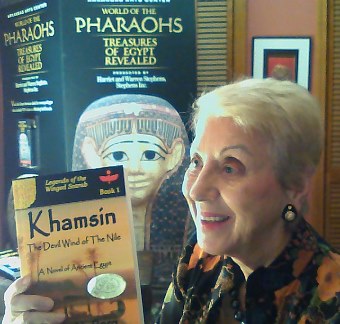
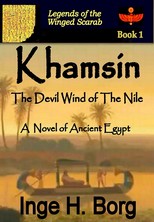
Khamsin, The Devil Wind of the Nile - A Novel of Ancient Egypt, is Book 1 of Inge H. Borg's historical fiction series "Legends of the Winged Scarab." It plays out during Egypt's First Dynasty (3080 BC). However, this ancient saga has the suspense, action & adventure of a modern thriller.
It is followed by Sirocco, Storm over Land and Sea (a 2012 thriller), and After the Cataclysm (a 2014 dystopian setting). Book 4 is The Crystal Curse (a 2016 adventure/thriller). Book 5, The Nile Conspiracy, is an international action thriller based on the very real and imminent threat of a huge Ethiopian dam on the Blue Nile, threatening to cut off Egypt’s lifeblood.
https://youtu.be/Z-dZflObgCU
Excerpt
“Rih al-Khamsin!”
It was an eerie howl rather than a cry. It multiplied, and it traveled fast. The urgency of the warning sent the inhabitants of the far-flung settlements scurrying. In great haste, children were collected, drinking wells covered, and home sites secured. All against the onslaught of the feared wind whose turbulent airs had gathered strength from far away.
Its father, the Sirocco, was spawned over the hot desert. Before it abandoned its cyclonic origins to reach across the vast stretches of the Great Green Sea, clawing young islands along the way, racing toward the densely forested virgin coast of the primitive Northern Continent, it gave birth to its unbridled son Khamsin, the Devil Wind of the Nile.
This new turbulence then grew into adolescence over the desolate sandy expanses of the great desert, gathering strength and hot dust, reaching merciless maturity as it slammed into the broad Valley of the Nile. With the Khamsin’s arrival, the populace knew to expect accompanying sand storms; and swarms of vermin covered the ground bringing widespread devastation to the already parched land.
Only when the Great Wind’s hot fury was spent, did its evil spirits seem appeased, and the land and its people could breathe anew, and anticipate the life-giving flooding of their river once again.
Just as once again, the principles of Ma’at would be adhered to. It was their cornerstone of all life, of all culture. Its teachings were to suppress all chaos stemming from ones emotions, feelings and reactions. To keep life in absolute order. No deviation was permitted. Those who offended its strict laws were severely punished - often by a cruel death.
But during those enervating days when the incessant wind raged, Ma’at was often breached; usually calm tempers flared; violent crimes were committed. And it was said, that people vanished without a trace.
* * *
Darkness hung over the Upper Region of the Two Lands, near the Karga Oasis. To the east, the first of the six roiling Falls rendered vast stretches of the great river Hapi un-navigable. Above the Falls lay the lands of the Wawat and the Kush and, further south, the Kingdom of Nobatia where the legendary King Ogoni ruled over his Black and Red Noba tribes.
A good two hours’ donkey-ride from the main encampment of King Aha’s Fourth Army, three small tents huddled in the lee of a barren hillock. The entrance flap of the main tent was thrown open allowing the cool desert air to cleanse the dark interior of the pungent smell of passion.
The man had spent his seed with unhurried maturity, savoring the ebb and flow of his pleasure. The girl, as usual, had clawed and defied and ensnared him. She was a beautiful desert girl, and he knew that she was greedy. But how she could harden the pillar of his Mehyt. In the end he always triumphed over her coy taunting, their intertwined skirmishes making him fight more ardently than on the battlefield, his hollow victories over her so much sweeter than any enemy’s defeat.
General Ali el’Barum, Commander of King Aha’s Fourth Army of Amun, enjoyed his occasional visits with its entanglements on the soft lion pelts, away from his smelly army camp, the clanging of war implements, the rough language of his men. Here, he escaped for a few sweet hours from the heavy burden of his responsibilities.
At thirty-five, he had weathered the seasons well and his muscles rippled forcefully in the moonlight. There was only a trace of thickening around his middle yet his face was deeply lined from the desert sun and the incessant gritty wind; even more so from the concern for his legions.
On these brief outings, Barum was accompanied by Keheb, his Aide-de-Camp, who served as his Quartermaster, Regimental Seal-Bearer and Scribe. They arrived with three laden jackasses. When they returned to their army camp, their saddlebags were empty. Still, Barum never felt that he left the tiny outpost empty-handed. He stretched in the cool night air and smiled at the beneficial bargain he had struck in this inhospitable desert. Naked, caressed by a light breeze, his thoughts dwelled on soft brown arms and smooth thighs. Yes, he was much taken with the unruly young woman waiting in his tent.
There was an added value to his slender temptress. By the complicated ties of the nomadic desert dwellers she was supposedly related to the tall tribesman with the sharp eyes and excellent memory, who spoke their language, and who was endowed with the appropriate greediness so that his tongue could be loosened by generous gifts.
It was well worth it, Barum thought. Whenever he visited this hidden encampment, the tall man would ride up on a scrawny ass and tell of his latest travels. He spoke with great flourish, his eyes blazing like the daytime sky. Pressured for details, the tribesman insisted that the hot wind from across the desert whispered all this to him. And while the wind was free, the man’s interpretation of its murmurs was not.
For their combined services, the tribesman and his obliging relative invariably found the general’s appreciation neatly stacked in the smallest of the three tents. Sacks of grain, bowls of fresh fruit, and an occasional well-sealed jar brimming with sweet date wine. Colonel Keheb always saw to that.
* * *
Barum slipped back into the dark tent and groped his way toward the soft cured lion pelts. A sleepy gurgle welcomed him. No sooner had he reawakened his young beauty with his newly stirring urgings than there was a scratching on the tent wall. With a lusty curse, the seasoned soldier roused himself again. He wrapped his kilt around his wide flat middle and stepped outside again. Keheb, carrying an oil lamp, pointed to the second-largest tent. Without a word, the two men strode toward it.
When his aide threw the flap to that tent open Old Barum, as his men called him, sensed someone in its depths. A second lamp was lit and its pale flicker danced across the small space. There were the usual floormats, a trunk and, unusual for this location, a writing box, a chair and a rough-hewn stand. The general’s visits were frequent enough for him to keep a few of his professional necessities on hand.
Sometimes, in the early morning hours, alone again yet no longer lonely, he would work out the details of his next maneuvers or compose a reassuring message to his wife. The scrolls he sent to her from this small camp were always filled with unaccustomed tenderness.
The tall tribesman unwound the long strip covering his head. Rid of the obscuring cloth, his long hair fell in dark matted tangles. His bearded face had the look of well-cured leather and a beaked nose separated a pair of piercing blue eyes.
Barum recognized his nightly visitor at once. It was Yadate, his young beauty’s supposed relative, one of his hired spies.
To all appearances, Yadate was a simple desert herder whose scattered tribe roamed the barren wastelands. They traveled from one oasis to the next, in search of water. According to Yadate, he had come north years ago from the far reaches of the mountainous Land of Punt in search of better grazing for his scrawny herd of goats and donkeys.
“Yadate!” Barum touched his lips and forehead, emulating tribal custom. “It is good to see you.” He motioned to a pile of mats. Over his shoulder he called: “Keheb, some libation for our friend.”
“I greet you, el’Barum, and I ask your forgiveness for disturbing your night. I trust you are well,” Yadate said as Keheb poured wine and left.
Both men settled onto the mats. The tribesman comfortably with his legs crossed, Barum reclining on his side supported by his right elbow. He would never get used to this awkward crouching down and winced as he tried to find the least numbing position.
“I am well, thank you, my friend. I trust that your travels led you to bounty-filled oases, that your flocks are fattened, and that your water-bladders are full. Yadate, I appreciate seeing you day or night,” Barum replied with the same formality, neither man betraying his suspicion of the other.
Barum detested having to go through these lengthy rituals, although he knew better than to press his furtive visitor into undue haste lest he offend the valuable spy and risk the other’s information to dry up like a dying spring.
“I am certain you will find my news of great importance.” Yadate scratched his matted beard.
In contrast to the people of Kamt, as the southerners called the Two Lands, desert tribes kept all their body hair throughout their life. In the enclosed tent, Barum vividly smelled the differences of their cultures. Much too eager to hear the man’s information he forgot to be offended by his visitor’s appalling lack of hygiene.
“Due to the dry season my tribe moved into the greener pastures of the Kush and Noba. We heard that a new lode of yellow nub was discovered between their lands. A rich vein. King Ogoni is claiming all of it for Nobatia.” Yadate paused to let his news sink in.
“The mine is located somewhere between the river and the Crystal Sea. Where the Hapi tumbles over the rocks a fifth and sixth time from here. Red and Black Noba warriors are moving north. I believe to combine forces with the Kush and the Wawat.”
Barum’s mind raced ahead. If the Noba unearthed a new mine yielding precious yellow nub, King Ogoni could outfit huge tribal armies, in addition to enticing foreign mercenaries to fight his battles. He could then push the timing of a long-feared confrontation months ahead. Barum had to inform King Aha at once.
“Yadate, if I draw for you the river’s course, can you show me the location of this mine,” Barum asked. “And where the Noba might be by now?”
He took a piece of papyrus from his document box and spread it on the floor, reaching for a lump of charcoal.
Despite the crudeness of his drawing, the well-traveled nomad easily recognized the snaking of the river. Yadate studied the image and pointed to a site east of the river, between the fifth and sixth Falls.
It gave Barum a fair idea of the location and his military mind weighed at once the possibility of taking the mine by force. They would have to decimate the enemy first, of course. A confrontation was overdue and King Aha wanted to extend their borders further south at any rate.
“Yadate, your news is interesting. Although, a mine that far south does not concern us, you understand.” Barum hoped his feigned disinterest would throw the nomad off.
Yadate inclined his head. He understood; the general was lying. He, too, kept his face impassive.
“As usual, you will find my humble gifts for your valued services. They should compensate you for your long journey. Shall you need a place to spend the night?”
The provisions in the adjacent tent could hardly be called humble. Still, custom had to be observed even in the harsh desert. For the tribes, outward courtesy toward visitors was paramount. It being understood that at any moment a gracious host might slit his guest’s throat, or the other way around.
“My people sleep by day and travel by night,” his nocturnal visitor grinned thinking of the sweet wine, the sacks of emmer wheat, fresh produce, and shining copper implements.
“I must leave.” Yadate jumped up as lithe as a panther and slipped from the tent before Barum could struggle to his feet and follow him outside. The tall tribesman had already vanished into the indigo night.
Barum called for his aide. The valuable man appeared within the blink of an eye. The two of them stepped back into the working tent and the scribe reached for his writing materials.
Pleased to sit down like a decent man, Barum fell into his chair. He disliked having to endure the cramping in his legs during Yadate’s visits.
Keheb, with the ease of a professional scribe, arranged himself on the very mat which was occupied by the tall nomad. He only hoped not to catch too many of the sand fleas that no doubt had escaped from the sweaty folds of their visitor’s rough-woven robe.
Barum realized the news had to reach the Grand General in Ineb-hedj with utmost speed. His very message might become the signal to push the campaign against the enemy forward and the signal for the King to journey to Nekhen. War could be declared only by King Aha, Supreme Commander of all armies. Although, Aha’s official arrival at Nekhen would be the signal for the combined forces of the Wawat, the Kush, and the fierce Noba to march against the Two Lands.
Sending messengers was dangerous business. They could be intercepted by enemy spies. With the river now at its lowest, most boats were unable to make a swift journey downstream. Barum’s messenger would be forced to take the slower, even more dangerous, route through the western desert.
“Scribe,” he nodded to Keheb, letting his loyal Aide know that he appreciated his many talents.
“Begin: To Chancellor Makari, Grand General of the Four Royal Armies, at the Royal Palace in the Court City of Ineb-hedj. Maneuvers of the Fourth are progressing well. However, I urgently request supplies for our New War Games. May Horus, the great Fighting Hawk, give us his protection now, without fail.”
Within the ambiguous language lay the pre-arranged signal; the push into the south, described as the New War Games, could commence as soon as Hor-Aha arrived upriver to lead his armies into battle.
By now, the Wawat were accustomed to large masses of armed men near their borders. Repetition and non-aggression by the royal armies had lulled them into believing that these were mere maneuvers. The growing enmity between their nations not yet having turned into open hostility, both sides kept a tenuous peace, allowing their caravans to travel beyond each other’s borders where traders exchanged exotic wares from the south for much needed foodstuff from the Two Lands.
After Colonel Keheb finished writing, Barum took the document and placed it in a sturdy leather tube. Deep in thought, he fingered a cylindrical object around his neck, but ruled against sealing the scroll with his personal mark just yet. His messenger had to memorize the simple words. As the scroll needed to be authenticated by the recipient, a matching stamp was to be worn by the messenger - indelibly burnt into his skin. The necessary utensils for this procedure were at the main camp, as was the messenger yet to be chosen.
Barum went to the large tent to take tender leave from the sleepy girl while Keheb rounded up the hobbled donkeys.
* * *
It was still night when they arrived at the Great Oasis where the vast encampment of the Fourth Army of Amun hugged barren desert terrain. There was a good supply of water from the Oasis and in three days, a trek of donkeys could bring fresh supplies from the old southern capital city of Nekhen where a desert-weary warrior could find a bit of amusement during his leave. There, parched for drink and affection, a man could head for the House of Pleasures to dip his swelling pillar into the costly honey pot of a whore while others, given to fierce wagering with the city’s less alluring denizens, could bet on anything from Nile frog races to rolling the ivory dice. Officers often preferred to wager heavily on the outcome of Senet, a board game played by favored masters. As they drank sweet date wine, they often increased their bets beyond their ability to make good. It was of little consequence. Montu, the God of War, hovered around the next hillock. They might not see Nekhen, or their debtors, ever again.
* * *
|