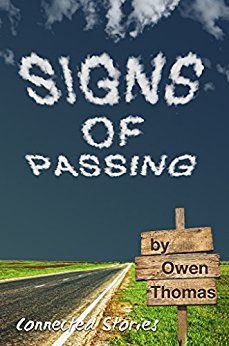
What convinces us that we have been wrong about the world? When do we know that the usual ways are no longer working; that it is time to set down one life and pick up another? Winner of the Pacific Book Award for short fiction and a dozen others..... Signs of Passing presents ten stories told from the nearside of epiphany, less a time or place than a state of mind in which one can hear the voice calling from beyond the veil of conscious understanding and singing of how life can be better.
What convinces us that we have been wrong about the world? When do we know that the usual ways are no longer working; that it is time to set down one life and pick up another? Winner of the Pacific Book Award for short fiction, Signs of Passing presents ten stories told from the nearside of epiphany, less a time or place than a state of mind in which one can hear the voice calling from beyond the veil of conscious understanding and singing of how life can be better:
• A young boy, abandoned by divorce, discovers something inexplicable happening in the two-dimensional world of Winchester County, his favorite TV western;
• A waitress at a bar called The Office, so alienated from the tedium of her own existence she no longer feels any fear walking home at night in the dark when perhaps she should;
• A crime detective novelist so beset by writer’s block that he attends the funerals of strangers in hopes of gleaning some advice from the dead, unaware that he is being followed;
• A young and secretly talented widow struck by the revelation that her late husband was not the man she thought she had married;
• A homeless, rural bus driver forced to confront the possibility that the dreams keeping him alive have been too small for him and that it is better to embrace peril in risking everything for a better life than to live safely in a prison of the familiar;
• A squared-away child psychiatrist forced to confront the reality that one of his immature patients and an erotic dancer know more than he does about the fraud of his own existence and the excruciating secret to happiness;
• An assistant veterinarian for a small-town zoo who, unbeknownst to her undeniably perfect husband, has taken to following random strangers around the city as a way of escaping both her guilt and her contentment;
• A young photojournalist surrendering herself to the control of a brutish and degenerate winemaker, all to exorcise a past that will not let her go and that holds all love at bay;
• A shopping mall employee whose enmity for a local television meteorologist is rewarded with an unlikely opportunity for revenge; and
• An entertainment media mogul, stricken with sudden news of cancer as he battles in court to retain the rights to remake an old television western about a better life in Winchester County.
A collection of separate stories about interconnected characters, Signs of Passing is devoted to the experience of waking up—of recognizing the better life in all of its unlikely disguises—and then summoning the courage to leave everything else behind, and to give chase before it’s too late.
Excerpt
The last place Quinn had worked was at the Qwicky Pawn on North Front Street near the lumberyard. Before that, he had been the Assistant Produce Manager at the Pay-n-Go Grocery Stop, where he worked under the thumb of Edna Cornwallis, a woman almost twice his age and half his maturity. Edna had made it clear that she wanted a man, not an assistant, and she spent the better part of three years trying to show Quinn the difference. For not taking the lesson, Edna tended to punish him by imagining and then itemizing all of his shortcomings on the quarterly installments of his annual performance reviews. It was clear to Quinn that pay raises and promotions would only come at a price.
Not clear eventually; but clear almost instantly after his orientation. Almost before the dramatically demonstrative lesson in distinguishing between cucumbers and zucchini had reached its denouement.
And yet he had hung in there.
That he had endured the job for so long under those conditions without looking for some other job was as much a testament to Quinn’s conflict aversion as to his antipathy to change if indeed there is any practical difference between those things.
For as consistently degrading as the job had been, Quinn had still managed to leave on something of a high note, telling Edna where she could stick her most recent disciplinary notice, dropping his green apron on the floor, and walking out on her in the middle of his shift. He had turned for one last look at her just in time to see the ball of iceberg lettuce Edna had thrown at the back of his head. He had caught it casually, with one hand, as if it were a softball in a park, and sent it hurtling back across the receiving bay and into the back of the truck, where it had connected squarely with Edna’s stupefied face, detonating in cold, green shards of cellulose and sending her sprawling back into an open crate of tomatoes. It was, he would later admit to himself in a kind of reluctant pride, the single greatest triumph of his young life. It had taken him three years to do it, but that was how you put an end to a bad situation and got the last word.
The job at the Qwicky Pawn had only been to tide him over until he could find something better. Something that held a more promising opportunity for advancement. That, anyway, was how he explained the decision to himself. The truth was that Quinn was lost. Still lost. The truth was that for all of the satisfying decisiveness of the iceberg lettuce resignation, he had no idea what he was doing with his life and the Qwicky Pawn, like the Pay-n-Go Grocery Stop before it, was but a chunk of driftwood floating in an empty sea. He had seized upon it instantly, with all the desperation of a drowning man.
The gnawing truth of it was that his father had been right. Dropping out of high school was probably the worst thing he ever could have done. If nothing else, high school was constructive confinement. Even if he never actually learned anything, it would have spared him the hazards of personal freedom. At the very least it would have corralled him through a pre-structured life, moving him lock step into Summerfield Community College or some vocational training program and then into suitable employment, each year handing off securely to the next like a chain of fire fighters handing a limp, gasping body over burning obstructions and out the window and down the ladder to a place out onto an open lawn where it can breathe.
His father had done the most he was capable of doing, which was not, objectively speaking, very much. Anger had been the only emotion available to Clement in those days. Rage was his only tool and his only sustenance. It was rage that got him up in the mornings. Rage that made the funeral arrangements for Christy and that forgot to call The Party Palace to cancel the birthday clown. Rage that for months sat vigil at Carol’s bedside, still in his uniform, every night, after every shift, fondling the black shard of Detroit iron the surgeons had extracted from her brain, until she finally gave up and slipped out of her coma. Rage that testified at the trial. Rage that got him drunk and that got him fired from the police force and that got him a job working ten-hour shifts guarding inmates locked up in The Alley. Rage that got him the reputation as the meanest screw in the joint.
And it had also been Clement’s rage that had taken charge of young Quinn who, choking blind in the acrid smoke of his own life, was suddenly unwilling to sit at a desk and stare at a chalkboard and solve for X, day after day after day.
In the aftermath of it all, Quinn and Clement had become enemies of a sort. Each saw in the other the ruin of hope and they each banished from their lives what they could not comprehend. Clement’s way was to fly into drunken tirades and to pretend to draw boundaries and issue edicts about what it meant to live under his roof. Quinn’s way was to turn into stone and sink to murky, unreachable depths, where no teacher or guidance counselor or strip mall psychologist or father could find him.
So, yes, his father had certainly been right about dropping out of school. But, in Quinn’s defense, his father had been right from a million light years away. The truth is simply unrecognizable at that distance.
The Qwicky Pawn on North Front Street was the original Qwicky Pawn that had, over the past thirty years, bloomed into a mini-empire of six Qwicky Pawn storefronts scattered throughout the county. The Qwicky Pawn king was Lonnie Mopes, a one-armed veteran generally known as Mr. Itch or King Itch or simply Itch, all nominally for the thing he could no longer scratch, but the moniker could just as easily have represented his professional devotion to impulse. The pawn business had been successful enough for Mr. Itch to retire from the nine-to-five grind and to help finance the ventures of his friends, such as Blue Reels Video and a strip club on Springfield Road called Shocks & Struts. Itch eventually purchased controlling interests in both businesses and devoted his time to counting his money, making spot inspections and sampling the goods.
Quinn’s job at the North Front Street Qwicky Pawn was as part of a three-man crew that, in shifts of two, made sales, kept rigorous track of inventory, discounted sentimental value, and loaned money on the back of heartache. The store manager was Itch’s cousin Mel, a mephitic fat man with a high voice, a quick temper and a deviated septum that kept his mouth dangling open on its hinge when he was not actually thinking about it. Which was almost always. The North Front Street Qwicky Pawn training program was for Mel to yell at you and hit you on the arm until you got it right. The health plan consisted of a promise to fire you if you ever called in sick.
Professional Reviews
Signs of Hope
An historically great American writer, Mark Twain, ended his book about Huck Finn with the title character saying, "I reckon I got to light out for the territory ahead of the rest ….”
In Signs of Passing, a great contemporary American writer, Owen Thomas, has created an ensemble of compelling characters who, each in his or her own way, are constantly lighting out for one territory or another, sometimes inward, sometimes to touch the heart of another, sometimes to live the California dream, but always moving forward, exploring a new frontier where they hope to realize a better life.
And they sure could use a better life. Signs of Passing is a collection of short stories, each of which stands on its own as an integral work but is also loosely connected to the others. The stories take place in, or have long roots leading back to, the small town of Summerfield, located in Summit County in what appears to be the southern part of a Midwestern state. For the most part, life in Summerfield is unrelentingly bleak. These stories are dark!
Like the characters in Owen Thomas’s sweeping novel, The Lion Trees, those in his new book live amidst a sea of troubles. Children, women, men -- all are set upon by life circumstances that are unfair, by other people who are mean spirited to the point of evil, by sheer hopelessness. And yet, there is hope.
One protagonist, the waitress Lydia, sees the cycles of routine tragedy with a clear eye. “All of that was coming eventually,” she knows. “There was no escaping it.” What she fails to see is an even more jarring calamity that jolts her from the routine and frees her to chart a new course for life.
In a review of The Lion Trees, I asked: “Is change possible? Personal growth? A new day? A fresh start? Or are we destined from birth, or perhaps from our first early missteps, to an immutable character? Character not just as a collection of mental and moral qualities, but as a character in a play, a dramatis persona that we must act out again and again in multiple scenes of our lives, a perpetual Groundhog Day? And what room is left for morality, judgment, approbation and adulation if we are each merely spinning in the discs of our lives?”
Signs of Passing poses similar questions through its well-crafted cast of characters and the decisions they make. Another of them, Maribel, notes the cycle in which we continually meet our own lowered expectations. “We expect and then we repeat. We repeat and we are not free. We are not free and we are not happy. Which is what history teaches us to expect out of life in the first place, but we follow expectation anyway.”
How can there be hope in this dismal scenario? Even in the depths of the Holocaust, the psychologist and philosopher Viktor Frankl found meaning and ennoblement. “Everything can be taken from a man but one thing: the last of the human freedoms—to choose one’s attitude in any given set of circumstances, to choose one’s own way. When we are no longer able to change a situation - we are challenged to change ourselves.”
And that is the key to hope and salvation for Thomas’s characters as well. They show up for the fight, not because “it will turn out different -- no one can know that; only that it might turn out different. It takes an act of faith to get out of bed believing that today might be different than yesterday and believing a man can change a thing that might happen into a thing that will happen.” That act of faith is like Frankl’s choice of attitude, and Thomas’s characters, for the most part, rise to the occasion eventually, lighting out for the territory ahead and breaking free from the cycles to which they were initially bound.
In addition to exploring these themes of hope and redemption, the craft of Thomas’s writing is an exercise in close observation. He has an ethnographer’s ability to describe Summerfield and Summit County in terms that make them come alive as a real place, inhabited by real and believable characters. In this, he is reminiscent of Wendell Berry and his intimate portrayals of Port William, a small fictional town in Kentucky. Like Berry, Thomas chronicles the good and the bad, with an even hand but a loving touch.
Many of the characters who populate the book are also close observers. Indeed, a theme of observation, even to the point of stalking, recurs in the various stories. Individuals follow one another on a regular basis, sometimes because they are private eyes working on the clock, other times because they are interested -- to the point of compulsiveness -- in the foibles of others. In many cases, it is this keen observation of others that leads characters to rise above their own initial conditions.
This has been a good year for Owen Thomas. His powerful novel, The Lion Trees, has garnered critical acclaim and an impressive and growing number of prestigious book awards. And now comes Signs of Passing, a dark exploration of the depths of the human condition to be sure, but with the possibility of breaking free and finding a new territory of the human spirit. It is a provocative and enlightening read.
Sarah Thompson has ten days on Maui to find her lifetime after lifetime soulmate. She is certain he is waiting for her there on one of the last remaining land masses of Mu still above water.
I Made My Boy Out of Poetry is a powerful literary vision of rare scope, beauty and emotional intensity composed of stories and poems that flow in and out of each other like the most lucid and articulate of dreams. These are portraits and studies of
In this eccentric tale set in a small town in northern India, Pawan Mishra masterfully weaves ingenuity and sarcasm in a manner that’s simultaneously hilarious and tragic.