Quarry Bank Tales
Do not miss the opportunity to download all 5 novels in this fascinating series of Historical Fiction!
It includes many of the characters who were linked to the famous Cheshire Cotton Mill during the period from Regency through Georgian to the earlier times of Queen Victoria.
Child apprentices, workers, owners, and law breakers – they are all here! All 5 books for under £4!
https://www.amazon.co.uk/dp/B0CKS5SYTW?binding=kindle_edition&ref
Quarry Bank Tales (5 book series) Kindle Edition
link: https://www.amazon.co.uk/dp/B0CKS5SYTW?binding=kindle_edition&ref=
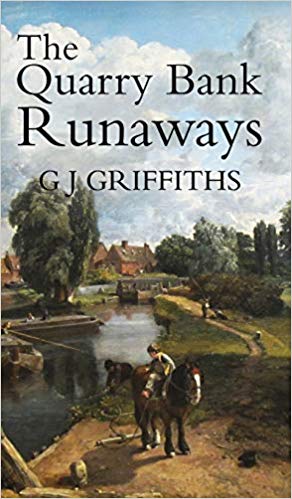
This is the story of the adventurous journey of two boy apprentices who ran away from Greg's cotton mill in the UK. What they did was illegal in the eyes of the authorities and it concludes with the events in the Middlesex courthouse after they were "caught".
In the early 19th century, when it was the policy of many of the poorhouses and workhouses to deter paupers from applying by making the conditions inside harsh and unpleasant, two boys set out on a journey to Hackney Workhouse in London. Their starting point was in the pleasant Cheshire countryside, where they were apprenticed to the cotton mill built by Samuel Greg in 1784. Children as young as 9 would be employed there, as scavengers, piecers, mule doffers or can tenters. These jobs could be just as unpleasant and difficult for a poor child as those we may have heard of, such as chimney sweeps and match girls.
Quarry Bank Mill was some 200 miles north of London and the boys had to sneak out unnoticed and then attempt to walk all the way. It was likely that these enterprising travellers took advantage of the drovers’ roads and the newly developed “motorways” of the times – the canals. Perhaps they were lucky enough some days to hitch a lift; their general direction of travel taking them to Beartown, the Potteries, Dunstable Downs and eventually to London. Whatever challenges they encountered along the way archive evidence shows that they made it.
Runaway apprentices had become a problem for society during the years of the Industrial Revolution – so what had prompted Thomas and Joseph to do such a hazardous thing? What happened to them on their long journey? Did they receive any help? Or were they chased relentlessly wherever they ran, since what they were doing was illegal in the eyes of the authorities?
This is the story of their adventure and it concludes with the events in the Middlesex courthouse, known then as the Old Sessions.
https://author.amazon.com/profile/updates
Excerpt
Chapter 1: Mills Apart
‘Tommy, Tommy, wake up. Wake up will you.’
‘Uh! – What! What is it, Joe? I was dreaming of a great big pudding and –’
‘Sh! Keep your voice down, pal. Never mind that pudding. There’s two masters a-coming along the road on horseback. Let’s get behind this bush afore they see us.’
‘Why we got to hide again, Joe?’
Without bothering to reply to his younger companion Joseph Sefton grabbed him by the arm and pulled him into the ditch behind an overgrown hedge of hawthorn and ivy. The sleepy lad winced with pain as he hung on to his sack of meagre belongings, ensuring that he kept it with him.
‘Shush,’ hissed Joseph. ‘They’re here now.’
He had one arm around Thomas Priestley’s shoulders and also hung desperately on to his sack with his other hand. As if they were one person, the pair of boys flattened themselves into the tangle of rotting leaves and mud, ignoring the odour of stagnation that crept into their clothes and lungs. For a few minutes the two were relieved of the stench while they held their breath, watching the gentlemen riders slowly pass by, their thoroughbred steeds huffing and puffing, eager to show their galloping prowess. The two men had much to speak of together, about gambling debts and the finer points of their newly purchased hunting hounds, so were quite unaware of the poorly dressed observers. Thomas waited until the riders were out of sight and beyond earshot for his grumbling remark.
‘What we got to hide from the likes o’ them gents for, Joe? We ain’t done nothing wrong to them have we?’ He held his hurting hand to his chest and added, ‘This hand’s a grieving me something terrible now.’
‘We just got to be careful, Tommy, tha knowst. If we get picked up and sent to the magistrate, then who knows what old Greg’ll do to us for running away. I keep telling you, pal, they got indentures on us both and running away is breaking the law.’
Thomas had started to weep in his pain and frustration and was picking at the grubby cotton rag wrapped around the remains of his left forefinger. The doctor back at Quarry Bank Mill who had attended to Thomas had packed the bloody stump with a bread dough and iodine poultice of his own concoction. Hannah Greg, the wife of the mill owner, had nursed him for a short while. Despite this attention the constant throbbing and pain meant that Thomas needed his mother and he persisted in telling anyone near to him. His friend, Joe, also from the mill, had agreed to take him along since he was bound south himself. At 17 years of age Joseph was confident of the way to London from North Cheshire, having noted a few landmarks on his wagon journey from Hackney, some eight years earlier. When he had been the same age as Thomas, four years ago, he had accompanied one of the engineers to Sandbach to collect some parts for a spinning-mule and considered himself a seasoned traveller. But for now he had to raise his friend’s spirits again and took Thomas’ injured hand in his, saying, ‘I don’t think you should pick at it, pal. Doctor Holland and Mrs Greg told you to leave it for a couple of days. They said it would pain thee.’
‘Aye, but it’s been a few weeks since.’
The two boys were a sorry sight standing together on the Old Chorley road. Their cheap and well-worn clothing was wet and muddy and they had soggy brown leaves sticking to their hair and skinny legs. It was late in June but their soaked breeches, of a dubious colour, and the early morning chilly air combined to remind them of the foul, cold, ditch water. Completely distracted for a few minutes by poor Thomas’ plight they failed to notice a drover wagon slowly approaching.
‘Eh up, lads! As tha fallen into the ditch then? If’n tha wants a lift you best hop on the back o’ the cart… Whoa!’
The red-faced farmer, hiding behind a bush of a brown beard, stopped his wagon and looked round at the full sacks he was carrying. His enormous grin and twinkling eyes calmed the panic that had jumped to the throats of the boys.
‘Are you going to Sandbach, sir?’ asked Joseph.
‘Nay, lad, just to Chorley. As far as Alderley Corn Mill wi’ this lot.’
Thomas’ teeth were chattering now, the cold having reached his bones, and the pathetic sight of the boys touched the farmer’s heart. They nodded to each other.
‘Thank you, sir. Much obliged,’ said Joseph.
‘You look as though you could do with a hot drink and a visit to a wash-tub as well as a lift. Hop on them sacks, lads. They calls me, Parbold… Gidyup, Feather!’
The enormous grey carthorse ceased sampling the long grasses at the roadside, chuffed his breath, as if responding to Parbold, then set off in its strong and steady fashion.
Professional Reviews
Wiggins
For me, "The Quarry Bank Runaways: The Journey to London of Thomas Priestly and Joseph Sefton in 1806", is initially reminiscent of Mark Twain’s, "The Adventures of Tom Sawyer", and, "Adventures of Huckleberry Finn". Even later on in the story it’s still reminiscent of Twain, in that on the surface it’s about two runaways evading ‘bad people’ who could and would swindle them—or worse, send them back to the Mill—while also meeting ‘good people’ who help them in times of need as well as showing them that not all people are bad and some families are ‘normal’ even though they, too, are poor. But there’s also the undercurrent of a much bigger picture going on: The egregious practice of the indentured servitude of children—otherwise known as slavery. Griffiths didn’t sugarcoat it and I applaud him for that.
Traveling back in time to visit a corner of this world so vibrantly described was an absolute pleasure to experience. The descriptions of everything: the land, history, people, socioeconomic backgrounds and lifestyles, even the food, were a delightful decadence. I was mesmerized by the rich and colorful dialect woven into the characters’ dialogue. Some of it reminded me of the Gullah language. Example: “Ah” for “I”. I also took note of, and enjoyed, the subtle changes in regional dialects of the various characters.
The historical aspects, which I suspect were heavily researched by Griffiths—and probably born from impassioned heartstrings—added credibility to the story, capturing the accuracy of our shameful, not-so-ancient past while also maintaining the stunning and quintessential essence of young Joe’s and Tommy’s journey.
I reached a point where I clung to Joe’s and Tom’s adventurous voyage across the countryside and rolling hills to reunite with their mothers—a delicate reality I can relate to, though my own mother is much farther away from me than London. I rooted for them to make it, became a tagalong in their legging journey.
But let us not forget one moral interpretation of, "The Quarry Bank Runaways"; a story of the born elite vs. the born downtrodden. And though many conditions and circumstances have changed, certainly improved… how far have we really come in bettering the lives of those born silver-spoonless?
This novel glimpses into a past that for all practical purposes can best be defined as human agony designed by ‘the haves’ (those with wealth and status) who then wield it upon the ‘have-nots’ (the vast majority of human civilization). Why was there a differentiating spoon? Why is there still one today? Why is it still our division? Though we’ve come a long way from the widespread practice of indentured servitude of children and the poor, it does still occur, proving we still have far to go—still on our journey—before human civilization can call itself civil and truly altruistic.
Mrs Bernadette Reid
The Quarry Bank Runaways; The journey to London of Thomas Priestly and Joseph Sefton in 1806.
GJ.Griffiths
Publisher GJG (April 2017)
This is my first Saturday off since March and I ‘m spending part of it reviewing a book I have just read on my kindle. That’s how much I enjoyed the book I ve just finished. It’s a short read. It took me 3 hours and I read most of it yesterday in the inspirational setting of the top garden at Quarry Bank Mill. I want to recommend this to you all. It’s a work of historical fiction but well supported by the known facts provided by the boys themselves before the Middlesex assizes. It tells an imagined journey they led from Cheshire to London and the characters they meet along the way. It suggests how they supported themselves, where they may have slept and how they travelled. One of the most charming elements of the book is the dialect that the author has used at great lengths to explain the story. In the reviews I read on Amazon the readers criticised the use of dialect but for me it was essential in emphasising the terms and what they meant. I had no difficulty recognising some of the terms from my own community and that of my parents and grandparents. In both northern and southern twang author cleverly draws out the plot. It gives insight into the historical times they led and creates background relating to the fear of the French invasion, the war with France and its consequences. It touches on the precursors to Luddites, social reform and the establishment of the factory acts. (It was a bit of a stretch to imagine the boys actually met Robert Peel though.) It contrasts the economic gap between rich and poor. Religious persecution is explained and it is faithful to what we know about the Greg family and life as we understand it at Quarry Bank Mill during the early part of the 19th Century.
I did find the boy’s plight amusing in part (though I’m sure this wasn’t the intention of the author) and identified with the lads drawing parallels with my own youth growing up in a mill town as I did. One thing that strikes me is the kindness shown to them by strangers and the author contrasts this with the officiousness of those in the employ of the Greg’s and the ruling class. The thread running through this book is the indomitability of the human spirit where family love is concerned and the book is touching and heart rending especially since you know it’s based on a true story.
I don t like to write a review without making at least one criticism and I thought I had found a term which was anachronistic. I thought the use of constable would be related to the establishment of the first police force but when I looked it up the people of the internet informed me the term has been in use since the 13th Century. You do have to keep reminding yourself this is a work of fiction but it is very believable and created a new empathy for the runaways and a better understanding of the issues.
If you download this book for the kindle it is only 99p a saving of £7.00 and it’s the best 0.99p I ve spent in ages. With acknowledgements to our own archive team. If you ve got a few spare hours read it, and you could do worse than do so with a latte, over-looking the magnificent Quarry Bank Mill in one direction and the Apprentice house in the other as seen from the top garden.
To quote Hilary Mantel. “Life is a live show. You can’t relive it except through art.” GJ.Griffiths has brought this story back to life through word play.
The Six Bells of Madame Lin is the first book in The Witch of Marigold Hall Trilogy, a fictionalized account of the struggles of Lin Mang, a blind woman who manages to navigate the world during the Mongol conquest of China in the 13th Century. Withou
Compelling historical fiction that traces the life of a young English immigrant woman who travels to America at the turn of the century to start a new life for herself. Encountering danger, romance, heartache and tragedy, she strives to fit into a