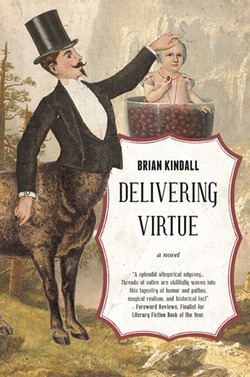
Zealots, savages, and wildfire abound on this journey west. Rogue Didier Rain must deliver an infant across 1,000 miles of rough frontier to a Mormon splinter sect to fulfill the Prophecy. Editor's Choice at The Historical Novel Society.
Didier Rain is broke, lovesick, and just off a three-day whiskey binge. And yet, The Church of the Restructured Truth has been told in a vision that he’s the man to fulfill their Holy Prophecy. He must deliver Virtue – a blue-eyed infant – 1,000 miles along the western pioneer trail to their prophet’s stronghold as his child bride to be. Savages, zealots, and wildfire all stand in Rain’s way, not to mention a list of Thou-shalt-nots designed to thwart any man’s most basic comforts. But, there’s something holy about the job – something, Rain suspects, that might just turn his sorry life toward a better path.
In Delivering Virtue – Book One of The Epic of Didier Rain– Brian Kindall takes the classic novel of the West and turns it on its head. Grandiloquent humor, pathos, and a cast of absurd and depraved characters all come together in an American Frontier world inspired by myth and legend, creating a surreal and disarmingly poignant adventure reviewers are calling a triumph of American Magical Realism.
Professional Reviews
Awarded Awesome Indies Seal of Excellence!
Delivering Virtue by Brian Kindall is a different kind of western
story. Didier Rain, a dissolute poet is hired by an offshoot Mormon sect to deliver a bride to their Prophet Nehi in his isolated compound in northern Utah. Rain is shocked to find that the ‘bride’ is an infant named Virtue, but the prospect of a $10,000 payday causes him to accept the challenge.
From Rain’s departure the story takes many quite unexpected turns, with aspects of mysticism, fantasy, and strange glimpses of the future thrown into a hard-boiled western story of a not-so-good man’s journey of self-discovery. The author skillfully weaves the mystical elements into the story, with flashbacks into Rain’s past making them even credible.
The narrator has a notably extensive vocabulary and elegance of prose suitable for the poetic aspirations of the character, and it even includes made-up words, such as ‘spelunkulatory’. Some readers may find phrases such as “discussing business in a private glossolalia,” a little off-putting, but personally, I enjoyed the depth of vocabulary and the writing style. Luckily ereaders have inbuilt dictionary to help ascertain a word’s meaning, because it is not always clear from the context of the passages.
All up, it’s a great story, and it has a strange, but somehow satisfying ending that I won’t spoil by revealing. 5 stars.
Foreword Clarion Reviews
Threads of satire are skillfully woven into this tapestry of humor and pathos, magical realism, and historical fact.
Brian Kindall’s splendid allegorical odyssey, Delivering Virtue, features ne’er-do-well wannabe-poet Didier Rain, chosen to transport the cherubic infant Virtue to her intended groom, Nehi, prophet of a Mormon splinter sect known as the Church of the Restructured Truth.
Set in the American West of 1854, the tale is written in pitch-perfect, florid 19th-century prose: “And so it came to pass…that a baby girl, two geldings, a she-goat, and one so-called Deliverer set off on the long and onerous journey to the City of Rocks.” A tragicomic story, Delivering Virtue employs biting social commentary and stinging critiques of a variety of religious faiths with Chaucerian ribaldry. Threads of satire are skillfully woven into a tapestry of humor and pathos, magical realism, and historical fact, along with swashbuckling adventure, depraved violence, and moments of heartrending tenderness.
Kindall’s characters are deftly drawn. Protagonist Didier Rain is riddled with foibles; he easily succumbs to the pleasures of both demon rum and carnal temptations. But at his core, he is a gentle soul capable of handling whatever danger confronts him, even if he doesn’t know his own cunning. His flawed persona is perfect counterpoint to the angelic Virtue, who grows by surrealistic leaps and bounds while under the care and protection of her rough-and-tumble companion. Throughout their perilous journey, the unlikely duo encounter trials and tribulations grand enough to test the mettle of even Sir Galahad. Always, their steadfast steeds stand ready to serve as collective Sancho Panza to their beloved Don Quixote. Thus, through thick and thin, they persevere—a ragtag band well worth cheering on.
Delivering Virtue turns decidedly darker when the Deliverer repeatedly fails to realize that his bouts of bacchanalia inevitably result in tragedy. His debauchery raises crucial questions: Will Didier Rain’s devilish underbelly ultimately destroy all that is good? Or can “even the lowliest beast…rise to scruples when pressed”?
Brian Kindall is author of two previous books, Blue Sky and Pearl, both coming-of-age fantasies for younger readers. Delivering Virtue is his first—but hopefully not his last—novel for adults. It, too, is a coming-of-age tale, although one wonders just which character—biped or quadruped—eventually ripens into maturity.
Delivering Virtue will appeal to bibliophiles who appreciate allegory, sophisticated satire, and impressive vocabularies, as well as to anyone who identifies with the perennial struggle between good and evil that we all endure in life.
BlueInk Reviews
This provocative, wholly satisfying novel is a Western adventure told in the language of magic realism. It skillfully blends historical insights, moments of fantastical humor, stories of travel through exotic climes, and references to European poetry, Homeric mythology, and even Oedipal psychology.
The story opens in Independence, Missouri in 1854, where Didier Rain struggles toward sobriety following “an epic bout of debauchery.” Somehow, in his depleted state, he manages to obtain a contract to deliver an infant girl to a settlement of breakaway Mormons in Utah, where she has already been committed to an improbably arranged marriage.
Thus begins a picaresque story told by Rain himself. First appearing to be an aimless layabout, he is full of surprises. Unexpectedly fluent in a variety of languages, he gradually reveals depths of learning that first appear in casual asides: quotes from Shakespeare and English Romantic poets, along with offhanded mentions of Hieronymus Bosch and the lagoons of Venice. So unusual is he, in fact, that the author (as an in-joke perhaps) has him quoting T.S. Eliot many decades before that poet’s birth.
Eventually, he reveals a past even more tangled than the present journey, partly justifying both himself and the misanthropic cynicism he often displays as the tale meanders along.
Author Brian Kindall delivers it all with crisp dialogue, well-developed characters and a steady, relentless pace. He expertly juggles a multitude of elements in a story marked by violence, human frailty, natural hardship, and religious excess — all finally and surprisingly redeemed by love. While the story is focused mostly on Virtue, the infant who miraculously grows to young womanhood in the course of the journey, there are contributions along the way from an Indian maiden they encounter and even from the horses they ride.
By its end, all the revelations, disclosures, surprises and their aftermath bring the novel to a gratifying and rewarding end. If it raises more questions than it answers, the questions are surely worth the asking.
Want to review or comment on this book?
Need a FREE Reader Membership?
Reviews for "Delivering Virtue, The Epic of Didier Rain, Book 1"
Reviewed by Mary Wazelle
6/30/2018
A very strange tale, indeed! The story's voice comes from the main character, Didier, a bumbling individual with the West on his mind and a singular focus that was thrust upon him without warning - delivering a girl named Virtue to her suitor across the country.
Along the way, Didier finds himself and his traveling companions - mostly animals, sometimes straggling humans - in strange situations that defy explanation and logic, but he accepts them as they are. We experience joy, heartache, love, loss and everything in between along with the characters.
The story is humorous, reflective, and shows just how truly weird our world can be.
Reviewed by Michael Hartnett
6/7/2018
A Daring and Entertaining Novel
Near the very end of this fascinating and provocative novel, our narrator Didier Rain ruminates: “I wondered about all the people in America – both young and old – the Mormons and the gentiles and the Indians, too – with all of their thirsts and their hungers.” Thirsts and hungers, indeed. Delivering Virtue by Brian Kindall captures a mid-Nineteenth Century American West in all its beautiful vastness, its brutal violence, and its perverse isolations. Rain and a peculiar cast of characters are largely overwhelmed by the unforgiving landscapes even as they play out their roles. That is except for the preternaturally astute Virtue, an infant (and ultimately young girl) whom Rain is hired to lead across the harsh and treacherous countryside and to deliver to the prophet of The Reconstructed Truth, a fringe Mormon sect.
The journey Rain and Virtue take is more disturbing and harrowing than the average picaresque. A good measure of the wretchedness derives from Rain himself, since debauchery and misery seem to cling to him like a rare contagion. And yet, Delivering Virtue is a funny and entertaining novel. Much of that comes from the skills of Kindall as a writer, since he is prone to wit and deft turns of phrase. For all his faults (and they are legion), Rain is a narrator who never fails to engage and amuse: “At any rate, it seemed like the kind of map that could, if followed too closely, lead a man to becoming profoundly and most hopelessly lost.” The journey itself is a wondrous odyssey, including bison stampedes, severe storms, grizzly bear attacks, and the forsaken community of Ablutia.
Along the way, Rain has what can be loosely described as romances, particularly with Delight Tuttles and Turtle Dove. Without giving too much away, let’s just say Rain has troubling conditions and issues, many of those developed in an adolescence that makes Huck Finn’s look like Lord Fauntleroy’s. Little wonder that the broken, wounded, oddly dressed Rain finds Virtue a stabilizing force. “Virtue led me onward, urging my haste. Who now, I had to ask myself, is delivering whom?” On one level, Delivering Virtue serves a satire of a pilgrimage, rife with Biblical allusions intermingled with references to poets ranging from Homer to Shakespeare to Shelley to (anachronistically) Eliot.
Right to the very end, Delivering Virtue takes many surprising twists and turns; some are downright shocking. Interspersed are disarming scenes of poignancy: Rain’s “conversations” with his horses (truly traveling companions) are marked by unexpected tenderness. Ultimately, Kindall’s Delivering Virtue challenges the reader to reconsider the America psyche. That Kindall has written a daring and lively novel in the process makes for a very satisfying read.
Reviewed by jeff carpenter
2/22/2018
Brian Kindall is a special writer. I've rarely come across anyone who puts words together in such an artistic and imaginitive way. I found myself re-reading many different sentences, paragraphs, and sections of this book, just to enjoy them again. I also enjoyed his ability to integrate unanticipated events so smoothly. Again, I re-read, after an initial "are you sure?" ... and sure enough, he had slipped in another surprise, or smacked me with one on a few occasions. Ribald, irreverent, and charming? I'd say so!
Often surreal,never boring, Brian Kindall's novel describes the journey of Didier Rain, a self-described ne'er-do-well who takes on the task of delivering an infant girl named Virtue to the Church of the Resurrected Truth at the City of Rocks, somewhere north of Salt Lake City, in 1854. On arrival he would be paid $30,000 in gold, a sum that makes the job impossible to resist, even with contractual restrictions such as no carrying of weapons and no consumption of alcohol. With two horses and a goat (the latter to supply milk for Virtue), Rain sets out from Independence, Missouri, on a trail that will take him through unexpected experiences horrific and humorous.
Kindall's tale is full of unexpected surprises for the reader. Didier Rain is no stereotypical Westerner, and he most definitely isn't a hero in the traditional Western novel's sense of the word. Neither is Virtue an ordinary infant. As the novel progresses, Rain and Virtue evolve in more ways than one. Much of the novel is written in a picaresque style, Kindall sneaking in some sly humor as he pokes fun at religious cults, and treating horses as more intelligent than the humans who ride them. But he also digs deeply into Rain's life and all its personal tragedies. After a series of adventures and misadventures, Rain and Virtue finally arrive at the City of Rocks, only to find that the expected Paradise on Earth is rather different in its reality, and that "delivering Virtue" is a term with a double meaning.
In sum, this is a Western novel quite different from traditional Westerns. Readers will find the revelations that occur in the course of the story to be surprising, and its unexpected ending a cause for reflection on how one's life can involve choices that for better or worse must be made.
London: Lashed, Lacerated, Lampooned and Lambasted satirizes 18 popular Jack London novellas with adult content and language and the work is author Jay Dubya's 37th published hardcover/paperback book.
What causes America's mainstream media to fear and try to destroy a group of artists and their work? What happens when such a creative movement grows in strength and threatens media's bottom line? Why would extremists find it necessary to take acti