
Kindle Edition
Amazon
Fredrick Boling -- Writing Western
Category:
Historical Fiction
Publisher: Bighorn Publishing
ISBN-10: 0972280871
Type: Fiction
Pages: 319
Copyright: August 27, 2012
ISBN-13: 9780972280877
Price: $4.00 (eBook)
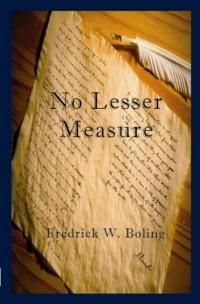
Abraham Lincoln revealed the nation’s gratitude to all of those who gave their last full measure of devotion during his address at the cemetery in Gettysburg on November 19th in 18 and 63. This story lays claim to this sentiment for those who fought for the South as well as the North.
No Lesser Measure is a story about a young man who was a son of a South Carolina plantation owner. He fought for the Confederate States of America against the United States of America during the Civil War. He was severely injured and lost his closest friend during the Battle of Gettysburg on July 3rd in 18 and 63. He suffered imprisonment, escaped and served in the defense of Richmond until General Lee surrendered the Army of Northern Virginia at Appomattox, Virginia on April 9th in 18 and 65. His love for the daughter of Pennsylvania College’s president and commitment to becoming a Christian clergyman caused him to return to Gettysburg. It was at the site of his loss that he found a new pathway for healing of the injuries suffered at the High Watermark of the Confederacy. His quest would not find fruition until discovering the fate of his closest friend. His story reveals how he copes with being a slave holder’s son who has to face the morality of slavery. Out of adversity he finds the answer to his quest.
Excerpt
More years than I care to count have gone by since we answered the call to fight the Northern invaders. Most of the skirmishes, battles, days and nights of marching barefoot along muddy or dusty roads and suffering from fevers and dysentery have faded into the recesses of my memory. However, one day remains as if it had only been yesterday -- the afternoon of the third day of July in 18 and 63 near Gettysburg, Pennsylvania.
Silence hovered over the killing field as our tattered gray ranks stepped in measured cadence toward the Yankee's line along Cemetery Ridge. The heat and a pall of impending death oppressed us on that horrible day. The sun was obscured by a veil of acrid smoke from belching cannons and dust rising from thousands of our ill-shod feet. "I reckon this is it," Hank Johnson said as we marched behind our frayed battle flags.
All semblance of order dissolved before I could answer. Cannon shot and canister, ripping through flesh and bones, hissed like geysers of steam in the midst of our long gray line. Each exploding fireball slashed vacancies where sweating men had been only seconds before. Every sweep of the sickle of death gleaned untold numbers of our young men grown old by war into eternity.
We lunged onward, blinded by smoke, dust, and fear, into a holocaust of Minieballs screaming from thousands of rifles. Men groaned and crumpled all around us.
Time disintegrated into a void for Hank and me as a shell exploded above us. Tongues of fire cascading downward sprayed our company with searing shards of shrapnel. The violent concussion rendered me senseless, unaware of anything.
Then pain, ascending from my mangled right leg, wrenched me from a dark abyss of nothingness. Each jolt of the litter sent new waves of agony that lodged in my gut until the sickness, bitter and sour, spewed between my clenched teeth. "Set 'im down till he's done pukin'," one of the bearers said.
"Can't wait," another said, "Doc's ready t'cut off that leg."
I continued to retch until someone shoved a gauze mask reeking with chloroform over my mouth and nose. The pungent, sweet vapors slithered into my lungs, severed the cords of nausea, and swept away the pain. Like a velvet blanket, sleep wrapped itself around me and deafened my ears to the surgeon's saw cutting through bone.
I felt no pain, but visions of days gone by haunted me like ghosts from the past. Once again, I experienced surviving brittle cold, searing heat, an empty belly, and marching barefoot into battles across North Carolina, Virginia, Maryland, and Pennsylvania. I saw my father trying to comfort my mother. In his hand was a letter informing him that my older brother, Andrew, was missing after the loss of his ship, the C.S.S. Sea Bird, in Albemarle Sound. I experienced anew the regret I felt the morning I left home, my mother being certain I would never return. Again, I met Hank Johnson in Charleston the day we both volunteered. Even though we had fought side by side for two years, his features were murky as a photograph faded by time. I kept stepping closer, trying to see more clearly, but his appearance dissolved like fog on a summer morning.
The voice of a young woman awakened me. "Are you feeling better?" she said, setting a wicker basket filled with cotton lint and rolls of muslin dressings on the table.
I blinked sleep from my eyes, trying to clear my mind. "Yes, ma'am--better."
"That's good, it's time to change your dressings."
"Dressin's?"
"Yes -- your leg."
I lifted the sheet. "My leg? Oh."
"I'm so sorry," she said, looking away.
I gazed beyond her at the row of injured men lying on canvas cots. Some of them were moaning and thrashing about while others lay quietly with faces blanched from bleeding wounds. "What is this place?"
"It's the old dorm," she said, pulled the sheet aside, and began to remove blood-soaked bandages from the stump that once was my right leg. "I'll try not to hurt you."
I stared at my bandaged thigh, determined to keep my composure. Anger flushed my face and clenched my fists. I was alive but wished I wasn't. "What's the old dorm?" I asked, not really caring.
Without looking up from her task, she continued to cut through bandages that were stiff and brittle from congealed blood. "It's a residence for our students here at Pennsylvania College."
My mood turned sullen as she changed the dressing. My thoughts returned to the killing ground. I had no idea what had happened to Hank or our charge against the Yankee horde. He was probably dead, torn apart by canister or exploding shells fired at point-blank range. He might be wounded and here in this same hospital, or carried back to our line on Seminary Ridge. He could have completed the charge, helped overwhelm the Yankee line, and sent them scurrying back to Washington City. I pondered these possibilities only to realize that our charge had probably fallen short. "Are all these men, Yanks?" I asked, gesturing toward the long row of cots.
"Yes -- they are."
"Any of my people here?"
"No, you are the only one."
She completed her task, placed all of the bloody bandages in a sack and picked up her dressing basket. She smiled and placed her hand on my shoulder. For the first time, I became aware of the young woman who was attending my needs. She could have been no older than I, which was nineteen years. Long, golden ringlets falling loosely across her shoulders framed her features. Kindness reflected from her eyes that were bluer than South Carolina's bonny flag. Her gentle fingers squeezed my shoulder as she asked whether I needed anything before she left. I was taken aback a bit by her pleasantness. After all, I, a rifleman in General Lee's army, intended to wreak much destruction upon her people. Maybe she didn't understand why we were intent upon our pillaging foray. Was she aware of the Yankee's atrocities that were being committed daily in the South? Did she know that our army was marching barefoot or on footwear held together by twine, thong, or wire? We heard that her town had a shoe factory -- that is why we came. We needed shoes, even Yankee shoes.
"I need a shoe," I said, pointing at my callused left foot.
At first, she seemed surprised at my request, but a quick pat on my shoulder told me she understood. "Of course, what size do you wear?"
"Whatever I can squeeze my foot into -- a 9 or 10 works best."
A wounded man lying on a cot across the room spoke up. "You can have my left shoe -- won't be needin' it no more."
I rose up on my elbows to look at the fellow who was propped up on a pillow. His hair was disheveled and red as Georgia clay, and at least one thousand brown freckles covered his face. He threw back the sheet and pointed at a short stump, the only remnant remaining of his left leg and thigh. "You Rebs blowed mine clean off."
I thanked him for the offer, but knew his shoe was long gone. It probably wound up in a discard bin, thrown there by a litter bearer or surgical attendant.
As she walked away, seeming to be intent upon the needs of her next patient, I realized I had failed to get her name. I called after her, "I'm John Pendleton -- what's your name?"
"Penelope Gresham-- I'll be back tomorrow, John Pendleton." Then she smiled. "With a 9 or 10 shoe."
The next day, as promised, she returned carrying a size 9 shoe with plenty of wear left in it. That shoe became not only sturdy footwear but it also would gain a new friend for me, the redheaded Yankee whose leg had been blown away by my people. He asked to examine the shoe to determine whether it might be the one he had promised. Of course, it wasn't. He tossed the shoe back to me. "No -- that's not mine, John. I'd inked my name, Timothy O'Brien, on the underside of the tongue."
He seemed disappointed, but chuckled when I said, "I'd give you my right shoe, Timothy, if I had one, but I haven't had shoes for over a week. Mine became more twine, thong and wire until there wasn't any more leather that could be mended."
"It's Tim -- only me mother calls me Timothy."
His response caused me to pause, to remember the time Hank and I boarded the train in Charleston. I introduced myself after noticing Henry Johnson stenciled on his haversack. "Only my mother calls me Henry," he said, "just call me Hank."
Some day, within the providence of the Almighty, I pray to once again grip his callused hand and say, "Hank! It's good to see you again." But, in case that isn't to be, I have set down my own recounting the best I can of my life after Gettysburg. Maybe, the time will come when he will have the opportunity to read it. But if that never can happen, I pray he rests in peace.
My recovery was enhanced by the care I received from Penelope over the ensuing weeks. Each day her gentle hands and effervescent smile brought healing to my wounded body and soul. Our relationship grew until I realized life spent apart from her was unthinkable. I prayed daily for God to allow us to continue to be together, but doubted it could come about. Would our love survive the terrible war that was engulfing our lives? Only God held the answer.
|