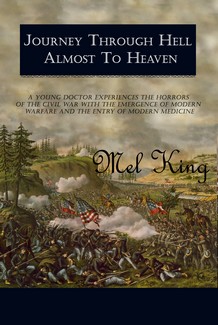
Historical Novel about a young doctor's experiences in the American Civil War.
FIVE SAMPLE CHAPTERS ARE ON AMAZON'S KINDLE BOOK SITE.
For more than a century and a half since the end of that War, for the most part Southerners have almost reverently referred to the Civil War as “The Lost Cause”, and to its military leaders [Robert E. Lee, Stonewall Jackson, etc.] as heroes. The author leaves it up to the reader to decide whether they should be remembered as valiant heroes or traitors to the United States. What is certain is that their actions led to the devastation of the South and a legacy of bigotry and oppression of blacks for far more than a century.
Inspired by recent often violent disputes about displaying the Confederate flag in state and local government areas, and monuments to Confederate military and political ‘heroes’ in public parks and government buildings, Mel King wrote this novel. Set against a background of actual historical events, a young doctor experiences the horrors of a war that pitted family members against each other, countrymen against countrymen. He realizes the truth of the phrase coined by Union General Sherman: “War is Hell.” He concludes that the primary motivation of the South in starting the War was to preserve the abominable institution of slavery.
Author King shows how military leaders on both sides failed to recognize that recent advancement in the accuracy and capabilities of weapons of war made the predominantly practiced Napoleonic tactics obsolete. The result was massive deaths and casualties on both sides, enhanced by some seemingly uncaring generals. The novel raises the issue of whether the South’s military leaders should be remembered as heroes or as traitors to our nation. It also shows a dark side of Confederate General Lee who, possibly due to his belief in his infallibility and/or lack of understanding how new weapons made Napoleonic tactics obsolete, ignored the pleadings of his second-in-command and ordered thousands of his troops on a suicidal mission.
The novel also shows that the War changed medical science and treatment from a prewar condition that had changed little in over a thousand years, to the first steps forward into modern medicine, with recognition of the importance of sanitary conditions, the use of anesthetics during surgery, and the keeping of detailed medical records. This is revealed as the reader follows the life and deeds of a fictional character, a young medical student who joins the Union Army and experiences the horrors and successes of the War as a surgeon in the Medical Corps.
As with his previous books, the author hopes that his new novel will inspire an interest in history, because, in the words of George Santayana:
“THOSE WHO CANNOT REMEMBER THE PAST ARE CONDEMNED TO REPEAT IT.”
Excerpt
Prior to the 1860s, the armies of most major countries followed the Napoleonic tactics of war; their rifles were smooth barreled muskets that were inaccurate at more than 100 yards; and their cannons were similarly inaccurate. Medicine had only slightly changed in hundreds of years; the existence of bacteria and the cause of disease were not known; sanitation was not practiced and its benefits were unknown or even ridiculed; anesthesia had only recently been discovered; and surgery was very risky with often deadly results. That all changed with the improvements in weaponry that resulted in massive increases in casualties during the Civil War, which was brought about by Southern States’ attempt to secede from the Union so as to preserve the abominable institution of slavery. In this novel, a young doctor experiences the horrors of the Civil War with the emergence of modern warfare, and the entry of modern medicine. For more than a century and a half since the end of that War, for the most part Southerners have almost reverently referred to the Civil War as “The Lost Cause”, and to its military leaders [Robert E. Lee, Stonewall Jackson, etc.] as heroes. The author leaves it up to the reader to decide whether they should be remembered as valiant heroes or traitors to the United States. What is certain is that their actions led to the devastation of the South and a legacy of bigotry and oppression of blacks for far more than a century.
Shanghai Escapist grabs the faint-of-heart right from the get-go and serves up an ultimatum: What would you do if caught in the same circumstances? From the opening scene, the reader is tossed into the maze of daily intrigue as it existed in 1960s-70
Autumn 1940. Germany invades Britain. Newport is blitzed. Danny O’Shea’s house is bombed, his wife is killed. While taking his young son Adam to neutral Ireland, they witness an attack on a German convoy. The result is brutal.
Tralee, Ireland. September 1948.
An arrogant, and highly agitated, priest arrives home after 40 years.
Days later he's dead. Suicide? Or did his past catch up with him?