
Kindle Edition
Download from Smashwords (eBook)
Amazon
KOBO
Chapters Indigo
Category:
Travel
Publisher: White Rose Content
ISBN-10: 1552850099
Type: Non-Fiction
Copyright: Feb 16, 2013
ISBN-13: 9780969954071
Price: $2.99 (eBook)
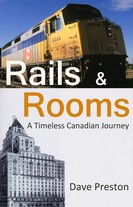
A journey across Canada, a journey across time. With humour and insight, Dave Preston invites readers to share his month-long journey across Canada, over 4,414 miles by rail. Travelling through every Canadian provinces that still has a track, stopping to recount the glory of the luxurious CPR hotels, Rails & Rooms offers a unique travelogue that covers Canada from Halifax to Victoria, past to present.
“I found myself very much as though I was actually taking this fascinating transcontinental journey. The fast moving descriptions of the great stations were particularly enriching. I highly recommend this book to any lover of trains or travel” – Ross Rowland, railway entrepreneur.
From Halifax to Victoria, Dave Preston rode the rails, exploring what was once the penultimate mode of transportation in Canada only fifty years ago. Days and nights spent rollicking across the diverse geography of Canada were interspersed with by stays at some of Canada’s oldest and grandest hotels, those built by the CPR to cater to their most affluent travelers.
Intrigued by an 1887 CPR brochure that promised “… mighty rivers, vast forests, boundless plains, stupendous mountains and wonders innumerable,” Preston set out on a journey of over 4,000 miles guaranteed to make even the most jaded traveler appreciate the grand geographical and cultural differences that both separate and unite the different regions of Canada. His record of the journey, Rails & Rooms, is an often-times humorous and poignant reflection of Canada’s railway industry, past and present.
Like the railways that bore and nurtured them, the Canadian railway hotels spin a story that is long and perplexing, involving all manner of politics, confounding economics, hundreds of companies and thousands of business deals. My story doesn’t simplify or explain this complex evolution; it is merely a personal account of a train journey that includes visits to some of the grand hotels that still provide rest and relaxation for travellers. This is the story of a month-long trip that took me gently across Canada, and occasionally through time.
Excerpt
For some odd reason, I didn’t want to leave Halifax. My hotel bedsheets clung to me as a fretful mother would, but I eventually broke free, packed my bags, and checked out. Crossing the street through a thick, humid mist, I bade a quick farewell to the pier and the old part of town. Poking about between buildings and docks I made my way carefully down narrow wet steps to water level. Call me romantic, but I wanted to do what so many other trans-Canadian travellers have done before me: take a splash of the Atlantic to pour into the Pacific at my journey’s end. I soon had an empty film canister filled, sealed and tucked safely into a pocket.
I caught a cab to the train station just before noon and saw another huge cruise ship, the Norwegian Night, dwarfing the pier buildings a couple of hundred yards away. Entering the station, I heard an announcement in English and French over the PA system, but I couldn’t make out either version. The hall, as an acoustic engineer would say, is full of active surfaces, or echoey, as the rest of us would say. I checked in two pieces of luggage for VIA train No. 15, scheduled to leave for Moncton at 1:30 p.m. With more than half an hour to spend, I sat and watched people go up to the counter to buy tickets. The travellers were a real assortment, and most seemed to be locals -- some travelling light with just the clothes on their backs and others with enough luggage to rupture an elephant. I saw more than one tearful farewell, a few bilingual goodbyes and lots of hugging.
A few people stood around, unsure of their roles in this pageant. I think the only way to spend time at a train station, or a bus depot or airport, is on your own. Free of the need to make promises of writing or calling or keeping in touch, unencumbered by the guesswork of when to give that final hug, or whether to kiss on the cheek or the lips. Not worrying about whether to whisper “I love you” as you finally break away. Goodbyes are stressful, so not having to say one here in Halifax lightened my load, leaving me free to watch others leap or fall through emotional hoops.
I turned towards the platform doorway, just in time to be caught by my friend Peggy, who’d brought her mother along to meet me and say goodbye. I thanked them for their Halifax hospitality and made a quick dash through the hoops: firm hug, cheek kiss, promise to keep in touch. Then I strode out of the station into the pale sunlight and relative quiet of the platform.
Walking the length of the train, I took a quick inventory of what made up this first vehicle of my journey: the signature park car, with its bar lounge and upstairs dome observation room, three sleepers, a coach, a dining car, another park car, three more coaches and right behind the locomotive, as always, the baggage car.
When I finally got to the front, past big yellow locomotives No. 6432 and 6458, I saw the engineer taking a break. His name was Jim and he was sitting on the side of the track. He said it was “too bloody hot” to get in the cab just yet, so I sat down next to him and we chatted. A railroader for twenty-seven years, he told me how the three-thousand-horsepower diesel-electric engines would take about 4 1/2 hours to haul us all to Moncton, at an average speed of 75 miles per hour, which he hoped would get some air going through his cab windows and cool things down. On a passenger train, the engineer makes sure the luggage is safely stowed in the baggage car and that the locomotives have whatever fuel they need. Meanwhile, the service crew, supervised by a service manager, looks after all the passengers and makes sure they get on board and into their allocated seats or cabins. The engineer is eventually told that all are aboard, that doors are shut, and that he can move off. It’s a loose team but it works. Jim said he tended to keep to himself, but he was friendly enough with me.
|