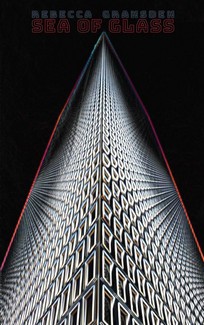
Smoke fills the city air, choking the street, curling up and around the tower. Kattar Bassis hits the ground and crawls blindly through the chaos. A light shines out in the black, leading him to the entranceway of his building. So begins his ascent and search for the ever elusive EXIT.
Professional Reviews
Harry Whitewolf
After a few days of pre-summer blue skies and warmth, it’s turned cloudy again today and there’s been a hint of rain in the air all day long. It felt like it would be the perfect day to read Rebecca Gransden’s new novella Sea of Glass, and I was right.
I’m a fan of everything this author has written to date, so I was very eager to dig into this one. As always, the language Rebecca Gransden uses amazes me, absorbs me and excites me. There’s no one else writing in the same style as Gransden. She’s a one off. Highly poetic words haunt, befriend and sometimes befuddle the reader. Specific adjectives and nouns are not always placed together as one would expect. Every few chapters there’s a word you have to look up. That could be annoying if anyone else tried to do it. But these words are written by a craft master. Above all though, Gransden knows how to make the reader FEEL. Although I’m now used to her writing style, it’s elevated to another level in this book due to the dreamlike, bizarre, suspenseful and horror-ish story that is weaved between the pages of Sea of Glass’s Esperanto-numbered chapters. The style and the story go hand in hand, which is one reason why this is probably Gransden’s best work. I say “probably” because I think her novel anemogram. might still be my favourite of her books, but objectively speaking: this is her best.
“What about the plot Harry?” Well, Kattar is trapped in a building trying to find the exit. “What, is that it, Harry?” Nah. But what Kattar encounters during his metaphysical, bizarre and gory Dante-esque journey is for you to discover yourself. It needs to be experienced. Trying to summarize the plot to this book would be like trying to build a house out of treacle.
I’m not going to pretend I understood every aspect of this story. It is somewhat intentionally left open for a reader to find his or her own take on events, but at the same time, it feels like with one or two more reads, a reader could discover much more of the book’s intentions. The idea of a building be some sort of ethereal embodiment of global capitalism is just one thing I’m not sure I’ve got quite right and want to revisit. This book works in exactly the same way as a David Lynch film. I watched Lost Highway for something like the seventh time recently and only then did I feel like I fully grasped it on all levels. Exactly how it should be. (And when in the theatre in the building in this story, “no hay banda” came to mind, from the scene in the theatre in Lynch’s Mulholland Drive. This book also reminded me a little of Cardboard Wall Empire’s other author’s book: Leo X. Robertson’s Bonespin Slipspace. The two books would make a great double-bill read.)
As with Gransden’s other books, I read this in one sitting. It only takes two or three hours to read, and it feels as though Sea of Glass is best read in one go in order to fully immerse yourself in its splendour. Anyone who still poo-poos independent authors really should read Gransden. Her stuff is better than any mainstream book I’ve read from the last decade. In fact, I believe she’s one of the greatest writers of our generation, despite being unknown to many. Will her stories appeal to one and all? Absolutely not. And that’s a good thing.
One more thing: I love the cover of this book. The building is as imposing as it is in the story’s words. It also appears to be a straight-sided triangular shape but it’s not. And when you look at the top part and notice where the straight lines bend, you get to see the perspective of the building’s top. But that’s not quite right either. It’s a bit like an Escher drawing in fact. Those thoughts about Gransden’s chosen image for the book cover mirror the perspective you will have when reading Sea of Glass. I feel like I’ve been walking on a Möbius Strip and now I don’t know how to get off.
Kevin Berg
Somewhere right on the edge of a nightmare, Kattar is stuck within the walls of a city giant, helpless and lost in his struggle to find the EXIT. Wonderful, dreamlike, even stomach-turning imagery at points, written in beautiful prose that falls from your lips in a whisper of song almost like poetry.
This thing is really good.
From the start you are tossed into the chaos, the panic that ensues from the death and destruction outside the building, streets clogged with blood and ash, though the real horrors lay waiting within the walls of your safety. The author does well to highlight the confusion and hopelessness of the lead character as he finds his way up, down and between floors, wandering into new rooms that act as the gateway to another dimension - something frightening and unbelievable - yet with just enough familiarity to make it that much more real and terrifying for the reader. Written with a voice that is as gentle and comforting as it is angry and frustrated, the story will probably mean something different to everyone, as I assume most usually do. This is put together with such thought and care that it definitely sticks with you, a story that will give you something new every time you come back to visit. I’ve read and enjoyed some of the author’s writing previously, but for me, this is on an entirely new level. Incredibly impressive piece of work, a story equally entertaining and disturbing, the nightmare of corporate and bureaucratic rule suffocating in our safe haven from the outside, while everyone is trying to get out.
Or maybe I got it wrong. Like I said, stories mean different things to different people. What’s important is that this thing is written so well, you are bound to find something inside that you can hold onto, keep it cupped in your hands and held close to your heart, warm and bright, as you fight your way through the madness in the real world. This is one of the most chilling reads I’ve had in a while, the language sharp and beautiful, a very enjoyable experience. So, I’ve already read it twice, certainly more to follow, and maybe I got it wrong, but you should pick one up and see what you take away from the story. This is one you don’t want to miss.
Paul Jameson
Wow.
Surreal, crazy, horrifying and genius; I hardly know what to write. Sat (metaphorically speaking) in my own little pedalo and was swept along by the imagery, insanity and horror that is Rebecca's writing. I think that's pretty much all you can do.
Unique, but would appeal to lovers of VanderMeer (Area X) and King.
The trailer didn't do much for me. Just a bunch of surreal images with weird music. Kind of like some bad dream one would want to get out of as soon as possible by waking up. But then from reading your reviewers, I realized that this may be the problem that your character, Kattar Bassis, is in. I read recently that dreams generally lashed about a half second. Not enough time to take 158 pages to escape from this glassy dream. I am intrigued, but don't read much. I write. Might take a look at it when I retire I from writing. I like things in The Twilight Zone.
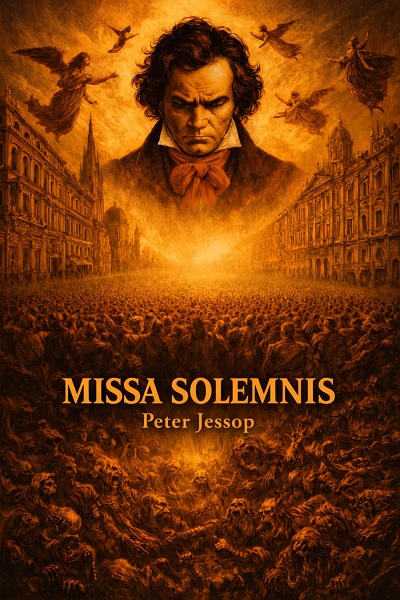
As deafness, illness, and demonic forces close in around him, Ludwig van Beethoven must summon his faith and genius to complete the Missa Solemnis—a sacred masterpiece he believes could bring divine light into a darkening world.
London: Lashed, Lacerated, Lampooned and Lambasted satirizes 18 popular Jack London novellas with adult content and language and the work is author Jay Dubya's 37th published hardcover/paperback book.
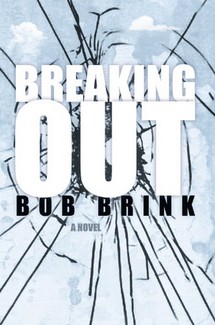
A teenage boy struggling with the coming-of-age issues of sexuality, religion, and peer approval is overwhelmed, but soldiers on. After several years, he comes to understand the family forces that have left him so deeply troubled, and the process of