
Kindle Edition
Download to your Nook (eBook)
Amazon
Barnes & Noble.com
Category:
Self-Help
Publisher: Echion, LLC
ISBN-10: 1946397008
Type: Non-Fiction
Pages: 410
Copyright: 2017
ISBN-13: 9781946397003
Price: $9.99 (eBook)
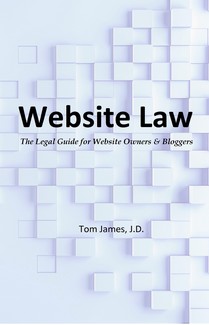
comprehensive legal resource for website owners and bloggers. Covers copyright, trademark, privacy, defamation, and more.
Thomas James, Cokato Minnesota lawyer, wrote this book to give website owners and bloggers information about the laws pertaining to their online activity. It is an indispensable resource for every website owner and blogger, explaining what you need to know about copyright, trademark, defamation, privacy and publicity rights, obscenity, pornography, and other laws. Fair use and the "public domain" are concepts with which everyone who uses the Internet needs to be familiar. This book dispels common misunderstandings, and provides detailed, accurate information about both. It also explains how you can use the Digital Millennium Copyright Act and the Communications Decency Act to protect yourself from liability for user-provided content. The book also explains how to license music and other kinds of content for use on your website, with detailed information to help you determine what kind(s) of license you may need, whether you will need to pay a royalty or other fees, and if so, how much. Complete with forms, resource directory, and quick-reference charts to help you navigate the hazardous waters of Internet law. Written by Cokato, Minnesota attorney Thomas James (Law Office of Tom James).
Excerpt
PUBLICITY RIGHTS
Everybody has an exclusive right to his or her own identity. Other people cannot exploit that right without permission. If they do, they may be sued for misappropriation of name, voice or likeness (or as it is sometimes called, “misappropriation of personality.”)
In many states, appropriating another person’s personality is also considered a form of invasion of privacy.
The elements of a cause of action for misappropriation of name, voice or likeness are:
1) unauthorized use
2) of another person’s name, voice, likeness, or other identifying characteristics
3) for commercial gain or other advantage.
The gravamen of this cause of action is the commercial use of another person’s personality without permission. Thus, liability may arise not only from the unauthorized use of a person’s name or of a photograph of the person, but also from the unauthorized use of the person’s voice or a recognizable drawing of the person.
Any publication of a person’s name or voice, or a photograph or drawing of a person, raises potential misappropriation of personality issues.
The most common way to incur liability is by publishing a person’s name or image in an advertisement for a product or service without the person’s permission, or in a way that suggests the person’s endorsement of a particular product or service. But liability can arise in other ways, too.
COMMERCIAL OR OTHER ADVANTAGE
Not every display of a person’s name, voice or likeness gives rise to misappropriation liability. Liability for misappropriation arises only if the person’s name, voice or likeness is used for commercial or other advantage. Displaying a person’s name, voice or likeness on a purely noncommercial website, for reasons other than to bring some advantage to the user, is not misappropriation. In some cases, it might be wrongful for another reason such as invasion of privacy (see Chapter 9), but it would not be actionable as misappropriation.
Liability for misappropriation of personality for commercial advantage may arise even if the person’s name, voice or likeness is not used to state or imply an endorsement or other connection to a particular product or service. If you have advertising on your site and advertising revenue is tied to the number of hits your site receives, then including a person’s name, voice or likeness on your website as a means of attracting visitors to your site could be considered a use for commercial advantage.
Unless a particular state statute provides otherwise, the gain or advantage need not be a commercial or pecuniary one. A few states have enacted statutes limiting liability to commercial uses, but others, such as California, have not. Political popularity is an example of a noncommercial advantage. Using a person’s name, voice or likeness to state or imply the person’s endorsement of a candidate would be an example of misappropriation for noncommercial advantage.
At least one court has held that using another person’s name as a keyword in competitive advertising does not violate the person’s exclusive publicity rights. If the name is also a trademark, however, then it might be a violation of trademark law.
PHOTOGRAPHS
Misappropriation of name or likeness, and invasion of privacy, are the causes of action that should be of particular concern to you if you are publishing or copying photographs of people on your website. The most common way to incur liability is by publishing a person’s image in an advertisement for a product or service without the person’s permission. It may arise in other ways, too, though. If revenue from your website is linked to the number of clicks on it, then publishing a person’s photograph to get more clicks would be a use of the person’s likeness for commercial advantage. And using a person’s photograph to state or imply that person’s endorsement or sponsorship of a product, service, business or political candidate could be considered a use of the person’s likeness for commercial or other advantage.
NEWSWORTHINESS
The use of a person’s name or likeness in connection with reporting on a newsworthy incident is permitted. For example, a website may publish a photograph of people attending a political rally without violating the privacy or publicity rights of the individual participants depicted in the photograph. A political rally is newsworthy.
UNFAIR COMPETITION AND FALSE ADVERTISING
The statutory or common law of about half the states recognize a person’s exclusive right to use his name or personality for commercial or other advantage. Even in states that do not recognize such a cause of action, however, the right of publicity may be protected under the law of unfair competition. Misappropriation of a person’s name, likeness or voice for the purpose of misrepresenting or “passing off” a product or service as being made, sponsored or endorsed by that person is a form of unfair competition.
The federal Lanham Act authorizes a person to sue for false advertising. Using a person’s name, voice or likeness in a way that falsely suggests the person’s manufacture, sponsorship or endorsement of a product or service may be actionable as false advertising under the Lanham Act.
LICENSES AND PERMISSIONS (AKA “RELEASES”)
The best way to reduce the risk of liability for misappropriation of personality is to refrain from using other people’s names, voices or likenesses to your advantage.
If you do choose to make such a use, however, then you should obtain written permission (sometimes called a release) from the person in question. This certainly should be done if you intend to use the person’s name, likeness or voice for a commercial purpose such as a product or service endorsement. Consent is a defense to misappropriation.
Because some states allow a cause of action for misappropriation for non-pecuniary advantage, you should also secure such a release when you intend a use for noncommercial advantage. For example, if you are running for office, you should get a person’s written permission before identifying the person to the public as someone who supports your candidacy.
It is also not a bad idea to obtain permission when you intend to use a person’s name, voice or likeness in a way that might otherwise expose you to liability for invasion of privacy. See Chapter 9.
Children are deemed incapable of giving a valid consent. A parent or legal guardian must give consent on their behalf. Depending on state law, an incompetent, coerced, defrauded or traumatized person also may be incapable of giving consent on her own behalf.
When copying a photograph taken by somebody other than yourself, or a drawing made by someone else, you may need to obtain permission from both the photographer/artist and the subject of the photograph/drawing. This is true whether you are using it for commercial purposes or not. Liability for copyright infringement can attach irrespective of motive.
Get permissions in writing, and signed. That will make it easier to prove that consent was given.
An example of a model release is provided in Appendix V. A general purpose request for permission to use copyrighted material, which may be adapted to use as a request for permission to use a photograph, appears in Appendix IX.
KEY POINTS:
Get permission before using a person’s name, voice or likeness for commercial or other advantage.
If website revenue is tied to the number of visitors (or “clicks”) the site gets, publishing a well-known or controversial person’s photograph to it might be considered a commercial use.
Newsworthiness may be a defense to misappropriation of personality in some cases.
|