Kindle Edition
Download to your Nook (eBook)
Download from Apple iTunes (eBook)
Amazon
Amazon
Google Play
Category:
Memoir
Publisher: Self via Createspace and Amazon
ISBN-10: 154541078X
Type: Non-Fiction
Pages: 180
Copyright: Apr 15, 2017
ISBN-13: 9781545410783
Price: $2.99 (eBook)
You will laugh and cry as you peek into Paz's childhood, from her naughty toddler years to her rebellious teens and the ups and downs of her relationship with her parents.
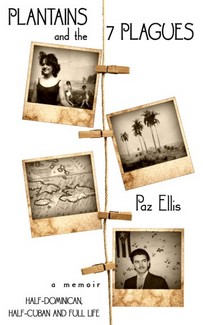
Author Paz Ellis takes readers on a cross-cultural and trans-generational journey through her childhood in New Jersey to adulthood with Plantains and the 7 Plagues, A Memoir: Half-Dominican, Half-Cuban and Full Life.
Paz insightfully describes, the complexities and contradictions of growing up in the United States to a Dominican mother and a Cuban father. From her mother’s obsessive cleaning rituals to her father’s remarkable knack for invention, this book beautifully explains what living a hyphenated-life means for so many Hispanics. She writes about what it means to be American, and Cuban, and Dominican, and having to be all of those things and only one of them… all at the same time.
Following the passing of her mother, the author finds herself on a search for meaning through not only her past, but also her mother’s. This book is about life, loss, memory, culture, and family, the glue that determines who your family actually is- love. Written with a healthy dose of wit and an abundance of sincerity, Plantains and the 7 Plagues is honest, painfully relatable, and deeply heartfelt.
Excerpt
I am one-part plantain and one-part displaced Cuban in search of Biblical plagues. My life has been split between deciding loyalty to both parts of my heritage which was subject to change at a moment’s notice depending on who I was around growing up. I was a mutt, a combo-meal, to some, on one side of the family, I was an undesirable mistake of nature. Some of my father's cousins advised him against marrying someone with too much tint. My mother, to a white Cuban, had too much pigmentation in her skin, a hint of tar brush. She was a morena. Ironically, within her own family she was rather "light-complected" and a genetic wonder. Much like India, The Dominican Republic has its own social caste system. She, having married a white Cuban, was refining the family not staining it with biracial love. It was different in 1960’s. Mixed couples were not the norm. Even Hispanics were opposed to the mix of color or nationalities. My parents had a few barriers to break and prejudices to overcome; even some of their own. But what is meant to be, and has been preordained by destiny, is immune to convention, tradition, and public opinion.
They met in 1966, at the entrance of the Roseland Ballroom in New York City on West 52nd Street under unusual circumstances. My mother was going to commit suicide that night. She was angry and severely depressed. She wanted to return to the D.R., but her foster mother insisted she stay with them in New York where she could go to college and have a better life than the one she had been living when they took her into their home. As my mother told it, her foster sisters wanted to dance and literally dragged her into the nightclub, yanking her arm to get her in the door. At the same time my father was either going out or into the club when he saw her for the first time. He always said that the moment he saw her, he fell in love. She had pitch black hair, nearly blue, and hypnotic dark eyes. But it was not until later while she sat at a table, alone, while the other girls danced, that he really knew she was special. He watched as several men had asked her to dance and she turned each one down. Some politely, and others with rude exasperation. He said he was nervous, but that he could not leave that club that night without having spoken to her. She said that when she saw my father standing before her, she looked up ready to reject the next idiot with a dance request. But instead saw something humble and kind in his eyes. He was handsome too, and well-mannered, but it was those eyes that moved her. He asked her if she would dance with him, completely prepared for rejection and to resort to begging. But she nodded her head, yes; and my shocked father, took her hand and led her to the dance floor. I don’t know how many songs they danced or what happened when the music stopped that night. But Mami always said he had an air of sadness about him and she was drawn to his frailty. He had been recently divorced, and had a four-year-old daughter, so I can understand how he may have appeared sad and broken. Maybe even as broken as the beautiful girl he had just snatched away from the dark finality of ending her own life.
The details of how the ‘courtship’ began are lost to me now since both my parents have passed on and left so many unanswered and unasked questions. However, I know that he would later pick her up at the apartment she lived at with her foster family, evenings after work and sometimes on the weekends. And in the course of those first few weeks he told her he had a daughter and wanted my mother to meet her. When my mother heard that, it was if someone had lit a fire under her ass. She got out of the car and said, “vuelva a su familia!” (return to your family). She did not want to live with the thought of knowing she could have impeded a family from mending itself. She knew what it was like to be a child of divorce. My father, mild-mannered and passive as he was, surprised her with his refusal to give up on her.
|