A proposal to solve wealth inequality and other pressing global issues.
This book is intended as a renewed call to unite the planet under a single government with equal rights for all citizens of the world, get rid of monarchies and military industrial complexes, tax billionaires out of existence by setting a wealth cap at $999 million, and using the trillions acquired through these measures to introduce shelter, access to clean water and food, education, healthcare and stable speedy internet connections as basic human rights.
The main focus here is on the utter uselessness of the billionaire class. Arguments for the benefits of their presence are deconstructed and debunked one after another with an AIDOP (AI Debates on One’s Publications) session at the end of the book; handling a debate with ChatGPT on the counterarguments presented.
The arguments and counterarguments tackle speed, efficiency, additional consequences to elimination, motivation, spending habits, whether getting rid of billionaires is essential for getting rid of cronyism, whether extreme wealth concentration has been historically beneficial, philanthropy, balance of power, recruitment and training, private diplomacy, whether billionaires provide real value to customers, and market accountability.
Key takeaways from the book:
• Just like they sought to monopolize markets, they may seek to monopolize opinions; threats to freedom of expression do not only come from governments, corporates have the power to silence dissent.
• A person does not maintain their position in the current list of the wealthiest people on the planet by following the rules of society; they do so by manipulating rules through their influence on legislation and regulation.
Excerpt
Humanity’s Money
This book is intended as a renewed call to unite the planet under a single government with equal rights for all citizens of the world, get rid of monarchies and military industrial complexes, tax billionaires out of existence by setting a wealth cap at $999 million, and using the trillions acquired through these measures to introduce shelter, access to clean water and food, education, healthcare and stable speedy internet connections as basic human rights.
The main focus here is on the utter uselessness of the billionaire class. Arguments for the benefits of their presence are deconstructed and debunked one after another with an AIDOP (AI Debates on One’s Publications) session at the end of the book; handling a debate with ChatGPT on the counterarguments presented.
The arguments and counterarguments tackle speed, efficiency, additional consequences to elimination, motivation, spending habits, whether getting rid of billionaires is essential for getting rid of cronyism, whether extreme wealth concentration has been historically beneficial, philanthropy, balance of power, recruitment and training, private diplomacy, whether billionaires provide real value to customers, and market accountability.
Arguments for and against maintaining billionaires:
First Argument: Speed:
They have the un-democratized capital required for the speedy deployment of ground breaking technological innovations; they can move faster than governments and mobilize the required resources to establish the renewable energy infrastructure required for climate change mitigation, conduct pharmaceutical research to face current diseases and upcoming pandemics, ensure progress with the AI development required for economic expansion, produce semiconductors to enable this development, and explore the space, which is essential for extracting resources from celestial bodies.
Counterarguments:
According to Forbes, there are currently 3,428 billionaires in the world, compared to 3,508 according to Statista. None of these billionaires has declared a life mission to mitigate and adapt to climate change globally or fight pandemics, and even if they did, they cannot be held accountable, as the un-democratic nature of their huge amounts of capital and influence allow them to rule the world while avoiding accountability.
Yet, it is worth examining whether they have exerted efforts to solve the world’s main problems; so, let us unpack the subpoints included under the speed argument and provide counterarguments accordingly.
Firstly, how are billionaires doing in terms of wealth accumulation versus how well are they doing in terms of climate change mitigation?
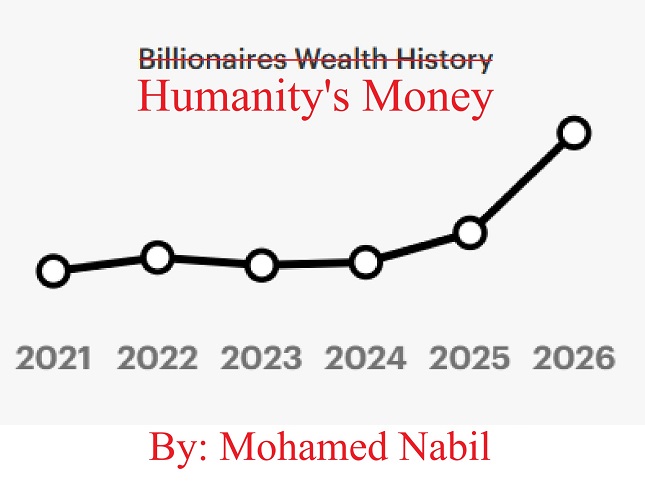
According to Forbes, the following graph represents the growth in billionaires’ wealth over the last few years:
According to Copernicus, January 2026 was 0.51 Degrees Celsius warmer than the 1991-2020 average for January.
According to Forbes, the wealthiest person on the planet is Elon Musk with a net worth of $839 B. He cofounded several companies including Tesla, which produces electric vehicles that might be viewed as necessary tools for climate change mitigation. Tesla’s batteries require multiple minerals as displayed in the chart below:
Tesla sources these metals from all over the world, remarkably, they have a long-term supply agreement with Glencore to supply cobalt to its factories in Berlin and Shanghai. Glencore extracts cobalt from the Democratic Republic of Congo, which approximately accounts for 70% of the world’s cobalt reserves.
According to Amnesty International, children as young as seven years old are engaged in mining activities in the Democratic Republic of Congo.
This is often discussed as the “great green extraction” or a feature of the neo global colonialism; to power the green grids and electric vehicles in wealthy nations, labor is exploited and children are being abused in developing nations. It is worth noting that a homeless person in New York did not benefit from this mining process, and it is also worth mentioning that there are many stakeholders within developing nations that are benefiting from the current situation.
Tesla is reportedly planning to reduce its reliance on cobalt, yet this is only one example within one industry. Older examples include Brian Merchant’s book, The One Device: The Secret History of the iPhone, in which he demonstrated the devastating working conditions in the enormous complex in China where these phones are produced, which led some workers to commit suicide.
Billionaires have influenced the creation of the current combination of legislations across countries, and they tend to move jobs away from places where certain labor rights are established to places where they can exploit “cheap labor”, which also causes an increase in unemployment rates in some areas. A united global government with equal rights for all citizens of the world can effectively solve this problem.
The new government should not be built around a certain ideology; a country like the United States is strongly associated with capitalism, and most of its politicians oppose policies like universal healthcare and universal basic income. A country like China is strongly associated with communism, yet its politicians also lack the will to provide a strong social safety net for its citizens. According to Forbes, the US currently has 989 billionaires and China has 610. These billionaires can move money and resources freely between countries while controlling their governments, a company like Apple can produce the phones in China or India and sell them in the US and all over the world… “communism”, “capitalism” and other ideologies have been reduced to labels.
If we are moving toward a green economy, we have to make sure that it is a just transition. We also need to move faster by setting this green transition as a priority, not as an economic opportunity that may depend on billionaires’ willingness and visions for wealth generation.
Secondly, pharmaceutical research, along with medicine and vaccine development. The two dominant behavioral patterns of communication in today’s world are “Blind Elitism” which involves following the “Elites” or “Experts” blindly on any given matter without asking questions or investigating issues and “Ignorant Populism” which involves relying on feelings or trends to form opinions, attitudes, beliefs… without investigating the relevant information.
Enlightened Populism is presented as a healthy alternative to both behavioral patterns of communication; it involves listening to multiple experts in all fields, trying to understand how they reached certain conclusions and investigating the information provided to discern the truth.
The main issue is how we deal with the superficial narrative often provided through traditional media and/or social media.
Let us apply these theoretical words on a real-world issue like vaccination, there are people around the world who are willing to accept any kind of vaccine offered to them as long as “Elites” or “Experts” approved it and there are people around the world who reject all vaccinations because of fear and mistrust of the system. These are the “Blind Elitists” versus the “Ignorant Populists”.
It is important to tackle questions of development, accountability and profitability.
1- Development: corporations should not be allowed to monopolize vaccines.
All vaccines should belong to the public & this is why scientists in all countries should work together to develop vaccines, collaboration ensures efficiency in terms of quality & timing.
Following the development process, companies in all countries shall be ready for implementation, which ensures accessibility.
2- Accountability: under the PREP Act, pharma corporations have total immunity from liability, also the FDA cannot be sued for authorizing a vaccine for emergency use and employers cannot be held accountable if they mandate inoculation as a condition of employment.
The best way to solve this problem is for corporations to express willingness to send their own executives to prison if undisclosed health issues occur because of their vaccines.
Accountability is generally the best way to maintain trust.
3- Profitability: corporations in general, including pharma corporations are using tools like Donald and Joe to take huge loads of the people’s money, instead of taking a reasonable amount; that is money taken from hospitals, schools, housing projects...
Justice is essential; justice in development, justice in accountability & justice in profitability.
In this example, Enlightened Populism helped solve the matter; after applying the mentioned steps people can logically trust the developed vaccines.
Same goes for public opinion on any given matter, we need to stay away from the superficial discourse and tackle the root causes of the issues.
So, in this case, cooperation definitely beats competitiveness and we do not need the billionaires for that, we just need scientists working together to develop medicines and vaccines.
Thirdly, AI development is definitely desirable as a tool for economic expansion, but what kind of expansion are we talking about? A few charts including the GDP and other metrics that measure the overall growth? Another chart like that previously displayed showing further jumps in the overall wealth of billionaires? Or are we talking about enhanced living conditions for members of the population?
Let us apply the example of Elon Musk and Tesla again to the automation of labor, among their initiatives they are heading toward completely self-driving cars and Robotaxis. Taxi drivers around the world will lose their jobs accordingly; with a strong social safety net, these drivers may stop worrying about affording their families’ basic needs and start redirecting their time and energy elsewhere.
The same can be said about workers across fields, a reduction of working hours can be applied instead of layoffs, allowing members of the population to have enough time and energy to participate in citizen assemblies that govern the world.
With a solid social safety net and a universal basic income in place, one can surely imagine having more artists, thinkers, musicians, painters, philosophers, authors…
Fourthly, manufacturing semiconductors, the “semiconductor war” is the new cold war between the US government and its allies and the Chinese government and its allies. A few companies lead the market, with Nvidia and TSMC at the top of it. Instead of wars of any kind, we can have more semiconductors by sharing the knowhow and allowing more companies around the world to produce them… the billionaires associated with the industry should be taxed out of existence, just like other billionaires and wars of all kinds shall be completely eliminated with the establishment of a unified global government.
Fifthly, space exploration, which will get us back to Elon Musk, this time with SpaceX instead of Tesla. The company’s main mission is to make humanity a multiplanetary species, which raises lots of questions on the use of resources extracted from other planets and the systems of governance that should be established over there. There is a treaty adopted by the United Nations General Assembly and signed by all of the major and emerging states in terms of spacefaring. It is titled “treaty on principles governing the activities of states in the exploration and use of outer space, including the moon and other celestial bodies”.
In its text an 1884 resolution is recalled, by which States should refrain from placing nuclear weapons or other weapons of mass destruction in orbit around the earth or on any celestial bodies.
According to the agreement, celestial bodies cannot be subjected to sovereignty or occupation, they should not include fortifications, military bases or installations. Most Importantly, in one of its articles it is stated that any state party of the treaty may give notice of its withdrawal one year in advance.
According to SpaceX, one million people and millions of tons of cargo should be delivered to Mars in order to build the first city. All while multiple governments are engaged in a renewed space race to the moon.
The mentioned treaty is ambitious, aimed at benefiting humanity as a whole from scientific advancements in the field, yet it is unrealistic; the very competing structure of nation states as governing bodies contradicts with the most ambitious articles in the treaty.
The treaty implicitly implies that whoever can find resources on the moon or other planets can take advantage of them before others do.
So let us learn from the history of earth and apply the lessons to the outer space; if the unexpected happens and life is found to exist on any of the celestial bodies, we may witness a new genocide by colonists, just like what happened during the colonization of the Americas.
If new life is established on Mars through SpaceX’s plans, we may witness a new tyrannical private rule by SpaceX on Mars, similar to that established by the British East India Company in India. As history has shown us, a private company can have its own powerful military presence and the political force required to rule vast regions.
So, the main questions are whether humanity can unite a planet and then eventually multiple planets along with their moons, whether we can collectively believe in unity and cooperation or we may simply prefer division and competitiveness.
Second Argument: Efficiency:
Billionaires have expertise in terms of managing complex supply chains, allocating resources and optimizing logistics… a dollar spent by them is highly likely to be more efficient than a dollar spent by government officials.
Counterargument:
This is a common point for those who support the importance of the existence of billionaires in society. If they can invest money and resources more efficiently, then their presence in society is essential. This is simply a common misconception, being able to generate billions of dollars or simply inheriting a huge fortune does not imply that a person will always invest wisely.
Examples of billionaires failing to maintain wealth include Vijay Mallya, who used to be a billionaire but his net worth diminished; his reliance on a failing airline (Kingfisher Airlines) and failure to diversify sources of income were reportedly among the factors contributing to his financial collapse.
Examples of governments investing wisely include Norway’s sovereign wealth fund, which currently holds assets of over $2 trillion.
Third Argument: Additional consequences to elimination:
Billionaires’ money is highly concentrated in companies they founded or purchased shares within, and the valuation of these companies depends on how the public market collectively believe in their value. Upon setting a wealth cap, these billionaires will be forced to liquidate stocks whenever they fluctuate upwards in the stock market. This may deprive them of chances to keep controlling companies they may have founded and directing them with their own visions for the future. It may also destruct the retirement portfolios of common citizens tied to index funds.
Counterarguments:
We can start by addressing the more pressing issue, which is the potential destruction of common citizens’ retirement portfolios. Instead of confiscating money, the global government can take over stock market shares of these billionaires in their companies, and these shares will only be sold by the government eventually and gradually (if needed), in order to protect common citizens’ portfolios from sudden reductions. As for the former billionaires’ roles in these companies, that will mainly depend on whether the stakeholders believe their input is essential for expansion and prosperity.
This book is about a radical transformational Way of Insight, Awakening and Realization to transcendent Self of Nondual Consciousness. If your're interested in transcendental Enlightenment, in Awakening to Nondual Self of Wisdom and Compassion, then