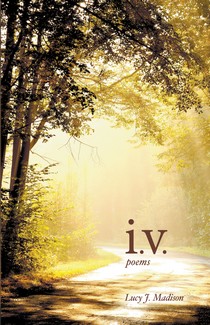
Debut collection of poetry from lesbian romance author Lucy J. Madison
These poems feature Lucy's lyrical words about love, time, passion, and the beach. You don't want to miss this thoughtful, romantic collection.
Professional Reviews
Tipton Poetry Journal Spring 2017 Review
In Lucy J. Madison's collection, I. V., we are infused with red, dripping words from an inverted, familiar place of baptism, morphing, longing, passion, remoteness, the fullness of the natural world, and manmade emptiness. The reader is left drowning in water that we keep returning to, as pond, lake, sea, or rain. All is storm and tide, sucking and pulling, ending life, giving life, frightening, comforting. Ice is bourn or ice covers over us. Tears leave their wet remains on cheeks.
And here are winds that whip us, lull us, and displace us from some comfort. Winds that lift hopeful wings, and winds that return memories they have borrowed for a time. Leaves fall or upturn, but their veins are rarely satisfactorily fed by their branches.
If poetry should be tied to song in either rhythm or movement, these qualify as segments from a symphony with nostalgic notes we've heard before-or think we have-but that also sweep into refrains we could not have expected.
There are conflicts of dueling externalizations. While in a few poems Madison humanizes inanimate objects, in others she herself wants to change into something other than human in that she becomes a part of seasons, oceans, a hummingbird. In "The Farmhouse," a forgotten home is almost eerily personified.
Now empty and forgotten, the ivy eats it board by board
greedily engulfing the entire lower floor, stretching its sticky
fingers upstairs, past the shattered windows, the black eyes swollen shut,
the red trim peeling and dark, dried blood caked into its sides.
There is a sense that this conglomeration of wood and nails is not only alive-yet dying-itself, but knows the pride of motherhood.
Once upon a time, life kicked within it, and it held itself
like an expectant mother who smiles each time she touches her stomach.
"Annie's Pond" reveals that the author can visualize an animal in one's self as clearly as she can see humanity in an animal. She anthropomorphizes a hawk soaring overhead in these lines:
His white woven shirt ripped open to the navel,
feet swaying just off the ground, bare and dirty, calloused and bleeding. His shirt sleeves rolled up to his elbows as if after this,
he had fields to hoe and livestock to feed.
The need to be wanted, and the wait to be wanted is wrapped up in these fine lines from "I.V."
I am here, waiting for you to cherish
all those places inside me noone ever thought to look, like the corner of a closet where a favorite sweater smelling vaguely like winter rests
waiting to be worn again.
Renewal and rebirth are presented from the poet's natural surroundings, which are wooded, oceanic, trailed and trail-less. Seasonal changes pound, tides roll and wash, leaves brighten and die in their own cycles of rebirth. "I, Phoenix" is one complete remembrance of what it is to live and die, and "Here" reveals a simple theory of death and reincarnation:
It's the ones who say it all when they are alive who get to leave, who are reborn again or able to find their heavens
"Will you miss me when I'm gone?" the author asks. Her subjects long to fit together or against each another companionably. These poems make a definite whole, yet they are never fully settled or comforted for long. They seek peace, but never find lasting harmony here among the winds and rains, storms and empty rooms once joyfully occupied.
We are nourished on passion for a moment, but left feeling remote once our sustaining line has been removed. Floorboards creak. A forest makes us feel insignificant. Children fish and play at the peripheries of this collection, like a struggling catch on a line that is never reeled to shore. And all of it creates a beautiful dissatisfaction during the time that we are here. From "Dawning"-
until single words swimming in their own brilliance cease because mostly it is not about words at all but is instead
a reminder of the time we sat under the Oak tree drifting to sleep against one another before any words were needed .
5 Star Amazon Review
Legalities: I received an Advanced Reader Copy (ARC) in exchange for an honest review.
I am so jealous! I wanted to write these poems, and Ms. Madison beat me to it!
These are thought provoking, and beautiful, and poems I will read again and again.
On the first read through, the two that hit a responsive chord with me were Baptized and Gone. Okay, it was more like hit me with a 2 x 4 between the eyeballs--"I knew at that moment we both had been / Baptized." Wow! The perfect ending to a beautiful poem.
"I wonder if you'll miss me when I'm gone, /... " how often have we asked that question, if not out loud, at least in our hearts? Madison gives a stunning answer of her own.
The language of these poems sings. The songs are beautiful, are sad, are happy. They will make you weep; they will make you smile. They will leave you wanting more, and wondering when the next book will come out.
I admit, I did not just read these poems; I devoured them, a starving woman at the table of plenty. I haven't done that since the last time I read Erica Jong. I will read these poems again, and take my time, and chew each morsel carefully to extract all the flavor, all the meat, all the wonderful goodness.
Barry Harris, Editor Tipton Poetry Journal
“I first encountered Lucy J. Madison’s poetry when the Tipton Poetry Journal published her poem, “The Farmhouse.” Her deft use of language and knack for choosing just the right word becomes quickly evident. These are intimate and fascinating poems that probe the mystery of relationship, often while exploring those spaces where one thing meets the edge of another: black night yielding to dawn, or ocean surf pounding against a sandy beach. Her facility for metaphor and personification brings words alive in new and often surprising ways.”