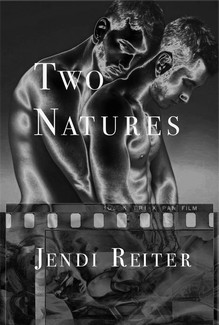
Two Natures is the spiritual coming-of-age story of a NYC fashion photographer during the 1990s AIDS crisis.
Two Natures is the coming-of-age story of Julian Selkirk, a fashion photographer in New York City in the early 1990s. His faith in Jesus helped him survive his childhood in the Atlanta suburbs with an abusive alcoholic father, but the church's condemnation of his sexual orientation has left him alienated and ashamed.
Yearning for new ideals to anchor him after his loss of faith, Julian seeks his identity through love affairs with three very different men: tough but childish Phil Shanahan, a personal trainer who takes a dangerous shortcut to success; enigmatic, cosmopolitan Richard Molineux, the fashion magazine editor who gives him his first big break; and Peter Edelman, an earnest left-wing activist with a secret life. Amid the devastation of the AIDS epidemic and the racial tensions of New York politics, Julian learns to see beyond surface attractions and short-term desires, and to use his art to serve his community.
Professional Reviews
Midwest Book Review (Two Natures)
http://donovansliteraryservices.com/july-2016-issue.html#tnn
Review by Diane Donovan for Midwest Book Review
Julian is a Southern boy and transplanted aspiring fashion photographer in New York City in the 1990s; a gay man facing the height of the AIDS epidemic and professional, social, and spiritual struggles alike as he questions himself, God's will, and Christian values in the advent of a specific kind of apocalypse.
It's rare to discover within a gay love story an equally-powerful undercurrent of political and spiritual examination. Too many gay novels focus on evolving sexuality or love and skim over underlying religious values systems; but one of the special attributes of Two Natures isn't just its focus on duality, but its intense revelations about what it means to be both Christian and gay.
In many ways, Julian is the epitome of a powerful, conflicting blend of emotions. Take the story's opening line, for one example. Readers might not anticipate a photographer's nightmare which bleeds heavily into evolving social realization and philosophy: "I woke from another nightmare about photographing a wedding. The bride was very loud and everyone’s red lipstick was smeared across their teeth like vampires, except vampires would never wear lavender taffeta prom dresses. It’s always the wrong people who can’t see themselves in mirrors."
Even the language exquisitely portrays this dichotomy: Julian's parents are still "Mama" and "Daddy", his language and many of his attitudes remain delightfully Southern ("You know, back where I come from, that was the first thing you asked a new fellow: what does your Daddy do, and where do you go to church?”), and his experiences with men, female friends, his evolving photography career, and life in general are wonderfully depicted, drawing readers into not just the trappings and essence of his life, but the course of his psychological, philosophical and spiritual examinations.
As Julian explores this world, readers should expect sexually graphic (but well-done) scenes designed to enhance the storyline (not shock it with departures or dominant heaviness), an attention to the social and political environment of the 90s that swirls around Julian and changes his perspectives and decisions, and a gritty set of candid descriptions that probe real-world experience.
Readers of gay fiction seeking more than a casual series of insights into the world of New York City's culture, enhanced by the deeper perspectives of a young man who spiritually struggles to find his place even as he fine-tunes his career and life, will welcome the close inspection of truth, love, and life provided in Jendi Reiter's Two Natures, powerful saga of Southern etiquette and perspectives turned upside down and the risks involved in moving beyond one's safe zone.
Two Natures takes us back to a time many of us have tried hard to forget
Jendi contacted me a while ago, asking me if I’d be interested to read her debut novel, Two Natures, which hit book stores yesterday. Ms Reiter is an accomplished writer, having won awards for her poetry. I’m always interested in reading a good book, and when a poet branches out into prose, I’m intrigued. I’ve read this novel over the past few days, taking much needed breaks every now and then, because Two Natures gets under your skin.
First things first: the writing is astonishing. Not really a surprise from an award winning writer, but still. It deserves to be said, as poetry and prose are two kinds of animals. Ms Reiter does an amazing job at describing the era, the early 1990s, the locales, mainly Manhattan, the politics of the Clinton and Giuliani era (seems history has a way of repeating itself…), and the fashion and publishing industry of the time. The characters become alive almost instantly, and I got to follow along the path of Julian Selkirk, the ‘hero’ of the story, as he tries to build a career for himself as a fashion photographer in New York. Work, life, sex, love, death. It’s all there, deliciously described.
A couple of years ago, I wrote The Fallen Angels of Karnataka, and I remember the reactions I got over the descriptions of HIV and AIDS in that book. As it started out in the eighties, I had no choice but to relate to “our” big drama. I also remember the acclamations from the like of e.g. A&U magazine for describing the HIV epidemic in a new light. I think I wrote TFAK the way I did, because I couldn’t bear writing it any other way. For many of us coming of age at the height of the epidemic, we tried to ignore it, stay clear of it, and we repressed it. The condom was there from the first time we had sex, never knowing anything else. Two Natures also takes an interesting, almost in passing, look at the epidemic. New York, at the heart of it, is a focal point for much of the hysteria, the resentment against the LGBT community, and the tiniest slivers of hope for a brighter future, spelling marriage equality, anti discrimination legislation etc.
Two Natures is not an easy read. It is, however, a darn fine read. The beautifully crafted language that belongs to a great literary work, the details in scenery descriptions and the well-crafted dialogues make it a delicious read. But never an easy one. I am not usually a reader of historic fiction, and it pains me to use such a word, acknowledging just how old I’ve become myself, being about five years older than Julian. I read about things like President Clinton signing the Defense of Marriage Act (commonly known as DOMA, repealed as recently as 2013, as it was declared unconstitutional). Twenty years it was in place, this horrible thing, and so much happened in that time. Much I’d forgotten, some I’d just blocked out. My life was not unlike Julian’s: partying, casual sex, friends, work, studying.
At times, Two Natures is really funny and witty, with a sense of humor so sharp it startles you. Here’s a sentence I highlighted in the first part of the book, from Julian’s POV:
Daddy grunted. He believed motorcycles were for Democrats having a midlife crisis.
I stopped mid-track, having to re-read that sentence a few times. So odd, so far away from my pre-conceptions of what a motorcyclist is like, yet what a beautiful description of a southern man’s mindset, his own pre-conceptions. The second example is just as witty:
“Does Linda Evangelista expect to be loved for her mind?”
Julian is quite the cynical photographer in the fashion industry, a typical New Yorker, despite his Georgia background. Not a judgement of Ms Evangelista’s intelligence, but how completely irrelevant it was to her career as model. The present tense of the phrase made it all more edgy. The book is littered with such bon-mots.
Two Natures begins in 1991 and ends in 1995. I remember some aspects of that time in my life. Like Julian, my sex life was varied, and like Julian, I had several relationships. There are many commonalities he and I (along with most gay men of the era) share, and while I was never even close to the fashion or publishing industry, the loose yet oh so important circles of friends were there. Ms. Reiter did an amazing job researching for the book, and it is painfully realistic.
Without going into details about the plot, the two main romantic or love interests of Julian, Peter and Phil, are painted in equally realistic colors. Both men flawed, but lovable. No, this is no romance novel, despite the romantic thread that permeates the pages. In fact, the mere mention of “open relationship” might send some readers of such novels screaming for the nearest therapy couch. Yet it is exactly the honesty, the unbridled truth told in Two Natures that makes this book so amazing. In fact, for all I know, Julian Selkirk is just a pseudonym for a real gay man living in New York in his mid-forties, married, no kids. I am deeply indebted to Ms Reiter for writing “our” story, the story of gay men growing of age in the nineties so honestly, so candidly.
As painful as it may be to remember some aspects of it, as hopeful is the picture she skillfully paints, and as we leave Julian on the floor of GalaxyCon, there is hope for the future. And as we all know, that hope has largely been fulfilled in the twenty years since, albeit loads of work still remains. Two Natures is an exquisite work of art, beautiful literary writing that enriches the LGBT section of any book store and Kindle, and it adds a beautiful facet to the mosaic of LGBT life past.
Two Natures is published by Saddle Road Press and is available from Amazon and other fine online retailers. Give it a shot, you will not regret reading it.
Release Day and Promo Post: Two Natures by Jendi Reiter
http://diversereader.blogspot.com/2016/09/release-day-and-promo-post-two-natures.html
Review by Meredith King for Diverse Reader
Talk about a debut novel that grabs you, bleeds you, and makes you cry until you're raw. It's one of those books that when it ends you realize you stopped breathing. This is not an easy read. The subject matter is very heavy and the author really thrusts you into the gritty.
Many of us remember the early 90's and how AIDS was actually vocal. Yes, it had been around for years before but it wasn't really until the 90's that people talked about it. Many people suffered and died because of this virus. This book not only addresses AIDS and that time period but you are gutted at the loss of one character because of the virus. That is the only warning you're getting about the seriousness and emotional upheaval in this book.
This tale is close to 400 pages long but it flowed. Pacing was terrific and the characters were fleshed out nicely. There's a high angst count on this story obviously so be ready.
You may walk away from this book angry and frustrated and that is really just a testament to the realism the author creates. The truth here is a beacon for awareness. Take a deep breath and be ready for an emotional pummeling.
Sarah Thompson has ten days on Maui to find her lifetime after lifetime soulmate. She is certain he is waiting for her there on one of the last remaining land masses of Mu still above water.
What causes America's mainstream media to fear and try to destroy a group of artists and their work? What happens when such a creative movement grows in strength and threatens media's bottom line? Why would extremists find it necessary to take acti