Category: History Publisher: CreateSpace Publishing
ISBN-10: 1507727275
Type: Non-Fiction
Pages: 116
Copyright: Jan 31, 2015
ISBN-13: 9781507727270
Price: $4.99 (eBook)
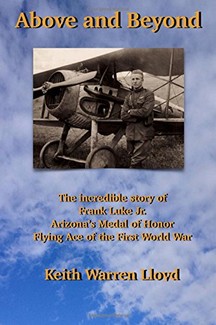
The Incredible Story of Frank Luke Jr., Arizona's Medal of Honor Flying Ace of the First World War
Born in Phoenix, Arizona in 1897, Luke was an adventurous young man who was an avid hunter and outdoorsman. When America entered the First World War in 1917, Luke became a fighter pilot in the newly-formed U.S. Army Air Service and was soon serving with a combat squadron in France.
Seen as a "high-strung, excitable boy," scorned by his squadron mates and frequently at odds with his commanders, "Above and Beyond" tells the story of how Luke soon became one of the most revered fighter aces on the Western Front. Exhibiting great audacity and skill in combat, he quickly racked up an impressive number of air-to-air victories, many of them against heavily-defended observation balloons which few pilots dared to attack.
"Above and Beyond" chronicles Luke's most daring mission of all on September 29, 1918, which cost him his life, and for which he was awarded the Congressional Medal of Honor.
Excerpt
Verdun is a clean and orderly village astride the banks of the River Meuse in a quiet, rural section of eastern France. It is a short journey from the village center, on a road that winds through wooded countryside, to a great cathedral that stands on the crest of a hill. The sight is at once breathtakingly beautiful and hauntingly silent, a memorial to the many thousands who gave their lives.
It is here in soldierly rows beneath a carpet of lush grass that they are interned, on the same hallowed ground where they fought so desperately to save their beloved France. It is here that they fulfilled their solemn pledge to one another: On Ne Passé Pas. They shall not pass.
Beyond the stone crosses of the fallen lie more emerald fields and scattered woods of broadleaf trees. Even today the rolling meadows bear scars from the Great War. The grass grows rich and green within subtle undulations that were once trenches.
It was in these trenches that the blue-coated French poilus and khaki-clad British tommies faced the grey legions of invading Germans across a few yards of treacherous no- man’s-land. Later the weary allied armies were joined by fresh American troops, who at first seemed brash and confident but would soon be indoctrinated to the harsh realities of total war.
In these same trenches the infantrymen of 1914-1918 became acquainted with the misery of mud, rats, dysentery, rotten food and immersion foot. Along with discomfort came death; it was abundant and its horror had arrived in many new forms. There were seemingly endless barrages of artillery shells, chattering machine guns, rumbling steel tanks and yellow clouds of poisonous gas. Scores of men would die to gain a few scant yards, cut down by automatic fire as they struggled through shell holes and barbed wire entanglements, only to lose the same ground to the enemy the next day.
Soaring high above it all was yet another new weapon: the airplane.
****
Although enviable by front-line infantry standards, the dugout where Jerry Vasconcelles found himself in September of 1918 was far from safe and comfortable. As a Captain in the United States Army Air Service, he commanded the advanced airfield of the 27th Aero Squadron, placed close to the front near Verdun and well within range of the heavy German guns. The airstrip served as a re-fueling and re-arming point for the airplanes of the First Pursuit Group, the pilots of which had been working hard all month to support the American offensive drive in the Saint Mihiel sector.
On this particular day, Jerry peered skyward from the dugout that served as his command post. It was late afternoon and the sky was beginning to darken. The artillery of both sides rumbled in the distance. As expected, there soon came the humming of an aircraft motor, and a stubby Spad pursuit plane drifted gracefully downward to land among the backfilled shellholes.
Jerry crossed the field to where the Spad had rolled to a stop, dreading the task that he had to perform. A few minutes earlier he had received a telephone call from the commander of the 27th Aero Squadron, Captain Alfred A. Grant. Jerry had been ordered to place the Spad pilot, one Second Lieutenant Frank Luke Jr., under arrest.
Professional Reviews
An Intimate and Inspiring Portrait
"An intimate and inspiring portrait of a true hero few people know. This book should be required reading for anyone interested in American history--or for readers looking for a book they won't be able to put down." - Tom McCarthy, author of "The Greatest Medal of Honor Stories Ever Told."
A good factual read along with an insight to the temperament ...
I grew up in Arizona and always knew about Luke Air Force base and who it was named after, but I never really knew his story.... until now. Author Keith Warren Lloyd did a superb job in writing this book that goes into Frank Luke Jr. life and ultimate sacrifice. A good factual read along with an insight to the temperament of the flying ace of World War I . I would recommend to all!
A highly-readable, concise yet detailed account of Luke's life.
A highly-readable account of Frank Luke's tragically short life. Lloyd's version is concise and yet not sparing of details, providing wonderful insights into the personality of young Luke. A great book not only for those interested in World War 1 aviation but for those who appreciate well-crafted stories of courage and sacrifice.
Want to review or comment on this book?
Need a FREE Reader Membership?
Reviews for "Above and Beyond"
Reviewed by william sweeney
12/12/2017
This is an excellent book. Frank Luke was one of our greatest heroes. It is good to see him remembered and honored, instead of just buried and forgotten. His story is something that anyone who still believes in American values would appreciate, and the book does a great job of telling his story. All recipients of our country's greatest honor should be remembered this way.
So well written, you made me believe that you visited Verdun in your research. You are also writing in a style (from the very brief intro) of the viewpoint of the characters, in this case, Jerry Vasconcelles in a way that is very engaging. Still, unless they were in his autobiography, when you write his thoughts, you are writing fiction. But I guess it's fiction that brings history to life.
The Borderline Anti-Memory PastBook asks questions a diary does not ask and raises the questions to dialectics and answers them in a way a memory work does not answer questions.
325 letters my father wrote to my mother during his time in World War II.
Woven together in a timeline of events of three of his brothers, 5 brothers-in-law, and one cousin, all 10 of them were in WWII at the same time.
Neil Armstrong played the Dissolution of America Card After His Return From Space-- the Military Dishonor Card. He had a very messy DIVORCE after a military Platoon Experience for his wife and family.