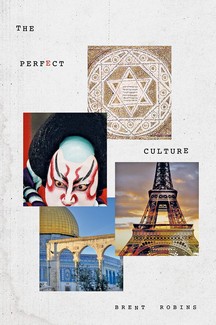
The international trip of a lifetime from a Monty Python perspective. Thomas expands his horizons after college and lives abroad in France, Japan, and Israel.
Thomas Gephardt is a world traveller. Or at least he would like to be one. Determined to leave the confines of his sheltered upbringing in the United States, he voyages to France to expand his horizons. He spends three months with a French family in Bordeaux, working in a local hotel. Inspired by these experiences, Thomas has plans to continue travelling. However, a romantic interest in Paris—an Israeli woman named Sendi—complicates matters. He leaves but remains in contact with Sendi while he lives abroad in Japan as an English teacher and then in Israel as a volunteer on a kibbutz.
Throughout his explorations, Thomas attempts to probe deeply into his experiences and to ponder big questions: What is the value of foreign travel? What is unique about each of these three cultures? How is each country shaped by its history? On the lighter side, Thomas has a variety of experiences—he is seen as a "quasi-alien" in a French restaurant, he wonders if he can meet expectations as a "talking monkey" in Japan, and he is informed that, unlike in The Big Lebowski, he definitely cannot roll on Shabbos in Israel.
Bill Bryson meets J.D. Salinger, The Perfect Culture is full of satirical observations and thoughtful analysis of travel, people, and customs.
Excerpt
[France]
"Everything will not be easily comprehensible from day one here. This may truly be like the real-life version of a French film where the plot is not easily defined, and at times, I get very frustrated from the lack of clear meaning and direction. But some of these vague French films have been ultimately satisfying when I persevered through them. Hopefully this experience will also be that way."
-Chapter Two
Professional Reviews
The Prairies Book Review
Funny and deliciously readable, this charming novel will make the reader wish for a sequel featuring Thomas Gephardt…
Full of wry humor and sharp wit, The Perfect Culture follows the exploits of a young man from rural Indiana who wants to escape his inhibited surroundings and explores different cultures around the world. Overwhelmed with relentless alienation with his surroundings, Thomas Gephardt decides to travel around the world and explores his conflicting urges for intellectual conversations and divine perfection. After he completes school, his travel plans take him to a French city for three months and then to Japan as an English teacher and later on to Israel as a volunteer on a kibbutz. As he becomes accustomed to different cuisines, cultures, and people’s ways of living, he realizes he is born to be a world traveler. Robins draws the reader into Thomas’s fascinating world of humorous observations, whose details are both scrupulous and hilarious. Thomas’s evocations of different cities, his reflective, humorous inner dialogue in the middle of real conversations, and his unique take on people and places make the reading a real delight. Sustaining a matter-of-fact and yet humorous tone, Robins fully engages the reader in Thomas’s travel exploits. Thomas’s observations are a true exploration of different countries and their people and customs, broadened by the book’s energetic pace and vibrant prose. Robins’s atmospheric settings and unique storytelling combined with brisk narrative and vibrant prose make this novel appealing to fans of both general fiction and travel fiction.
Independent Book Review
An entertaining coming-of-age novel that combines self-discovery with the importance of seeing the world
The Perfect Culture by author Brent Robins endeavors to marry the category of the coming-of-age novel with a fictional travel memoir. This book shines a light on the significance of immersing yourself in other cultures and overcoming the cultural faux pas which we inevitably commit when traveling. Robins conveys all of this through humor, empathy, and by using a protagonist who is easy to relate to. Therefore, readers ought to find this one a compelling read.
The novel’s protagonist is Thomas, a college student who turns his back on the debauched side of college life, favoring intellectual stimulus and history. Due to his social alienation at university, which subsequently serves as the impetus for Thomas to inquire about the possibility of working abroad, he is offered a job working at a hotel in Bordeaux. Thus, his adventure begins.
Thomas’s inner thoughts constantly punctuate the story with humor. ”I do not want to disappoint him by being a boorish American and guzzling down my beer and belching extremely loudly.” Unlike his time in university, when Thomas is in Bordeaux, he feels unsophisticated. There’s more to learn.
Robins deserves credit in the creation of his main character. On the one hand, Thomas comes across as haughty because of his arrogance toward certain people whose main objective is to drink themselves into an oblivion. On the other hand, he realizes his lack of cultural knowledge, resulting in a more vulnerable character than we first perceive.
“Foreign travel, generally speaking, is a bit like wearing an uncomfortable pair of shoes. In some places, it is analogous to a slightly uncomfortable pair, and elsewhere, it is equivalent to an extremely uncomfortable pair of shoes that is three sizes too big. Much growth and development can result from these experiences, but I have to be willing to wear the shoes that don’t fit.“ This shoe metaphor is one of many myriad references about Thomas’s adapting to the countries where he travels and the obstacles one experiences when traveling and working in a foreign country. From the ordering of apple juice instead of wine in France to the lack of linguistic competence in Japanese to the eventual political ambivalence he feels in Israel, the reader is fortunately a witness to his mistakes and learning.
Brent Robins provides an assiduous approach to writing about the countries Thomas visits, and although it is insightful and engaging for readers who are interested in the historical context of a place, at times it can read more like a nonfiction book. This is most apparent in the part of the book when Thomas is in Kyoto, Japan. I think Robins’s strength throughout this novel has been his character, and as a reader, I would have liked to have seen more about his friendships in this place, or even the flourishing of a possible love story. However, it can be argued that the author’s intention was to provide his reader with what has been the personal becoming of Thomas.
The Perfect Culture is an enjoyable read all the way down to Robins’s acute and observational writing style. The author creates a relatable protagonist in Thomas who shares both comedic and poignant moments. The novel will encourage young readers to pack a bag and leave the perimeters of their everyday lives, and even for me, as a thirty-something-year-old to take a sabbatical and be Thomas again for a year.
BookTrib
While walking to his French language class in Bordeaux, Thomas Gephardt muses, “We are free to travel down any road that we please in our mind, or any bridge, any ocean.”
This quote expertly sums up the intellectual protagonist of The Perfect Culture (Cicero Publishing, LLC) by Brent Robins. While Thomas journeys far from his hometown in rural Indiana to live in France, Japan and Israel, he also deeply probes each moment with anecdotes and apprehensions. Each page becomes its own journey.
Robins doesn’t have to stretch too far to imagine the onslaught of culture shocks that comes from traveling in a foreign country; he has trekked through over forty. Though The Perfect Culture is his first novel, every faux pas that his main character makes feels straight from life. For example, Thomas, always one for sardonic humor, tries to joke around with his classmates but realizes others cannot understand his English, and that he cannot communicate well in French.
Thomas has always felt on the outside. A first-generation college student in a family not particularly interested in deep learning, Thomas built his whole identity on a sense of alienation. Even at college, Thomas was disappointed to be surrounded by partiers rather than fellow history buffs.
Everything shifts when he finds a job at a hotel in France after graduation. He starts to see that there really are people like him out in the great wide world.
“It’s almost as if I am starting over again as a child here,” Thomas thinks. Even amid all the unfamiliarity and confusion of a new place, Thomas’s unique personality grounds the reader.
One of the most memorable lines is when Thomas is in an airport in Japan. The sound of “hai, dozo” or “next” from the customs officers fill the air, reminding Thomas of a “man’s pulse or heartbeat.” Throughout the novel, Thomas’s knack for metaphor makes the journey all the more immersive and rewarding.
Robins writes in a stream-of-consciousness style, entrenching us in the assumptions of his young narrator. Perhaps that is why it is so fulfilling to see how Thomas matures by meeting people he probably never would have met back home. More than just a novel, The Perfect Culture is a call-to-action: stop being comfortable. The only way to grow is by testing your limits.
From falling for an Israeli woman in France, to searching for porn vending machines in Japan, to working on a farm in Israel, Thomas’s adventure is thrilling and thought-provoking at every turn.
This may be the least expensive world trip that a reader could buy. The Perfect Culture is vivid with the tastes of exotic foods, the nuances of how people interact and the ways in which travel changes a person.
Robins writes as no one else could, and, just like Thomas, the reader will feel like a new person by the end.
Living in different and travel certainly can broaden one's perspective of the world, as I have learned. I have to assume that you have, as the author, actual living experience in the countries you are writing about in this book. Otherwise you are a very good researcher for your fine professional reviews.
I appreciate a book like this that combines coming-of-age, the history of and culture of other countries, at a given time in history. But I will not be reading it because of other obligations. Continue your good work.
At the heart of the eight compelling nonfiction stories and five-article appendix which make up Dreams of the Immortal City Savannah is this interesting question: What would your life mean if you were living someone else's dream of what it should be?