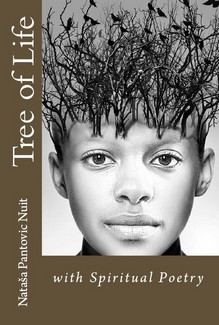
Tree of Life: with Spiritual Poetry, AoL #9 by Nataša Pantović, a metaphysical novel set in Findhorn, the UK, as a Journey into the Field of Dreams that in various religious interpretations, within myths, and as a mystical concept represents the inter-connection of all life on our beautiful planet. The story becomes a true adoption story venturing into Africa, Ethiopia, Kenia, within the magic of four elements, four directions, four stages of Life. Year: 2018, Publisher: Artof4elements. Paperback: 326 pages. Size: 6"x9".
Tree of Life with Spiritual Poetry. A novel by Nataša Pantović set in Findhorn, UK, as a Journey into the Field of Dreams. “I” as an individual know nothing and “we” as “humanity” or “Universe” as an entity know IT ALL. The full application of Yin and Yang Positive Forces will take us to a number of enlightenment-s within many fields of Life. Within Gaia, this amazing breathing ever-changing hermaphrodite environment, that is on Her own perfectly sufficient - Life flourished. Within her ever-changing atmosphere resonance is supreme. We as human beings at all times learn how to live within the Gaia’s environment. Following the laws of Physics, observing Gaia’s ether / environment as energy we observe that It is at all times either positively charged or negatively charged. Within the quantum physic’s logic, these states are randomly distributed within the 50% - 50% ratio. This greatly puzzled our ancestors and Chinese, for example, while researching this phenomenon, building their wisdom system, using both intuitive thought (that is an expression of Yin predominant states of Being within a female brain) and reason (that is an expression of Yang predominant states of Being within a male brain) have created the most amazing Calendars that listen to the heart-beat of Universe. to the Tree of Life that In various religious interpretations, within myths, and as a mystical concept represents the inter-connection of all life on our beautiful planet. The story becomes a true adoption story venturing into Africa, Ethiopia, Kenia, within the magic of four elements, four directions, four stages of Life. Size: 326 pg 6" x 9”
Excerpt
INTRODUCTON
A Tree of Life in various religious interpretations, within myths, and as a mystical concept represents the interconnectedness of all life on our beautiful planet. The Tree of Life connects all forms of creation. The Tree of Life is considered to be the symbol of 'Creator'.
Ancient Beliefs: Mayan World Tree
The Mayan believed heaven to be a wonderful, magical place on Earth hidden by a mystical mountain. They called this place Tamoanchan. Heaven, Earth, and Underworld (Xibalba) were connected by the ‘world tree’. The world tree grew at the locus of creation, all things flowing out from that spot into four directions. These were: East associated with red, North represented by white, West that is black and South that is yellow. The Mayan tree of life is a cross with its center being the point of ‘absolute beginning’, the source of all creation and its branches passing through each of the three layers of existence - underworld, earth, and the sky.
Sumerians and Babylon Tree of Life
The oldest name of Babylon, Tin-tir-ki, meant ‘the place of the tree of life’. To the Babylonians, it was a tree with magical fruit, which could only be picked by the gods. The earlier Sumerian traditions played a major role in Babylonian culture. The early Sumerian art (around 2500 BC) depicts pictures of a pole or a tree called the ‘axis mundi’. Guarding this tree is a snake or a pair of intertwined snakes. Babylonians have the concept of the ‘navel of the world’, the place of the connection of different spheres. This vertical dimension, axis mundi, is the connection between three cosmic spheres: heaven, earth and underworld. The sacred mountain, the temple, the sacred city are all considered to be this Sacred Space, the axis mundi, the connection of the three cosmic dimensions.
Assyrians Tree of Life
Assyrians substituted the tree for the caduceus with coiled snakes circling around the wood of the wand. Here we see a snake symbolizing an underworld consciousness, passing through earth, climbing a stick, transcends to a winged reality, a heavenly creature. Wings on a wand became a symbol of transformation and transcendence.
Egyptian Tree of Life
In Egyptian mythology, the first couple are Isis and Osiris. They have emerged from the acacia tree of Iusaaset, which the Egyptians considered the tree of life. Egyptians considered the Tree of Life to be the tree in which life and death are enclosed. The direction East was associated with the direction of Life, the direction of the rising Sun, and the direction West was seen as the direction of death, of under-world, because Sun sets in the West. Egyptian creation myths refer to a serpent and a primordial egg, which contained a bird of light.
Nordic Ygdrassil
Within the Nordic cultures we also find a Tree of Life called Yggdrasil. It is a massive holy ash tree where Gods assemble daily. the tree provides a magical spring-water of knowledge. An eagle is on the top of the tree and a serpent is coiled around the roots of the tree. The eagle and the snake hate each other.
Chinese Immortality Tree
In Chinese mythology a Taoist story tells us of a peach magical tree that produces a peach every three thousand years. The one who eats the fruit becomes immortal. At the base of the Tree of Life is a dragon, and at the top is a phoenix (a bird). In Chinese cosmology, there are four Dragon Kings (Qin, Kuang, Jun and Xun), each with his own elemental domain.
Kabbalah Tree of Life
The Tree of Life that is in the center of Kabbalah’s symbolism can be studied as a complex formula of existence, the flow of creation from the Divine to Earth and back to the Divine. It is the Tree of Life and Knowledge, a magical key to how life manifests itself. The Tree of Life is comprised of ten sephiroth, with twenty-two paths interconnecting them. The Kabbalah is a magical framework for the Hebrews' mystical thoughts.
The left column is called the Pillar of Severity. It represents the female aspect of creation and contains three sephira: Binah (Understanding), Geburah (Severity) and Hod (Splendor).
The right column is called the Pillar of Mercy. It represents the male aspects of creation and contains three sephira: Chokmah (Wisdom), Chesed (Mercy) and Netzach (Victory).
The middle pillar is called the Pillar of Equilibrium. It represents the balance between the male and female pillars. It contains four sephira: Kether (Crown), Tiphareth (Beauty), Yesod (Foundation) and Malkuth (Kingdom).
The Tree in the Garden of Eden
The tree legend became the Hebrew legend of Garden of Eden. In the center of the Garden of Eden grew the Tree of Life guarded by a snake. The main river flowing from Eden to water the garden spread into four major directions.
Within the Orthodox Church the cross of Christ is also referred to as the Tree of Life. The cross is a symbol of life, the union of heaven and earth, and spirit and matter. It also represents the center, meeting the divine in the human heart. The arms extend into the four directions.
Want to review or comment on this book?
Need a FREE Reader Membership?
Reviews for "Tree of Life: with Spiritual Poetry (AoL Mindfulness #9)"
Also Available as a part of the Ama Dios (9 AoL Consciousness Books Combined). Ama Alchemy of Love also published within the compilation Ama Dios (9 AoL Consciousness Books Combined)
Applying Quantum Physics to manifestation of Consciousness researching Ancient Psychological aspects of Alchemy & Chinese, Greek, Hindu Philosophers, the 9 AoL books: 2 fiction and 7 non-fiction explore Symbols, Mysticism, Arts, and Creativity in both Eastern and Western Ancient Traditions. Developing both Left and Right Brain could be essential for Creative Thinkers of our Future. To purify mind we start with the consciousness that energy follows thoughts and we use Quantum Physics Logic using spiritual exercises Taoism, Christianity, Hinduism, Shamanism to enter Creative Flow.
Size 8,000* pg
Dublin 1941. A brutal murder. Mistaken identity. And barman Eamon Foley is running for his life.
Nine months later Foley is in a crowded pub, and his brother-in-law is shot dead.
Shanghai Escapist grabs the faint-of-heart right from the get-go and serves up an ultimatum: What would you do if caught in the same circumstances? From the opening scene, the reader is tossed into the maze of daily intrigue as it existed in 1960s-70