
Kindle Edition
Amazon
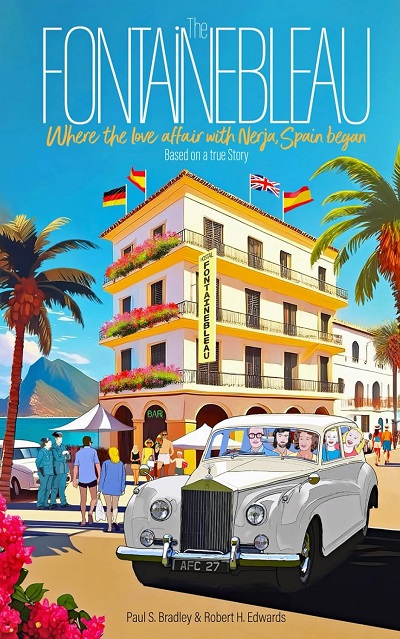
The Fontainebleau
Category:
Travel
Publisher: Paul Bradley
ISBN-10: 8409642425
Type: Non-Fiction
Pages: 320
Copyright: September 16, 2024
ISBN-13: 9788409642427
Price: $5.01 (eBook)
A nostalgic journey back to the 1970s when the love affair with Nerja, Spain, began. Based on the true story of the Edwards family.
In 1972, smooth-talking London bookie Jimmy Edwards was horrified by the daunting prospect of a tax-grabbing Socialist Government. With a pioneering British spirit, he sold up and voted with his feet. Seduced by the balmy climate and low costs, he crammed the family into the Rolls Royce and headed for Spain, still under the iron fist of a Fascist regime. Blissfully ignorant of the politics, linguistically inept, and without relevant experience, they purchased a half-finished hostel from a dodgy developer in the quaint fishing village of Nerja on the eastern Costa del Sol.
The bureaucracy was a nightmare, and rip-off builders were laboriously slow. But Jimmy was smart. He appointed a Spanish lawyer in Málaga who spoke English. What could go wrong?
Unsurprisingly, the project was delayed and then delayed. In 1974, well over a year behind schedule, the Fontainebleau opened and was immediately at loggerheads with oddball ex-pats, eccentric guests, demanding tour operators, and the dreaded Guardia Civil. With family harmony falling apart and bankruptcy looming, their only hope was luck and a gritty determination to succeed.
Excerpt
Introduction
As the nineteen-year-old son of a reasonably well-heeled London bookie, I’d lived a charmed life without lifting many fingers. A beautiful riverside house, plenty of pocket money, an annual cruise, regular holidays, and being driven around in a luxury car might have boosted my ego. But it provided little toward my path through life.
Was I worried? No, Dad had it all worked out.
How could I question his plan or disagree with his opinions on how the world worked when the fruits of his hard work were laid bare before me daily? My route to happiness and personal growth must be to go with the flow.
With the Conservative Party in its death throes, Dad’s suggestion to sell up and move to Nerja, Spain, seemed an ideal solution. Lower taxes and a warm climate sounded far more promising than a cold, grey island crowded with misery. After selling his chain of betting shops and our primary home, we loaded up the Rolls and headed south. With my father’s successful track record in business, how could we fail?
My parents’ principal objective was to retire and enjoy the sunshine. Dad invested in a hostel business to provide an income. He would show my brother and me the ropes before heading off with Mum to sharpen his gardening skills.
I harboured no doubts I would be equally successful as Dad, marry a lovely girl, buy a luxury car, and enjoy a fantastic life in my adopted country. Yet, this transition to the sun-drenched but unknown eastern Costa del Sol was not without perils. A new language and culture presented unforeseen challenges and potentially dangerous misunderstandings. I was naïve to think this wouldn’t matter.
Regardless of my almost comical lack of preparation, circumstances beyond my control were swinging in my favour. What I lacked in business acumen, I made up for in luck, but would this be enough to see me through?
The Spanish miracle that had fuelled rapid annual growth of over six per cent between 1959 and 1974, particularly in the automotive industry, was fading rapidly. The reliance on imported oil had ramped up inflation, but while Franco, the brutal dictator, still lived, the rest of the world viewed Spain as a pariah state. With little to no inward investment, his government would have to look elsewhere for foreign currency or run out of fuel. In this respect, Franco was smart. Tourism had kicked off on the Costa Brava and Marbella in the 1960s. In the 1970s, it was encouraged to expand rapidly. New airlines emerged to transport North European package holidaymakers to hastily expanded airfields in Barcelona, Alicante, Almeria, and Malaga. Mass tourism had arrived. On the coasts, Spain appeared to be booming.
The timing for our venture in Nerja should be perfect.
Shouldn’t it?
CHAPTER 1
HODSON’S CHOICE
Cedric Hodson may have been eight years older than my tender twenty but was neither mentor nor boss. We ran a part-time mobile disco called ‘Narixa’ and performed at private parties, weddings, and rugby clubs across West London. We shared everything on a fifty-fifty basis, but ‘business partners’ was too strong a description for our relationship. It was just something we both loved doing.
Cedric lived in a four-bedroomed pebble-dashed house with three others on a road parallel to Hounslow High Street in West London, near Heathrow Airport. I parked my beloved, but not so new, silver Jaguar 420G in the driveway behind his bright orange BMW 2002 Coupe. I jumped out, rang the Rule Britannia doorbell, and waited for the usual tardy response.
The dark grey sky threatened an imminent early April shower, and the depressing front garden resembled a scrap heap. Wrecked bike frames and a rusting Lambretta scooter with smashed chrome wing mirrors squashed a carpet of rotting weeds interwoven with the remnants of a few daffodils.
“Hi Robert,” said Harry, opening the squeaking door. Harry was a short, ginger-haired man in his mid-twenties. He was dressed in his BEA uniform. All four housemates were pilots working one week off and one week on for the iconic airline. They were never present simultaneously. “Cedric didn’t mention you were coming.”
“He rarely does. We are off to buy some new speakers,” I said. “He's in his room, is he?”
“Er… yes,” said Harry, grinning. “Go on up. He’ll be delighted to see you.”
A trim phone was ringing somewhere, and David Bowie’s Rebel Rebel was blasting on the stereo record player in the lounge. I trotted up the linoleum-covered stairs, wondering why Harry was so effusive when he was usually as quiet as a church mouse. I paused outside Cedric’s door to admire the Narixa advertising poster. The two of us stood behind the sound system, wearing our trademark bright red mock military jackets, surrounded by adoring teenage girls. I knocked and, as always, walked straight in.
The untidy room stank of body odour and sex.
Cedric, a tall, well-muscled, mousy-haired man in his mid-twenties, was under the bed covers, lying back against the headboard. His freckled hairy arm was wrapped around a naked young blond girl, who was snuggling into his manly chest. She glanced up.
“Robert,” she said.
I could have been the cleaner for all her affection toward me. She was, after all, Tracy, who, until this moment, I could have sworn had been my faithful girlfriend for over a year.
“Is this a joke?” I said.
“Ah, er... Robert, sorry, I forgot you were coming,” said Cedric.
“Distracted, were you?” I said, clenching my fists.
“It appears so,” said Cedric, blushing.
“Anything to say, Tracy?” I said, stepping closer to the bed and glowering at both.
“You know how I am with uniforms,” said Tracy. “Especially flyboys.”
“Joysticks, Tracy,” I said. “Have always been your priority. Well, Cedric, thanks for your loyalty, mate. You have shown your true colours at last. After this, we can’t continue working together, but now you owe me. Tell you what. Your choice. Narixa or the girl?”
Cedric glared back and forth between the two of us several times. Tracy gazed at him, ignoring me.
“Tell you what, old boy,” said Cedric, turning and putting his other arm around Tracy. “I’ll take the girl.”
“Er… fine, I’ll pack the gear and leave. Goodbye.”
I walked down the stairs, pulse racing. Harry stood at the bottom, his astonished expression staring up at me.
“Expecting a punch-up, were you?” I asked.
“I was hoping,” said Harry. “The arrogant arsehole deserves it. Little does Tracy know, but she’s the third in three days.”
“Then they are well suited.”
“What will you do?”
“I gave him a choice. The girl or the business,” I said.
“And he took the girl?” said Harry.
“Correct.”
“Mad bastard. Listen, Barbados is calling, and I must leave for work; otherwise, I’d give you a hand with the gear. I’ll leave the door on the latch; help yourself.”
“Thanks, I will.”
“Nice to have known you,” said Harry, shaking hands.
“Likewise,” I said, heading out the door.
Adrenalin surged around my body, causing my hands to shake. Was I angry, disappointed, or hurt? I was certainly confused by this turn of events, even though half of me had been expecting something. My relationship with Tracy had recently cooled. Was it because she and Cedric had been an item for a while? Although finding them together was a shock, I now had a clean field to decide my future without emotional entanglements.
I opened the vehicle doors and, piece by piece, transferred the valuable equipment from the cupboard under the stairs. The well-practised routine didn’t take long. I knew exactly where everything went, so it fitted in and didn’t rattle around.
The main console came in a solid wood cabinet with a removable lid comprising two turntables, a pre-amplifier, and a mixing console with a microphone. A separate external amplifier fed two large meter-high speakers. A sound-on-light, a unit that fed off the pre-amp music signals and transferred them to mobile light boxes, which reverberated off the bass, mid-range, and treble frequencies. A few bubble-light machines to reflect mysterious shadow patterns via a projector onto any wall or ceiling, and lamps for special effects.
I was about fourteen when introduced to the emerging concept of a disco. We were heading to southern Spain and paused overnight in Tossa del Mar. A delightful unspoiled village in north-eastern Spain, where an English couple ran a disco in the basement of a hotel on the beach. The dolly bird wait staff had a white line stitched around the bottom edge of their briefest miniskirts, which, when highlighted in the dark by the ultraviolet bulbs, were mesmerising to a teenage boy seriously distracted by increasing levels of testosterone.
As soon as I had an opportunity, I formed my disco. I met Cedric when performing at a local rugby club, and he expressed interest in joining me in my venture.
Our audiences crossed the spectrum of Britain’s progressively diverse population. Significant events such as the Watergate scandal and the Beatles breaking up rocked the world, while the rise of feminism and environmental awareness provoked a revolution. As music is an expression of the times, our collection reflected these global upheavals with the continued growth of rock, emerging disco, and punk for the youngsters, tempered by old favourites for grandmas at weddings, such as Frank Sinatra and Nat King Cole.
Within a year, Cedric and I had amassed over a thousand singles and dozens of LPs, which we stacked into a custom-made timber cabinet. A removable lid revealed the discs, organised in rows and subdivided into Pop, R&B, Soul, Rock & Roll, and Oldies. The cabinet was heavy and needed two persons to lift it, but pumped up after the bedroom confrontation, I managed to heave it into the back seat alone.
I returned inside for a final check and heard them at it upstairs. Tracy’s orgasmic shrieks reminded me of when it was me pleasuring her. My heart skipped a beat. She’d not been much of a girlfriend, rarely said anything meaningful, and I knew she didn’t love me. Notwithstanding, I was fond of her, had grown accustomed to her kooky foibles, and tolerated her frequent demands for money. I’d given up counting how many hours I’d waited to pay for another pair of shoes. I don’t know why I had been so generous with her. Maybe it was because she reminded me of Spain, where we had met. But why had she gone off me? Was I too tall or skinny, did my full beard tickle her neck, or was my long hair too effeminate? Perhaps Cedric had a bigger wallet?
I gave them two fingers, left their front door open, climbed into the Jag, and pondered the future while departing Hounslow forever. Then the heavens opened. I selected a cassette from my favourites in the glove compartment and inserted it into the player. I set the volume to max and sang along to; I Can’t Stand the Rain by Ann Peebles at the top of my discordant voice. Breakup and lousy weather were appropriate themes for the mood, I thought as I put the car into gear.
I drove aimlessly westward, needing a diversion to rid my mind of its churning confusion. My ego was bruised, and my confidence dented. Sunbury should do it.
The windscreen wipers struggled to cope with the volume of water, and I could only just see where I was going. I turned onto Lower Sunbury Road, parked outside Dad’s old garage, grabbed a telescopic brolly from the door well, and sprinted over the road, fumbling with the catch. As the rain thundered on the brolly, I headed onto the footbridge, joining the north bank with Sunbury Court Island, one of the few habitable islands on the Thames. I paused in the middle, leaned on the railing, and gazed at the old wooden boarded family house halfway along the shoreline. Our beautiful Italian speed boat bought at the Boat Show in London, with the winnings of a ‘Yankee’ horse race bet Dad had placed, was still moored to the jetty, but the once bright red tarpaulin was now a dirty brown.
I lit a cigarette and let my mind wander back to when we lived here only two years ago. The chaos prompted by the oil crisis changed our world forever. With petrol now over 200 per cent higher, inflation rampant, and the UK reeling after three-day weeks, it was hardly surprising that the tax-grabbing Labour Government took office in the March elections.
My parents had seen this coming, sold up, and taken a massive gamble with a hare-brained scheme to buy a half-finished hostel in Nerja on the eastern Costa del Sol in Spain. For some completely unfathomable reason, my father preferred the thought of life under a brutal dictator against that of an inept bunch of socialists determined to bankrupt the country.
“At least we’ll be warm when the lights go out,” he said on more than one occasion to justify it to us.
My two elder sisters, Gloria and Diana, had chosen to remain in the UK with their husbands and kids, but the rest of us had elected to go to Spain. My difficult elder brother Jim wanted to stay, but he deferred to his wife Jen and two children, Samantha and Jim Junior, who couldn’t wait. It sounded like an adventure in paradise, and I was as excited as the kids. A few months later, with everything sold, we jumped into Dad’s Rolls Royce and headed for the sun with great expectations.
It was a disaster.
The hostel was nowhere near finished.
The builder’s excuses were generally plausible but always accompanied by another invoice for extras we had assumed were included. We soon learned our English-speaking lawyer was a complete tosspot and the meaning of mañana.
While we waited and waited for the next pathetic excuse and drain on our resources, life in our spacious, supposedly temporary apartment became strained. However, as the months ticked by, another problem raised its ugly head – money.
Lack of work permits banned us from working at anything other than the hostel. With no income, we quickly became strapped for cash. Dad clamped down on the usual free-flowing money supply to which we had become accustomed. We had to content ourselves with life on the beach without sunbeds and sangria, and I had to stretch out a single beer the whole night. Living in such close quarters with my brother and his family became intolerable. An invisible line was drawn between the fridge’s contents to distinguish our food from theirs.
Inevitably, it brought out the worst in both of us, causing screaming arguments and the kids running off and crying to their bedroom to escape the bad-tempered atmosphere.
Our rented apartment was on the edge of town in the La Torna building located on the corner of Calle El Barrio and the early makings of Castilla Perez. There was plenty of room, but a football field wouldn’t have provided enough distance between us to deter our mutual misery. Our life had always been comfortable and under control, but now I could see my parents' strain as the endless hotel extras somehow had to be paid for. I could only respect their resilience, but we could do nothing to help them. Notwithstanding, somehow, we never reached the stage where we mentioned packing it in.
My only light relief from this domestic cauldron was the actress Yootha Joyce. She had an apartment in the same building to escape shooting episodes of the British TV Series Man About the House. She enjoyed a tipple or two of brandy but was always friendly and usually departed with a slurred pithy remark and half a wave.
Then Tracy arrived.
She was with her parents. I bumped into her in the lobby, and our first exchange was almost one of relief. Someone of the same generation and linguistic persuasion was nearby to relieve the monotony of constant parental supervision. I failed to notice then, but her parents must have been pleased she was off their hands. We quickly became an ‘item’ and spent hours walking along the beach, swimming, and the occasional pedalo ride. She tanned quickly and attracted admiring glances with her long blond hair, shapely curves, and tiny bikini. It felt good having her around, even more so when she invited me to her room one evening when her parents were out.
She was willing and enthusiastic. I was in Heaven and soon became a dab hand at negotiating the exterior balcony railings up to her room two floors above. Thankfully, after a day on the Fundador brandy, Yootha remained oblivious and snored loudly as I scrambled past her open window in my best Edmund Hillary fashion.
Life was infinitely more bearable with Tracy as a distraction from the never-ending hostel-building saga, but I could see my parents’ confidence draining daily. Failure was something they had never experienced and were ill-equipped mentally to deal with, but they soldiered on. When Tracy’s parents announced they were driving their American station wagon back to the UK the following week, I saw my chance at escape and asked to go with them.
My parent's attempt to dissuade me was half-hearted. I didn’t mind; I was going anyway. Not just to be with Tracy but to free my parents from fraternal tension and be one less mouth to feed.
The journey back was fun but cramped. Tracey’s parents were also on a budget, so the four of us slept together in the car by extending the rear bench seat into a makeshift bed for our overnight stops. Lying next to Tracy was, at times, embarrassing. Finally, we arrived back in the UK. Readjusting to the cold and grey in a tiny bedsit in Staines in one of my father’s rental properties was when reality hit me. After the sunshine, it was depressing.
I worked in one of Dad’s old betting shops but soon had the idea for my discotheque and, within months, was making ends meet.
A particularly heavy burst of rain shook me back to reality.
This spot on the bridge used to be my therapist, a haven well away from Jim’s snide remarks and insults, where I could chew over life’s mysteries. It still was. The muddy water swirling downstream was calming, and when a piece of driftwood floated by, I wondered, like me, where it might end up. The treatment was working. My mind ceased its turmoil over Tracy, and clarity returned.
Ducks and swans glided regally among the reeds, the rain not bothering them at all; a water rat scuttled down the bank and disappeared into the greenery. As my short tenure on the island flashed before me – I recalled the exhilaration when returning home from boarding school. Picnics on the lawn, racing up and down the inlet in the boat, and the sadness when returning for another term in that awful place supposed to provide the best education money could buy. Some academic nerdy types thrived there, but not me; I was more the practical type. Nobody seemed surprised when I was asked to leave. I was sixteen, and an incident involving strategically placed spuds was the cause. The exhaust pipe of our Housemaster’s Hillman Hunter had proved irresistible to my friend Chris and me as revenge for detentions received for minor misdemeanours. I was allowed back to take exams and scraped through a few measly ‘O-Level GCE’ passes. Life would have to be my university.
Thoughts came to mind about Alison, my first girlfriend. I could see her pretty face hovering over the river. She seemed so realistic that I almost reached out to touch her soft blond hair and could sense her inexperienced, tender lips on mine. During my early teens, we’d met on successive annual family Mediterranean cruises and exchanged letters for several years, but regretfully, we had lost touch. Her memory stirred something within me, a thirst for family and warmer climes.
A sudden gust almost blew me over, exposing me to the storm. I was soaked to the skin within seconds but was more concerned about my tan-brown leather jacket. In the blink of an eye, it had transformed from a stylish fashion statement into a soggy rag.
“Enough,” I shouted to nobody but the inclemency. “Spain, here I come.”
I shook my head to clear the raindrops streaming down my face, flicked the damp cigarette butt into the water, watched it float away, and headed for my bedsit.
On the way, I reasoned it best to inquire if the hostel was ready and if I’d be welcome. Back home, I emptied my piggy bank, inserted most of its contents in the payphone Dad so generously installed in the hall, and dialled the number Mum had sent in their last letter. There was some noise on the line as the phone connected, and then, after what seemed an eternity, the ringing tone.
“The Fontainebleau,” said a distant crackling voice.
“Mum?” I said after pressing button A and listening to my only savings disappear forever. I pictured her standing in the hostel lobby, the phone jammed against her ear.
“Robert, how lovely to hear your voice. Where are you?”
“At home in Staines grappling with ten pence coins, I’ll keep it brief. Have you opened yet?”
“Our first busload of package holidaymakers from Wings Tours arrived yesterday.”
“How is it going?” I asked.
“Hectic, we completely underestimated how many staff we needed. Why? Are you offering to help?”
“It’s why I’m phoning. I’ve had enough here. How about me coming down like now?”
“That would be something. Is there anything wrong?”
“No, but I’ll explain when I see you. I’ll be there in a couple of days, ok?”
As the beeps announced more coins were required, we said our goodbyes.
|