Kindle Edition
Download to your Nook (eBook)
Amazon
Florence Weinberg
Category:
Action/Thriller
Publisher: Twilight Times Book
ISBN-10: 1933353465
Type: Fiction
Pages: 259
Copyright: Nov. 2008
ISBN-13: 9781933353463
Price: $16.95 (eBook)
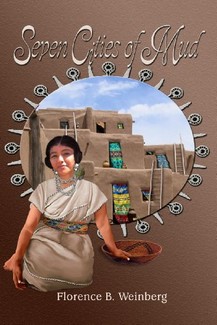
1581: 3 Franciscans and 9 soldiers set out to evangelize the Pueblo Indians of the Rio Grande, but the soldiers make prisoners of the priests and begin a gold hunt--with tragic consequences.
Two radically different cultures, 16th-century Spanish and ancient Pueblo Indian, collide. Franciscan Fray Agustín Rodriguez leads an expedition to evangelize the Pueblo Indians of the Río Grande. The group totals thirty-one people: three Franciscans, nine soldiers and nineteen servants. The Franciscans persuade Poli, a widowed Pueblo woman, to be their guide. She consents in order to escape a forced marriage to a warrior she suspects of having murdered her husband. The soldiers mutiny, taking charge and making prisoners of the Franciscans. The expedition becomes a gold and silver hunt. Conflicts and passions explode: love and faith oppose anger, brutality, hatred, lust, greed and ambition, with tragic consequences
Excerpt
Chapter Excerpt
Seven Cities of Mud
historical novel
Florence Byham Weinberg
Chapter One
Poli's shadow was the only thing that moved in the vast surrounding desert. Sun god Taiowa beat down almost overhead, shrinking the shadow-self from a slender trailing silhouette to a squat pool of darkness, the distorted image of a pueblo woman bearing a basket on her head. A second shadow swooped across the desert, then another, swift and fleeting. She lowered the basket of herbs to watch. Buzzards circled above, blots on the sapphire vault of sky, riding updrafts and gliding on the breeze. Something dead must be close by, but who or where was of no concern. Not newly dead. Older dead had surely found their places in the Spirit World. She replaced the basket and trudged on, climbing the mountain slope.
The trail wound upward along the steep cliff-side and narrowed to a ledge with a sheer drop from the outer rim. She faced the abyss, sidling around a blind corner, still balancing the basket. The ledge widened one step beyond the corner. Not three paces away lay the dead thing--a deer carcass--its carrion stench permeating the air. But a flash from amber eyes and bared white fangs warned that another had found it already. The circling buzzards would have to wait their turn. The fangs belonged to Iisaw, Brother or maybe Sister Coyote. One side of Coyote's shiny black lip quivered in time with a throaty rumble. Its forepaw claimed ownership, pressed into the hump of dun-colored fur. The deer must be four days dead, buzzing with flies, its head at a crazy angle, the belly gaping and seething with maggots. Perhaps it had been hunted and driven over the granite cliff that loomed above.
Iisaw was a mother coyote with low-hanging dugs who'd followed the scent, needing food for herself and the pups. Now, fearing the prize was about to be stolen, she was poised to spring, fur bristling down her spine and hindquarters trembling in readiness.
Without moving her head, Poli glanced to the rim of the ledge. It would be death to jump twice the height of a tall pine tree to the rocky wash below. A backward step might tell Iisaw the threat was retreating, needing only a leap and a slashing bite to hasten the withdrawal. A step forward would be worse.
In that frozen moment, her quick breathing rasped in rhythm with rapid shocks deep within, fist blows from that being that lived in there, the one the Ancestors once tore from a captured enemy's chest. Back then, it was sacrificed to Taiowa to keep the world in balance. But a sudden idea broke the paralysis and gave her courage. The song! The tribe's chant about the race between Coyote and Swallow was a part of childhood lore, something Mother Coyote would surely understand.
She sang in a voice that quavered at first, but soon steadied.
Coyote-Boy and Swallow-Boy
Wish to mate with Beauty-Girl,
Willow-grace, butterfly wing.
To one she turns: Coyote-Boy;
Swallow-Boy goes weeping.
For her they race, death to loser.
Coyote-Boy, triumphant,
Kills Swallow-Boy.
Swallow Clan in exile now,
Calls its home Puaray.
"You see, Mother Coyote, how your grandfather's grandfather won the race. Now let me pass in peace. I am only of the Swallow Clan and I live in Puaray Pueblo."
The song worked its magic. Growling at first, Iisaw cocked her head and sat back. Fur along the spine was now lying flat, though one forepaw was still on the carcass. It was time to inch forward, keeping as close to the outer edge of the trail as possible. Mother Coyote rumbled another prolonged growl, but remained sitting, following every slow movement, watching each step until the trail wound behind an outcrop of the cliff. The nursing mother would now turn back to the meal, and the supposed thief could go in peace.
Pusivi was the goal of this pilgrimage, the sacred cave up the mountain, only four bowshots further. Youths from the pueblo, after extensive purification ceremonies, went there to keep vigil and fast, hoping for a vision to reveal their life's direction. It was time to meditate there about her own future. Should she marry Mákta? The tribe said yes, but misgivings held her back.
She'd always followed a special life-path, even as a small child, toddling after Grandmother on herb-hunting excursions. How vivid were those memories! The wind had loosened wisps of the old woman's white hair, and her wizened, leathery face glowed with delight when she found yet another rare plant. The recollection brought a tiny smile. Some of those forays lasted all day, and sometimes she and Grandma would stay out overnight. Was it possible that five winters had passed since Grandmother had gone to the Spirit World?
The old woman had taken the place of her own mother, who'd died in childbirth, and a father who'd disappeared no one knew where. Collecting plants was now second nature, thanks to Grandmother, and she was now the one who supplied the tribe with herbs rather than grinding corn or cooking, plastering and repairing the pueblo, the tasks that kept the other women busy. The joy of discovering new plants and their uses was hers as it had once been Grandmother's.
The community, a second family, accepted her contribution. Often enough she gave them something exotic to flavor the squash, beans and corn the men cultivated. Men didn't search for plants and herbs for medicines. Instead, they hunted animals to feed the tribe. Their other jobs were cultivating the crops and weaving.
The shadowed mouth of the cave offered a cool contrast to the mid-day heat. She first lowered her basket and swirled the shawl from her shoulders, spreading it on the cave's stone floor--the shawl her beloved Hótewa had woven, Hótewa, now gone forever--then squatted at the entrance and took inventory of the plants. Those useful for medicines would be dried and stored and the rest shared with the women, to be used in cooking. The piñon pine nuts would be roasted on the embers and shared later. There were never enough of those to go around.
Then, cross-legged, she sat facing outward, hands folded in her lap and eyes closed against the glare, relaxing every muscle and waiting for the tumbling thoughts to cease. But her mental reflecting pool remained troubled; nothing formed there.
Stillness would not come.
Mother Coyote and the dead deer were not back there on the trail after all. They were present in her mind, plucking at her along with the story of Coyote-Boy who killed Swallow-Boy. Why could she think of nothing else? Of course! The Swallow-Boy of the song was Hótewa.
What is that sound? I hear keening; someone is dead. I see five hunters, chanting funeral songs, carrying a man's broken body into the plaza and laying him out for all to see before taking him into his kiva. I hurry toward the plaza, carrying the plants I've found, but Lénmana, Flute-maiden, my best friend, grabs my shoulders.
"No! Don't go over there!"
I ask her why, but then the crowd parts and I see a twisted, blackish form on the sand. Is it… can it be… Hótewa? Almighty Taiowa, NO! I'm afraid to look, and yet I must. I tear myself from my friend's arms and run toward that misshapen form. My beloved Hótewa, my husband! His body is gashed and bruised, his face distorted. Blood, so much blood--dried and blackened--trailing from nose and mouth, from gashes on his body, from arms and legs lying all wrong. I can't speak, can't breathe.
The others back away and let me grieve. Someone is wailing somewhere far away, a pitiful, lonely sound. I realize it is me. It's ME! As I thrust a fist into my mouth, a hand grasps my shoulder. It is Mákta!
"We were chasing a deer. He came too close to the cliff and slipped. We ran to the edge, but he was already down there, all broken up. It took us hours to climb down to him, then to get him off the mountain. I grieve with you, Poli."
She'd had time enough to sit and think since the funeral, to accept her loss. Hótewa had first come to her when she was ten and he a year older. He was a graceful, straight-backed boy, harmonious in every way. "When I'm a man," he said, "I'll marry you." She'd agreed, and he'd grown into someone beautiful, not too tall, retaining that grace and those perfect proportions.
Mákta was handsome, too, but she'd never trusted him. Not since the day when--they couldn't have been more than eight at the time--she'd come upon him out in the wild lands. She'd climbed a boulder, unnoticed, and saw him pounding something with a rock, muttering over and over "Kill! Kill!" His victim was a harmless horned toad whose blood splattered the rock outcropping. Fearful, she ran all the way home, afraid he'd pound her the same way if he could catch her.
She'd remained watchful ever since, and now… now?… Her thoughts returned to her beloved.
True to your word, you came to me the very day you were initiated into your kiva, Hótewa, dressed with great care. Your woven shirt was dark blue, you wore a clean loincloth and new deerskin leggings. Your shining black hair was knotted behind your head and tied with yarn dyed red with sumac berries. Yes, and you'd tied blue-green yarn around your wrists and just below your knees. Your clan brothers had painted reddish ocher stripes from the bridge of your nose to your cheeks, so perfect, two each side. You were beautiful.
You surprised me by climbing my ladder and catching me squatting there, sorting my plants, and I stood to greet you. That's when I saw Mákta, two levels down, staring up. He was scowling, and turned away as soon as I saw him. You didn't know. You were smiling in your usual slow manner, intent on what you'd come to say.
"I've come to marry you, Poli, as I told you so long ago. You are beautiful, as lovely as the butterfly that is your namesake. May I come in?"
Your words made me smile in return, for you were the beautiful one, not me.
I hadn't thought about marriage much, but you changed all that, Hótewa. I knew then that Taiowa, the Creator, had foreordained it. My part was laid out before me by our customs and my own preference, as plain as the main trail along the river. I welcomed you into my home and you sat watching me make something delicious to eat, just for you. It was my special pudding, with ground roasted piñon nuts and chaparral berries mixed with finely ground white cornmeal and a bit of water. Oh, yes, and honey from the small pot, and a little salt to brighten the flavors. You watched me the whole time, watched me make a fire, watched me mix batter for the thinnest, finest blue corn tortillas and then toast them on smooth, hot rocks until they were crisp.
I served it all to you in my best bowl, happy when you nodded your approval. Then I led you to my bedchamber where I spread my best blanket. We mated that night, planned for our children and pledged our love forever.
That had been seven days before the hunting trip.
How sweet the memories of that special day and the few that followed. The pueblo began the formal marriage ceremony the next day and two days thereafter, with the chief medicine man of her clan presiding. Their house was to be the one her grandmother left her, furnished with wedding gifts.
They sat on a bench where the whole pueblo could bear witness. Her aunt, who was her nearest relative, stood at her side in place of her mother. Hótewa's father stood by him, while the elder of her clan spoke. He blessed them in the name of Taiowa and the Corn Mother, then listed their duties: to love and protect each other, to provide for one another, to care for each other in sickness, to take joy in their youth and health and to produce many children. After each promise, they embraced to seal the vow before Taiowa and the Corn Mother. Then the heads of the other clans brought them fine blankets as wedding gifts.
Hótewa wrapped her in one of the gift blankets and she chose the most beautiful one to wrap around him. The elder told them what they could expect from life together and recited their duties to the pueblo. Then the ritual gifts were brought forward. Hers were the metate and mano, grindstone and grinder used for corn, then an olla, a big one to hold much water. A comal--a flat clay dish like a platter--and several drinking vessels joined the others. She promised to cook and provide for her beloved husband and their future family.
For Hótewa, they brought weapons for hunting and protecting his home--bow, spear, war club and shield. Then came the tools he would need at all times. First a pouch, or cacoxte, for carrying heavy loads on his back, with its mecapal, a leather band to bind around his forehead. He was given a new hoe for cultivating the garden, where abundant produce would provide for Poli and for their children. Then the dances began, continuing far into each night until the ritual was completed. That was four days before the hunting trip. Just four days.
Time slipped past her in a gray blur after the accident. The world and its concerns meant nothing without Hótewa. Three moons had waxed and waned when Mákta came to her, just as Hótewa had done. Mákta's shirt was not midnight blue, but the color of dark smoke.
"I've come to mate with you, Poli. You have no one left but me."
"You come too soon. My mind and my heart are still filled with Hótewa."
"Hótewa? He was careless, unworthy of you, Poli." He clutched his loincloth. "My kwasi will fill your löwa better than his did. I know; we grew up together. And then your mind and heart also will be filled… with Mákta."
She'd turned her face away. "Go, Mákta. Now is not the time. I cannot receive you." She'd had the last word, but he'd been haunting her anyway. Unless she went far from Puaray as she'd done today, he was always somewhere in sight. At least he'd left her to her grief for three more moons without approaching her again.
She opened her eyes, blinking at the light from the cave opening. The sun was sinking fast. She must hurry to be off the mountain before nightfall, but wait… she'd just had a thought, brief, like a distant lightning flash. What was it? Her forehead creased, then cleared. Ah! At last! Why hadn't she seen the obvious parallel? It took a mountain Kachina from the Spirit World to lead her toward understanding. The deity must be here, in this mountain cave, helping her.
My chosen one, my most beloved husband, Hótewa, as straight and beautiful as the finished arrow for which he was named, died just like the deer. He fell over a cliff on this same mountain. And Mákta, whose name means Claw, came to me at night three moons ago, to mate with me. The claw is cruel and sharp, not straight and beautiful. Perhaps Mákta, like Coyote, is a trickster. He was out hunting with Hótewa that day. Did Hótewa trip and fall, or?…
|