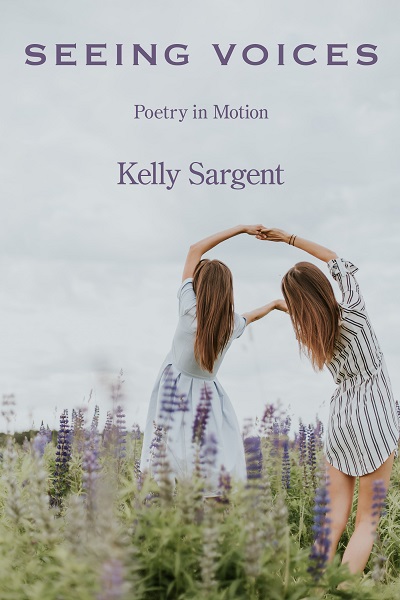
A poetry chapbook includes reflections on
twinhood, deafness, and “the mirrors through
which we see, lose, and find ourselves again.”
Kelly Sargent’s memoir in verse is a story of love shared between hearing impaired twin sisters and the loss felt when they separate as preteens. They are abandoned at birth in Luxembourg and adopted by a military couple. The responsibility Sargent feels for her smaller twin, born deaf, fuels her to take on the roles of sign language interpreter and teacher as they travel the world. When her twin later enrolls in a residential school for the Deaf, Sargent experiences her twin’s daily absence as a profound loss. She then begins a search for her own identity and place in a world without a mirror.
Also available in Kindle format.
Links to several book reviews of Seeing Voices: Poetry in Motion appear here:
https://kelsaybooks.com/products/seeing-voices-poetry-in-motion
Professional Reviews
Wordgathering Journal Review
Reviewed by Kate Champlin
Each of Sargent’s poems is dotted with facts of daily life for Deaf and Hard of Hearing individuals. These include speech teaching, the need to choose between conversation and holding swing chains or utensils, and linguistic separation from most of the family. The poems suggest that Sargent and her sister were the only members of the family who became fluent in a signed language. (Since the sisters grew up in both Europe and the United States, this language may not have been ASL.) As I read the poems, I was struck by how rarely I see disabled experience centered in literature or art. These poems were a rare treat.
Nevertheless, Sargent’s poems will become best known for their vivid imagery and for the emotion that they evoke. The most emotionally-intensive passages are those that speak about the author’s twin sister from whom the author was long separated. Verses about this separation make the longing almost visceral:
“Sometimes,
I slip away to my mirror in the bedroom
to see her nut-brown eyes gazing back at me.
I press my palm against the cool glass,
just to touch her hand again.”
Sargent uses the same evocative imagery to convey the experience of being close to someone who does not use the majority culture’s dominant (spoken) language. It is unfortunately common for Deaf children to feel cut off from hearing family members who never learn their child’s language. The final stanza of “Her Voice” uniquely captures Renée Nicole’s experiences and the author’s identification with her twin:
“The ten tiny fingers she must have clenched
that would one day be
her voice
differed eloquently from the vibrations in her throat
that assuredly joined in chorus with mine
to fill that stuffy, damp and narrow room.”
“Her Voice” challenges the idea of a normal body and the link that mainstream cultures tend to draw between disability and inferior embodiment. Here, Sargent notes that her parents considered signed languages foreign because:
“they had four ears that weren’t broken,
or because
they had four ears
that were broken.”
While questioning which bodies should be labelled broken and which should not, Sargent adds:
“I have one [ear] broken and one not,
but I didn’t know which one was which
until 23 minutes ago
when I considered it.”
Sargent never tells us whether her deaf or her hearing ear is the one that is healthy or “right.” Instead, after reversing traditional hierarchies of embodied experience, Sargent dismisses the entire subject as irrelevant, moving immediately to another stanza about her sister’s birth and future. In short, Sargent both reverses traditional notions of disability as damage and turns them into nonsense, a move that encourages readers to imagine a world entirely without ableism.
These poems question ableism, wow readers with stunning imagery, and place emotion at the center of personal experience.
Highland Park Poetry Review
Reviewed by Lynne Viti
It’s well known that from early childhood, many twins invent and share a private language. In Seeing Voices: Poetry in Motion, Kelly Sargent goes one better, painting a portrait of identical twins who must learn to accommodate the challenge of one twin’s profound deafness. The hearing (though admittedly hard of hearing, as she’s deaf in one ear) twin communicates with her sister using sign language and private gestures, born of necessity and inspired by both twins; inherent creativity when it comes to language in many forms.
Sargent’s suite of poems draws heavily on autobiographical source material—a deaf sister who could silence the hearing one merely by closing her eyes, so as to shut out the hearing twin’s attempt to argue via sign language—
“My twin sister used to shut her eyes
To shut me up when we argued.
Born deaf, she held the advantage in any girlhood fight.”
The irony here is clear—the “disadvantaged” twin seizes the advantage, besting her hearing sister.
Sargent and her identical twin were born prematurely in Luxembourg; one, three pounds at birth, was born profoundly deaf. Both babies were soon surrendered for adoption to an American couple. For the first few years of their lives, as evidenced by the poems “The Mushroom Caves in Madrid” and “Devouring Grace,” the family lived in Spain; these two poems recount the childhood exploration of mushroom caves in Madrid, and the Chinese restaurant in that city their parents took them to, near where a Little Bear statues in a fountain “waved his immobile paw to my twin and me…”
Even as a young child, the hearing twin—the speaker in all but one of these poems—attempts to teach her deaf sister to pronounce the words she can so far only spell out in sign language—“blue-ber-ry, ba-nan-a.” We observe the hearing twin holding her sister’s small hand to guide her: “I wrap your tiny hand around my throat…for you to feel the sounds vibrating within.”
Other poems shift the tone to mystery—the leitmotif of the poet-twin seeing in the mirror her own image which is simultaneously the image of her deaf identical twin:
“She crosses
Intuitively between night and day
With starved, skinny, bird-like arms…”
Then suddenly, this grotesque creature is brushed aside by a more comforting memory: “We blink away Night…we toast to Midnight.”
Sargent’s language is imagistic, highly visual, blending snapshots of the natural world of beaches and sunsets with the mysteries of the twin’s private one: “…we were/wrapped securely in a vast, uninterrupted galaxy…”
Throughout the collection, Sargent sets up vivid scenes of the past, then quickly brings readers into the present, when the speaker frames these accounts of her and her sister as children as memory: “A mourning dove coos/pausing/to remember.” Here, the cooing dove harnesses sound just as the speaker harnesses a voice that is unavailable to her twin in the same way.
Sargent deftly captures the experience of a child—now an adult—who is intimately entangled with her deaf sibling, the almost-self who remains apart from the hearing world. In the book’s penultimate poem, Sargent assumes the persona of her sister, aiming to describe for us, her readers, how the deaf person perceives the spoken word through sign language:
“Fingertips pave slick exclamations,
punctuated by nails sinking low into clamminess
I sculpt hyperboles.”
Kelly Sargent does more than deploy poetry to invite readers into the world of sisters who must overcome a language barrier posed by deafness. She demonstrates that sign language is only part of their mutual solution—the real magic lies in their invented language of touch, their mutual respect, and their sisterly love.
In the Whirlwind is a poetic storm that frees history from the cages of corruption and puts it in the hands of everyday people. Words are weaved into a new fashion statement that has nothing to do with runways but everything to do with projects!