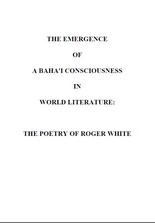
This 400 page book examines the life and writing of Roger White, a Canadian who joined the Baha'i Faith in 1947. he died in 1993 and wrote some of the finest poetry of his generation.
(i)
THE EMERGENCE OF A BAHA'I CONSCIOUSNESS IN WORLD LITERATURE: THE POETRY OF ROGER WHITE
Geoffrey Nash, in a review of Roger White's poetry in 1982, wrote that White heralded "the development of Baha'i consciousness in world literature." Literature, poetry and prose, letters and other genres, have been arriving on the world's literary stage from the pens of Baha'is for more than a century and a half. White certainly has been, in Nash's words, a herald. White's work emerged from obscurity at the same time as the Baha'i Faith was rising from an obscurity in which it had existed for nearly a century and a half. The Revolution in Iran in 1979 marked a significant point aloing the road of that emergence. It is more than coincidental that White's first major book of poetry Another Song Another Season was published that same year. There is now a burgeoning literature on the Baha'i Faith provided by individual Baha'is the world over in the two decades since Nash wrote what have become prophetic words. White has, indeed, become a herald. Though I'm sure he did not set out to become the brilliant initiator that he has been.
There are others I could focus on to describe this 'development of a Baha'i consciousness in world literature': Robert Hayden, Bahiyyah Nakjava ni, H.M. Balyuzi, M. Momen, Adib Taherzedeh, John and William Hatcher, among others, whose books, each in their own way, played their unique parts, in the 1960s, 1970s and 1980s, in laying this foundation of consciousness. To pick one example: in April 1966 Robert Hayden was awarded "the Grand Prix" at the Third World Festival of Negro Arts for "the best" recent volume of Anglophone poetry. This was without doubt a milestone in the emergence of a Baha'i consciousness in world literature. I could cite other events along the road of this emergence, but my purpose here is to focus on the poetry of Roger White. The focus is timely since he passed away ten years to the month that Juxta Publications in Hong Kong placed this e-book on their website.
The efforts of poets and critics to come to terms with the legacy of a post-traditional poetry that had begun as early as the second decade of the twentieth century with Ezra Pound and T.S. Eliot, especially its disturbing mixture of poetic innovation and reactionary politics, its vast international influence and intense Eurocentrism amounted to a kind of collective anxiety attack and this anxiety was reflected in post-war II poetry right up to the seventies. By the 1990s, by the time White died though, it had become clear that these sometimes embarrassing ancestors who appeared about the time 'Abdu'l-Baha went on His western tour, had laid the foundation for a post-traditional poetry. That new poetry had been growing by the time of White's first major publication in 1979 for at least six decades. Brian Conniff describes its last phase in the 1980s in the African American Review. This poetry, he writes, is "more explicitly heterogenous and more international, both in its sources and its influence, in such works as Adrienne Rich's Your Native Land, Your Life(1986), Seamus Heaney's Station Island (1983), and Derek Walcott's Omeros (1990)."
Conniff continues: "Considered more broadly, a distinctly post-traditional stance has become increasingly apparent in the linguistic heterogeneity of contemporary Irish poets like Nualani Dhomhnaill and Medbh McGuckian, in the communal heritage evident in the prison poetry and autobiographical writing of Jimmy Santiago Baca, and in the remarkable emergence of contemporary poetry by American Indians. For these later poets, any approximation of a tradition - any communal or even personal heritage - is conceived pragmatically, as one instrument among many others with which they can engage a world that is at once overwhelmingly various and desperately in need." And I would add the poetry of Roger White here and his three books of poetry written from 1979 to 1984. Much of White's poetry has a very traditional style and tenor, although its content is for the international stage. White gives his readers what Arthur Koestler said was crucial for modern men and women: truths which were perennial without being archaic. He also gives his readers the global Baha'i community, its history and its teachings. His is both a very traditional and an international poetic mix.
As a fellow poet I am only too conscious of the remarks of Charles Martindale in his introduction to the Roman poet Ovid that "artists, for all their intuitive insights, are often both idiosyncratic and egocentric when responding to the work of others." Martindale notes "the comparative poverty" of the critical tradition of Ovid." The afterlife of a great poet, the artistic responses of the generations that follow a writer, shows how even the finest writers can fail to be understood and appreciated. This first generation following the death of Roger White and the industry of critical reflection that it creates has yet to establish any pattern. I trust this book will initiate a pattern of enthusiastic appreciation.
I think the period 1979 to 1984 was especially significant in bringing about a transformation in the literature available to Baha'is on their Faith. White published three books of poetry and a novella which I deal with in essays later in this book. Nakjava ni published two books: Response and Four On An Island in a refreshing and highly stimulating idiom that was as much poetry as prose and, like White, left many readers puzzled. Others found her writing possessed of a vitality and originality that, as Henry Moore once put it, were uniquely her own. It was also a style of writing that was inspired by that same universal vision that inhabited White's poetry and that, I am confident, will take on additional significance as time goes on. And there were other books. But this series of essays deals with the poetry of Roger White. I leave it to other writers and critics to deal more comprehensively with the other authors who have been part of this emergence beginning, say, with the first teaching Plan(1937-1944) when, arguably, this Baha'i consciousness made its earliest appearances in world literature and the Faith itself begin to expand over the surface of the earth to become the second most widespread religion on the planet.
The course of development of the prose, the language, the thought--and especially the poetry--of a group of people: a nation, an ethnic group, a religion, indeed any group with a specific identity, a specific set of characteristics is, as the nineteenth century literary critic Matthew Arnold wrote, "profoundly interesting." "By regarding a poet's work as a stage," he continued, "in this course of development we may easily bring ourselves to make it of more importance as poetry than it really is." Perhaps I am guilty of this literary sin in what I admit to be, again in Arnold's words, my quite exaggerated praise, my arguable overrating of White's work. What may be the long term historical estimate of White's work and what is the intrinsic estimate of his work to a contemporary individual--and particularly this critic-are not necessarily identical.
The internationalization of literature, its global orientation, its planetization, its planetary consciousness, the perception of literature as part of the essential fabric of a global civilization or culture has really only emerged in the last quarter of the twentieth century. Goethe, at the turn of the nineteenth century, was the first great thinker to suggest that the literature of the future would be a world literature with a planetary consciousness. A. Alvarez remarks, in analysing modernism in literature in the first three decades of the twentieth century, that it was "synonymous with internationalism." The scholarship of comparative literature and the histories of comparative literature have demonstrated that a common vein of ideas and conventions runs through all of Western literature. Indeed, there is unquestionably an underlying uniformity in the literary heritage of humankind, although an outdated nationalism, parochialism and insular local traditions still militate against the thrusting sense of global culture. Of course, traditionality, localism, associations of a national culture will remain, will continue to be enriched. That, too, is part of the process currently underway on this planet.
Mr. T.S. Eliot once wrote that “literary criticism should be completed by criticism from a definite ethical and theological standpoint.” I’m not sure that is necessarily the case. It would appear than many of the greatest painters and writers did not write from an explicit, a defined and articulate philosophical perspective, but in the case of this work, this literary evaluation of the poetry of Roger White, I do write from much the same ethical and theological standpoint as White. Perhaps more importantly, though, the White I am analysing in this book is a very personal White. He is my White. A personal relationship grows up between poet and reader, a personal interpretation. My commentary on White is based, as Northrop Frye emphasized, in "the actual experience of art" that is in my actual experience of White's poetry. It is based, too, on a conceptual universe of analysis that I have constructed on my own with the aid of a range of ideas and concepts from the literary arts and social sciences. The poet may be part of an embryonic Baha'i consciousness in world literature, but he also becomes part of the individual reader's consciousness in a very private and personal world often quite different from the world's of other readers. Lionel Trilling made this same point in relation to Robert Frost's poetry at a talk he gave at the Waldorf-Astoria in New York in 1959 in celebration of Frost's eighty-fifth birthday.
For this reason and the personal friendship that I had with White over many years, I feel somewhat like the famous literary critic Helen Vendler who said in a panel discussion just recently in New York "I don't often do negative reviews…that does not seem to me an interesting kind of writing to do." Vendler went on to say that the negative, the critical, side of reviewing detracts from the affect, the vitality, of the content on the page. Critics want to write about the kind of poetry they would like to write themselves or they'd like to sponsor. No critic wants to write about some poet they don't like especially, Vendler concluded, as they get older and especially if they know the poet. Marjorie Perloff, another critic on the panel, said that to demolish or trash a poet was a devastating thing to do. Her approach was to say 'if you can't say something good about the poet, don't write the review or the book.' She said this is especially true for poets you know personally and when the review is not anonymous. Who wants to be critical of someone you know personally? It's not natural or instinctive, said Perloff. Some critics can hide behind the veil of anonymity and psychological distance and thus make more devastating comments. Others simply won't write about living poets. As far as these essays are concerned, then, readers will find little overt and strong criticism of White. There is, I trust, much of that etiquette of expression, that judicious and disciplined exercise of the writtten word, that moderation which "ensures the enjoyment of true liberty." Such is my aim.
I like to think my study, my literary criticism, is similar to that of the father of literary criticism, John Dryden. "His is the criticism" in the words of Samuel Johnson, "of a poet, not a dull collection of theorems, not a rude collection of faults….but a gay and vigorous dissertation, where delight is mingled with instruction, and where the author proves his right of judgement, by his power of performance." Whatever the standpoint, though, theological and otherwise, my aim, like the aim of White’s poetry, is to awaken and enlarge the mind by rendering it the receptacle of a thousand otherwise unapprehended combinations of thought. White knows that:
Life, like a dome of many-coloured glass,
Stains the white radiance of Eternity,
Until death tramples it to fragments.
And so he gives us that ‘many-coloured glass,’ some of his philosophy ‘the white radiance of Eternity’ and the process of the familiar feet of death trampling life ‘to fragments.’ And I give you this review of White's poetry. I try to convey something of the new voice that White creates for us in his several books of poetry. I try to save the poetry from the artist who created it. For this is what White wanted. He was quite insistent in making this separation. This book opens with a short biography in three parts. I know that readers are as much interested in the man as the poet and his poetry. I don't think I overdo it, though. I hope Roger would find my weighting of these two distinct categories in good taste. He was always so kind in his letters that even if he disagreed with you he would always let you down slowly, laughing as you went. And he is no longer with us, with me, to say "I think you overdid it here, Ron." He was also adventurous and frank, so you knew where you stood. He did not beat around the bush, as they say.
There is a high seriousness in White but his alembic is humour. For some readers the affect of his poetry is a lightness and pleasure that only humour can provide; for other readers White's seriousness and his language place too much of a demand and, not willing to read and reread his poems, these readers put him down without extracting the intellectual delights; for still others, White has the affect of an invigorating exercise of the mind. For them the laughs are a bonus and the reward is more than pure delight. These readers gain an understanding of the religion they joined at some time in the last half century, an understanding perhaps deeper than any learned commentary or, indeed, the efforts of their own investigation. These readers get a sense of a Baha'i consciousness, a Baha'i sensibility, a Baha'i voice, from a poet who has made a distinctive contribution to the birth of a spiritual and universal art.
Blended with this voice are interlacing strains of White's literary ancestry. They influence his style in quite complex and mysterious ways making whatever seems original and a fresh creative force partly and inevitably derivative. At the same time, as the sociologist Levin Schuckling emphasizes: "Somewhere, at some time, the poet follows the divine summons sent him and, true to an inner urge, responsible only to himself and answering no call from the outer world, creates his works of poetry that are dictated by the ideal that floats before him. The works brought into the light of day often show divergencies from existing forms and do not fit into the contemporary scheme of taste. Over time, though, the poetry finds friends, gains recognition and affects the general poetic taste."
Matthew Arnold, writing about the 'sanguine hopes' which accompanied the splendid epoch of poetry in European civilization in the first quarter of the nineteenth century, said there was a 'prematureness' to its expression. He said that, inspite of its energy and creative force, that epoch did not know enough. The creation of a modern poet, he went on, "implies a great critical effort behind it" or it will be a short-lived affair. Time will tell, of course, if there has been enough of that critical effort behind the poetry of Roger White to make it a long-lived affair. There is certainly a critical effort required on the part of the reader if White's work is to be appreciated. In this twenty-first century, sinking deeper as it appears to be into a slough of despond, one can't help but wonder with Harold Bloom what will survive in the long term from the world's burgeoning literary and media productions that fill people's lives today to assume a home in the world's literature in history's long arc.
In this greatest drama in the world's spiritual history in which we are all engaged, Roger White appeared for a time on the stage and is gone. But his poetry remains: as playful as Robert Frost and as serious as Ezra Pound, with his delightful metaphor and the freshness thereof, with his sympathy, infinitude and expansive virtues which, as Shelley once wrote, await "a world of peace and justice for their due recognition.” White, the voyager, is gone, ten years now. He gave himself, the only thing a writer has to offer. And where life is concerned, a writer, a poet, can only truly see, as he does through his own eyes and his own heart. He gave us the results of his search which, as Mark Tobey once wrote, are "the only valid expression of the spirit." He gave us what Dante says are the proper subjects of poetry: venus, virtue and salus.
He liked the term ‘minor poet,’ at least he used that term to apply to himself in one of his first poems. I think he would have eschewed the term ‘major poet’ for many reasons but, if a distinction can profitably be drawn between ‘major’ and ‘great,’ then White, for me anyway, deserves recognition as a great poet. Minor writers, minor poets, can be loved as purely and appreciated as much as major ones, and sometimes more easily, as another great analyst of poetry, Helen Vendler notes. The distinction between talent and genius may also be useful here. The former, said Arnold, gives the notion of power in a poet's performance, while the latter denotes felicity and perfection in the art. For me, White has some of both.
It is, perhaps, unimportant to "decide" whether White was a great poet. Pursuing labels of this kind and making such distinctions, may not be that helpful. White was good enough to provoke the question; perhaps that is enough. He was an exquisite craftsman. He produced an ample body of powerful poetry. That was enough, in the case of Balzac, for Somerset Maugham to use the term genius, or in the case of Wordsworth for Matthew Arnold to use the same term. Arnold also felt that "poetry to be truely excellent must have a high seriousness." White certainly had that.
Arnold also wrote that: " Whether one is an eagle or an ant, in the intellectual world, seems to me not to matter much; the essential thing is to have one's place marked there, one's station assigned, and to belong decidedly to a regular and wholesome order" as one gave others a taste for the things of the mind. Baha'u'llah explored the same idea in writing about the portion of some lieing in a gallon measure and others in a thimble. 'Abdu'l-Baha wrote much about the cultivation of the mind. Arnold was in good company. I got the impression these questions did not matter much to White.
Now, of course, I think it unlikely that recognition of this or any kind concerns him in the slightest. As he writes in one of his last poems:
…………………….Released from
wanting and having, I shall only be.
………………
Occupied with boundlessness
I shall yet divine your unspoken question:
Were you drawn away by the music,
The laughter,
The promised ecstasy of reunion?
The work of a critic can be fantastically overestimated. Readers often forsake the works critics are writing about. Instead of enjoying the poet, the reader turns to the critic as specialist, to his prodigalities of implication, his hyperboles, his nimbuses of rhetoric, his exaggerations and the various promptings that the critic places before the reader. This I do not mind. I think there is a certain inevitability here, at least for some readers. As long as all that I have written convinces you, the reader, if only for the moment, of White's talent and genius, I will have done my job. For my main responsibility is to the poet, Roger White, and the need to be truthful. If what I write appears over the top, as it is said colloquially these days, that is because of the genuine enthusiasm and pleasure I take in reading his poetry. White is a subtle, yet bewilderingly gifted poet. I would not want you to miss the experience of Whiteland. I like to think that most of White's life consists of only those things that weren't good enough to go into his poems. So, if his biographical details are a little light on, readers should not feel they are missing much. White wanted it this way.
The nineteenth century literary critic Amiel, describing perhaps that century's finest French literary critic Sainte-Beuve, wrote that "it is only at fifty that the critic is risen to the true height of his literary priesthood, or, to put it less pompously, of his social function." Only then does a critic have the required critical judgement. These essays were put in their present form when I was in my late fifties. I'm not so sure I qualify for any literary priesthood; I'm not sure I possess the maturity of judgement Amiel refers to, but I hope that readers enjoy the essays that follow.
Samuel Johnson wrote biographies of each of his subjects before proceding to comment and evaluate their works. Such a combination satisfies, it seems to me, a perfectly proper curiosity. Johnson's Lives of the Poets is part of a biographical tradition going back to the early seventeenth century and earlier, a tradition that keeps separate a man's poetry and the man. Gradually, in the nineteenth century, the study of a man and the interpretation of his work began to mingle and to mingle more in the twentieth century. I do some mingling. I am a moderate mingler. This is what White wanted. I hope both White and readers of these essays will find my mingling helpful but not intrusive.
Excerpt
(ii)
THE POEM NOT THE POET
Roger White would have liked George Bernard Shaw's views on biography. The facts of writers' lives, wrote Shaw, have no more to do with their writing ability than the shape of their nose. White used to quote Rabindranath Tagore on this biographical theme: 'the poem not the poet,' as Tagore put the theme succinctly. White felt that his life was, to use Shaw's words, biographically uninteresting. I don't think, though, that White's life, among those lives of the other minor poets to whose ranks he himself claimed to belong, could be said to be so unvarying and, therefore, so uninteresting. White did not want to diminish his work by restoring it to the particularities of what he felt was his mundane biographical context. And so there is little here of what that significant biographer and poet in our early modern period, Samuel Johnson, referred to as "domestic privacies" and "the minute details of daily life."
I'm sure White felt about his future biography somewhat the way Mark Twain felt about Shakespeare's biography: "an Eiffel tower of artificialities rising sky-high from a very flat and thin foundation of inconsequential facts, a fifty-seven foot high brontosaur that looks convincing enough in the natural history museum but is made of six hundred barrels of plaster of paris and maybe only 'nine old bones.'" He did not feel the same way about his poetry, although he does not appear to have had Walt Whitman's grandiose sense of destiny and overriding purpose about his poems. His was a more moderate sense of self-worth. But, like W.H. Auden, he was inclined to the view that an artist's private life sheds little light on his works. But like Auden, too, he would have been willing to bend the rule given the right circumstances. Of course, during his life White did not have to fend off biographers standing in line to write his story. I certainly don't have enough information about White's life to provide the kind of story White's life deserves, although Anne Gordon Perry has gathered a collection of White's letters and, if the right circumstances can be arrived at serendipitously and through Perry's insight into that collection, then White lovers will soon be able to read the first stab at a biography of White. The chief source material for biographers is often their subjects' letters or a diary. White was a most prolific letter writer and, for me anyway, his poetry serves as a type of diary. If any biographical skyscraper is to be built on White's land, his letters will provide the architecture, not his poetry.
Literary critic, J.V. Cunningham, once said of the poet E.A. Robinson that he was "a man almost without biography." I don't think White would have put it that strongly vis-à-vis his own life, but that was the sort of emphasis White wanted to give to his day-to-day life and, more importantly, that was the sort of emphasis he wanted his readers to give to it. I address myself to some extent to what White saw as his quiet and uneventful life, to the events behind his character and personality and to the tough fibre that was his life as a writer. I hope that readers will like and respect White more, find him clearer as a human being, as a result of the glimpse I have provided into his life story and his poetry. I hope, in the process, to deepen the understanding of White's art, for it is in his art that the greatness lies. But my purpose is not, in the main, to correct or refine taste, as T.S. Eliot said was the purpose of the literary theorist. Nor is my purpose to provide evidence for a thesis. What I write issues out of the pleasure I take in reading White's poetry and the belief that, as Robert Hayden once put it, "Poetry does make something happen, for it changes sensibility." Such change, incontrovertibly spiritual in nature, is the prerequisite for any transformation in the objective, quotidian world. I hope I bring to this exercise what the true father of English practical criticism John Dryden(1631-1700) said was the "primary qualification of the good practical critic-the ability to read the work under consideration with full and sympathetic understanding." I hope that I also bring a secondary qualification to my critic's role, a qualification which Dryden thought was important for any critic to possess; namely, the ability to communicate my relish and enjoyment of White's work and thereby help the reader enjoy his poetry in a similar vein. It is difficult, though, to rationally explain the effect of a poem on one's mind and emotions; I always find my comments on White's poems never quite explain my experience of them.
Good literary criticism of poetry, wrote George Saintsbury back at the turn of the twentieth century, is "as delightful as (one) can find in any department of belles lettres." I hope readers will find these essays a delight. It is rare to find two critics liking the same things for the same reasons. Diversity of selection and interpretation is the norm. But insofar as White's inner world is concerned, a world largely inaccessible to biographers except through speculation, it is my view that White's poetry comes closest to revealing its true nature. Of course, letters can be very useful in revealing the nature of a person's inner life and I leave that to Perry, as I indicated above. Mark Twain expressed some of my skepticism regarding the extent to which a person's outer life, their actions and their conversation are a revelation of their true nature. Twain says they are just "the clothes and buttons of the man." Twain continued:
"What a wee little part of a person's life are his acts and words! His real life is led in his head and is known to none but himself. All day long, and every day, the mill of his brain is grinding, and his thoughts, not those other things, are his history. His acts and his words are merely the visible, thin crust of his world--and they are so trifling a part of his bulk….The mass of him is hidden."
Twain expatiates at great length on this theme and it reminds me in some ways of what has become an oft'-quoted passage of Shoghi Effendi:
"One thing and only one thing will unfailingly and alone secure the undoubted triumph of this sacred Cause, namely, the extent to which our own inner life and private character mirror forth in their manifold aspects the splendour of those eternal principles proclaimed by Baha'u'llah."
Perhaps the real person is quintessentially a mystery. If so, my intention is to explore that mystery through White's poetry. My focus is not on some complex of internal and self-referential relations, some theory of psychoanalysis. I'm not trying to focus my gaze on the inaccessible inner reaches of the authorial psyche. I'm not trying to get inside White's head. I try to understand White the man in a way he wanted to be understood: through his poetry. For the most part, I leave to biographers the question of the poet's character formation and the peculiarities of his personality as they take shape over a lifetime. I hope in the process to give White what Auden said "every author hopes to receive from posterity--a hope usually disappointed--justice."
White's life may have been much like Jane Austen's novels: nothing much happens but you eagerly turn the page of his literary life waiting for what happens next. For the drama of White's life was in some ways like Lord Acton's, only on a different scale. That drama was a drama of ideas. Just as Acton's life illustrates the influence that powerful minds, past and present, exerted over his development, so does White's, only in his case the powerful minds were those of two manifestations of God and Their chosen successors who passed by before and during his lifetime, and some very impressive individuals in the first century and a half of the religion he became associated with in his late teens.
The whole of creation, Baha'u'llah writes, "was revolutionized and all that are in the heavens and on the earth were stirred to the depths." In 1921 T.S. Eliot expressed this change as a 'dissociation of sensibility.' Others have called it a paradigm shift. Society has not recovered; indeed, the tempest is still with us. For this writer, White is but one of the multitude of manifestations of this quite complex and profound shift, as it was expressed in poetry, in the early epochs of the Formative Age and, in particular, the tenth stage of history when the charismatic Force that gave birth to the Baha'i Faith was fully institutionalized.
I see myself very much like the type of literary critic that Eliot calls 'the advocate:' to help readers find merit in what they once overlooked, to find charm in what may have been first experienced as a certain tedium vitae or boredom, to remind others that there is a depth there in White's poetry that simply must be tapped and simply to express my gratitude to White, posthumously, on behalf of many of the lovers of White's poetry. There are no explicit canons of criticism. What is needed is a meeting of the author's intention and the critic's appreciation. "Worthwhile criticism," writes Herbert Read, has as its basis "pathos, sympathy and empathy." To some extent, too, this commentary is a by-product of my own creative activity. As 'Abdu'l-Baha said many times, the reality of man is his thought and it is White's thought that this book is devoted to, for the most part. Here is White's thinking talking to you. I hope that the reason readers want to know more about White's life is that they care for his poetry and are interested in his thinking. If former American poet laureate Robert Pinsky is right about what constitutes good poetry over poetry that is dross, namely, that it will admit abstract statement, then White's poems are good ones. They certainly tell you what he is thinking with a fair portion of abstract thought. They also, or so it seems to me, spread an imaginative solitude that, as Oscar Wilde once wrote, "works best in silence and in isolation."
I am more than a little aware that almost the last thing most people come to poetry for is literary criticism. Indeed, I am sure that many would agree with Wordsworth that the writers of literary criticism "while they prosecute their inglorious employment, can not be supposed to be in a state of mind very favourable for being affected by the inner influences of a thing so pure as genuine poetry." Of course, Wordsworth regarded the critical power very low, infinitely lower than the creative power that produces poetry. And he was also sensitive to the damaging effect of false and malicious criticism. This was the source, writes Arnold, of his exaggerated and negative view of criticism. My own feeling is that creative activity, in most forms, is invaluable and one form, like criticism, is neither higher nor lower in rank, than the writing of poetry. I have difficulty going as far as Oscar Wilde who saw criticism as demanding "infinitely more cultivation than creation" and more creativity than the creative arts of poetry and literature since criticism was, to him, "the purest form of personal impression." Wilde also saw criticism as "the record of one's own soul" and as "the only civilized form of autobiography." Criticism was in its essence purely subjective. This may be why I have been attracted in recent years to a critique of White's poetry because it allows me to deepen a literary process I began, myself, some twenty years ago but which ran dry in the channels of narrative autobiography.
Wilde writes that through criticism "the picture becomes more wonderful to us than it really is, and reveals to us a secret of which, in truth, it knows nothing." Such is the paradox of criticism as Wilde sees it. The poetry critic examines the poetic form and puts into it what he wishes and sees in it what he chooes to see. There is a freshness, a vitality, a provocativeness in Wilde's view of criticism that appeals to me. And I like to think that there is some of Wilde's perspective in my own.
I was able to piece together a basic outline of White's life. I sent it to him for his approval two years before he passed away. He made two or three minor corrections of fact and returned it. It was obvious to me that White was disinclined to provide more than he already had done about his life. "If you want to know about me, read what I have written," seemed to be his position, his view, on writing about his life.
I have done so and enjoyed White's poetry with the relish of a starved palate. Now I hope I can accomplish what the twentieth century's great poetry critic Randall Jarrell
said was the critic's aim: "to show to others what the critic saw in what he read." Inevitably readers here will be exposed to the defects of my own sensibility, prejudices and idiosyncrasies as well as a substantial body of analysis and evaluation of White's poetry. For the most part I do not dwell on the intricacies with which White's mind negotiates with its surroundings to produce what I find deeply satisfying poetry. For the most part I do not occupy myself with the nature of the connection between White's personality and his poetic imagination. I leave that to the more biographically inclined student. I am content to explore the poetry, the world that is contained in White's poetry and its meanings. Even then, I only explore a small part of his oeuvre. Poetry, in some ways, is the attempt to organize through the imposition of language raw human perception, the flux and mass, or should I say mess, of experience. I examine a very small part of White's specific perceptions, specific experience, specific poems and the examination is largely tentative. It is just an initial exploration of the territory. Perhaps it will stimulate others to journey into White's land, to follow his path, to continue beyond an examination which is the first published study in the early stage of what I am confident will become 'the White industry.' In some ways it is through the very incompleteness of White's story that it acquires a certain beauty. It addresses itself not to the faculty of recognition or reason but to the aesthetic sense alone, subordinating them both to a synthetic impression of White's poetic oeuvre. White felt the same way about life so many of us feel as life takes its long mile that it seems to be like a dream and an illusion. For White what came to be living and enduring, a fulfillment of his experience, in some basic ways, was his art, his poetry. It helped to shield him from the sordid perils of actual existence.
If you had met White at any time in his adult life, say after his marriage in 1954 at the age of twenty-five, the man you would have seen is one that I have only the most vague impression of. It is an impression I have gathered from several photographs and from the several letters I received: a short, slender fellow, thin and bird-like, a serious countenance, a ready smile, a quick-wit. But since I never met Roger White, since I have no observations of others at my fingertips and since White himself wanted me to focus on his poetry what readers have here is poetic evaluation as a type of philosophical activity. It is an activity as Lord Acton once described it: something concerned with "the latent background of conviction, discerning theory and habit, influences of thought and knowledge, of life and descent." I find it helpful to be able to connect White's poetry with his life, but I cannot go as far as the literary critic Emilio Roma III who wrote that "a critic will get at the meaning of a poem if and only if he does connect it with the poet's life….he must use this material if he is to be a good critic." Neither can I go to the other extreme, as far as Roland Barthes and Michel Foucault as far back as the 1950s and in the United States since the 1970s, where literary criticism has set itself the aim of erasing the author as an entity and "treating the text as a bloodless, authorless orphan." Readers so influenced by this approach to the study of literature in a spirit of aggressive demystification--and I think this approach has its place--will find my approach somewhat "belletristic." But to others, to the community of poets and readers of White's poetry, I hope this community finds what I write an encouragement to take criticism and evaluation of poetry back into their own hands. The study of literature, prose and poetry, does not need to be only arcane and for some literary elite. It can be for everyman and he can still do his gardening, fix the car and watch movies. I like to think White's poetry can and will spread far and wide because, for many, his work is free of that "narrow and dull decorum" with its studied plainness which Robert Breslin saw as having "spread over most, though not all, poetry in America."
I take some comfort in the words of the nineteenth century English essayist William Hazlitt who thought we could know too much about a person. Hazlitt wrote that "the more evidence about a person you accumulate the more complex and difficult it is to 'know' someone. Interest and prejudice take away the power of judging, especially of those we love. The harder and longer you look, the more impossible it becomes to attain knowledge of others. Actual qualities do not conform to any factitious standard in the mind but, rest upon their own truth and nature." It is difficult, as Virginia Woolf once put it, describing the process of creating biography, to describe some seamless whole around the life of anyone, some "granite-like solidity of truth" and some "rainbow-like intangibility of personality." And so I do not try, nor does White even want us to try. I do not try to portray or to shape White's life; I do not strain to define his identity; I do not describe from the outside some wholeness nor view his life from the inside in all its bits and pieces. I do not run after the unity of White's person. I accept that unity, as Alfred North Whithead expressed it, namely, as an "inescapeable fact." I find Whitehead's view of personal unity helpful in connection with whatever remarks I may make about White:
"Personal unity is a perplexed and obscure concept. We must conceive it as the receptacle, the foster-mother as I might say, of the becoming of our occasions of experience. This personal identity is the thing which receives all occasions of the man's existence. It is there as a natural matrix for all transitions of life, and is changed and variously figured by the things that enter it; so that it differs in its character at different times. Since it receives all manner of experiences into its own
unity, it must itself be bare of all forms. We shall not be far wrong if we describe it as invisible, formless, and all-receptive. It is a locus which persists." It is a locus which Oscar Wilde believed is inhabited by "the lives of the dead." The soul that dwells within us, it was his view, is "no single spiritual entity."
The literary critic Edmund Wilson and others of his school who employ psychology and sociology in their study of literature inform us of the immense complexity and subtlety of the task of relating writers' lives to their works. The latter, a writer's work, is not simply a variation on the former; each throws light on the other. Wilson prefers to work from the writer's life to his work, but more technical psychological criticism often works the other way. This is not so much of a problem if we know a great deal about a person's life. In the case of White, Wilson and his school are of little help.
It is the role of biography to describe the contours of this highly problematic receptacle and in the process portray character, render personality, place the individual in a sequence of culturally patterned relationships. That is not my role.
I find that man and milieu, idea and context meet somewhat haphazardly on street corners: in Akka, in Haifa, in Toronto, in Belleville, in Tehran and around the corner from where I live. I am not concerned with where the cameras were pointed, at what the newspapers said, how White might have appeared on TV or on the radio or the contradictions that inevitably arise from the multitude of views that people have of anyone and of White in particular. I am writing about a media event, but it is in the print media. I am not trying to transform a selection of ephemeral events and scattered accidents into some fixed documentary with reportorial authority. I am not trying to recreate White, although I must confess to a certain impulse toward elegy, toward commemoration. The fertile, the creative, facts that suggest and engender and that I am after are not in White's life but in his poetry. This is no exercise in 'mere impressionism,' as David Daiches calls the simple setting forth of an autobiographical response in the place of critical assessment of a work, a literary oeuvre. Autobiography is not literary evaluation.
The biography of a man whose adventures are played out silently under his brain cupola is a literary labour of another order. When a life is not crowded with incident and adventure, when a biographer can not compile external excitements but must rely on inner greatness of spirit and on quite complex phenomena in a man's inner life the challenge facing that biographer is greater. For the complexity of White and the phenomena associated with his poetry resides in factors like: who readers have gradually become by reading his verse; how his communication with readers is achieved; the exhuberance of his language and its appeal to our intellect and feelings; and his non-partisan political poetry which overtly attempts to reveal connections between the feelings-the inner life-of the individual and objective social/historical facts. To keep the poet and his poetry together, the doer and the deeds into one sober set of facts, under these conditions, and make it an interesting read for the public is beyond this writer. I do not see my role as an attempt to protect White, now that he has died, from "malice, obtrusive sentiment or vain curiosity," to use the words of one of Thackeray's memorialists; nor is my role to show and tell all. I show and tell very little really of White the man: whatever harmonies and disharmonies there may have been, whatever warts and all he may have had, whatever achievements he may have had while serving on a multitude of committees, assemblies and groups doing a myriad projects, assignments and activities as part of an embryonic Order, as an adolescent, a husband, a single man, a friend, indeed in one of any numbers of roles he had in life. I am not trying to save him for future generations. I am trying to put his poetry in perspective. I am trying to paint a mosaic in which White's poetry, its intimate imagery with so many of the historical landscapes associated with the birth and development of his religion-and ours-coexist as equal expressivities within a pattern. My aim is not to describe or embody in words some personal coherence of White the poet, like a Renaissance painting. If anything my style is more cubist. I come at White from a thousand directions, just brushing his side, touching his hair, taking a fertive look, as I hit his poetry with everything I've got. It's the hit of a baseball out of the ball park or a golf ball on a long putt right into the hole. That is my aim. Sadly I often strike out or settle for an eagle. For I am no professional. I am simply someone who loves White's poetry. And to arrive at what I really believe about his poetry I speak through the lips of thinkers different from myself. For I believe, as Wilde did, that the culture of my times is seen through my analysis and words. And this requires me to go to the words of others for my own understanding and perfecting: to feel myself alive. If I want to acquire the qualities of the Divine I must have contact with divine sources.
White approved, in the two years immediately before his passing, a collection of a dozen or so essays, essays which focused on his poetry not his life, his words not his life story. Put slightly differently, this same focus on the art not the artist was expressed by George Painter in his biography of Proust. "Tell me anything," Painter wrote, "which I could not find more intensely, acceptably and deeply in Proust's works." Biography would only provide meagre details of Proust--and White. In White's poetry the reader can find his personal analysis, his introspective pondering, his inner self. His poetry, he felt, could and should stand on its own. It is the thread joining his life's occasions of experience. It is the way he discovers and clarifies his vision. It is a vision far removed from every tinge of partisanship and politics but "wholly devoted to the interests of all mankind."
I'd like to say a little more about White's politics. The words of poet Carolyn Forche are useful here. Forche writes that "the quality of a poem is dependent on the quality of its engagement, a high degree of commitment." This is part of what she calls the poet's "ideological stance." The time to determine one's politics is the "whole of one's life. We are responsible for the quality of our vision, we have a say in the shaping of our sensibility. In the many thousand daily choices we make, we create ourselves and the voice with which we speak and work." This comes close to expressing the type of politics White was concerned with in his poetry. By the time White had become an adult he had been exposed for several years to what was clearly a Baha'i definition of the political. It was concerned with building a new Order and White worked within that Order in different capacities for nearly fifty years.
I think it is impossible to get a comprehensive, a coherent picture of White from his poetry. With some people, usually writers, there is a tendency to describe and record everything in their lives. This tendency gives a biographer a fighting chance. Virginia Woolf and Bertrand Russell were two such people. White did not put it all down. He put 'the love and madness of life,' as Woolf called life's travail and adventure, into his poetry. But I do not attempt to knot up the incoherences of White's life into some theoretical coherence. This is no psychoanalytic exercise, however probing it may try to be. White knew and experienced a great deal but I approach this knowledge, this experience, through his poetry, not through what happened to him. If readers want an entertaining yarn about an interesting Baha'i who lived in the last half of the twentieth century, they must go elsewhere.
White kept no diary and so we do not have a detailed picture of his life, what Stendal called the "excessive pile of I's and Me's.' Prose was not a sufficient vehicle for White, although he certainly made use of it in his letters and in his craft as editor. The miraculous gift that makes an artist, a poet, remains a mystery, however near he may be brought to us by our need to understand him and his work. His poetry, though, belongs to all lovers and appreciators of literature, whoever and whereever they are, even if the best critics of poetry are the poets as Seneca argued two thousand years ago and as T.S. Eliot stated the case in our own time. There is a basic unity to White's work, a unity that is difficult to define, except to say that White gives us Life itself, the Word and the World seen from a particular point of view by a North American Baha'i during the second, third and fourth epochs of the Formative Age. Poetry critic George Saintsbury refers to the "infinite manifestations" of poetry's "Grand Style" which he defines as "the treatment of a serious subject with simplicity." White certainly does this and, I would add, White's work is free of affectation which is fatal to any Grand Style and any pretensions to understanding.
Readers will find here in these essays a personal, unsystematic, eclectic kind of criticism, creating as it moves, a tone and an atmosphere, that reflects in various ways the special qualities of Roger White and his writing as well as my own qualities, preferences and prejudices. I do not try to demonstrate with analytic precision the presence of any given quality in White's poetry; I respond to the achieved work rather than engaging in some technical demonstration. I like to think there is an atmosphere in this book of a small library-study, for that is where I've done all my writing. The chairs are comfortable, the walls lined with books, some Bach or Beethoven is playing. I, like White, "Draw my chair beside the fire and/Gather silence to me./I wind my thoughts in knotless skein,/Unspoken mile by mile,-/A league from immortality/Lay down my wool and smile." And, in the process, I draw closer to Emily Dickinson in White's poetic evocation The Figure in White; or perhaps I draw closer to myself.
White was more than ready to respond to an analysis of his poetry written by others, even though he himself wrote little about his own life and little about his poetry. The essays which I wrote and sent to him about his life and his poetry were returned quickly with the occasional comment and a general appreciation and enthusiasm for what I had written. A dozen years later, in 2002, I revised these essays. It is these revisions which appear in this book. The result of this playing down of the biographical was that I never felt I was living in White's skin, only in his poetry and in the wonder of consciousness that emanated from his mind. In my essays I try to emphasize understanding White's poetry and to avoid the danger of slipping into endless explanation. Criticism in literature is not a science, however theoretically based it may be. There are no established canons or standards of criticism today as the Greeks once developed in the fourth century BC in Aristotle's Poetics. I try not to overemphasize enjoyment and the impressionistic and so avoid making poetry a mere amusement and pastime. There's a balance, I think, between the overlaping categories of understanding and enjoyment, analysis and impressionistic response. I trust I have preserved the balance, one that is often defined in our culture as that between entertainment and education. It seems to me there is an essential key, though, to the deeper understanding of a man's poetry to be found in his life, in spite of what White says. I toy with that key in this book while accepting the premise of Carlyle's biographer Froude that "every person is a mystery even to those closest to him."
I have never written to anyone who responded with such haste to my letters. These were the last days before e-mail began to move communications electronically faster than a speeding bullet. His correspondence was humorous and engaging. One of the affects of his letters was to make me want to dip into his poetry more frequently. As I came to enjoy the man behind the poems, I came to enjoy the poems even more. I never actually met Roger. We exchanged letters for a dozen years: 1981 to 1993, years when his poetry reached out to the wide audience that he enjoyed for the last decade or more of his life. He died in April 1993 at the age of sixty-three. I have included a sample of our correspondence because it tells about the man in a way that his poetry does not. In the main, though, I have left White's correspondence to Anne Gordon Perry whose new book I trust will be on book shelves in the next year or so.
The sample of letters I do deal with, though, is partly my concession to the biographical. I also aim to convey some of the joy or delight that is produced by reading White. "Poetry only gives joy," though, writes Herbert Read, "in proportion to the understanding we bring to it and our understanding must be of the most universal and intuitive kind." White was more than a little conscious of what Sir Philip Sidney once called: "man's erected wit and his infected will." His letters, at least the ones I received, are a tribute to his "erected wit." Indeed, given the human propensity and need for, and pleasure taken in, laughter, it will not surprise me if White is remembered more for his wit than his wisdom. For he is par excellence the entertainer.
Shelley saw the poet and the man writing the poetry as having two quite different natures. I find that sometimes they blend and sometimes they occupy two quite separate worlds. I can only partly agree with Shelley, but what I do in these essays and what Roger White would have preferred me to do, is to focus on his poetry or, to use Shelley's idiom, I focus on the poet and the poetry not the man. White was only too aware of most people's preferred interest in the man, the personality behind the poetry. He was prepared to admit that biographies were not only inevitable but that they were desireable. But such a concession he would have surrounded with a host of reservations and warnings. He would have been the first to admit that biographies are worthy of cultivation because they can enchain the heart by their irresistible interest and diffuse instruction by their diversity of form. But 'not about him' he would add, if you gave him the last word. At any rate White would have been pleased with any attempt to discuss intelligently his poetic opus. For he would have agreed with Daiches that "A civilization is judged by its amateurs, by the degree to which intelligent non-experts can discuss with sense and understanding the phenomena of their culture….not too far removed from ordinary readers of literature."
I wrote the preface to White's last major book of poetry Occasions of Grace(1992). This preface focused on his poetry not his biography. And I do it again, here, in what is a more extensive and, I feel, a more deserving way, a decade after his passing. The timing seems right. The 'White industry' has had a quiet beginning, not an unusual one, though, for a poet. There is not yet a Collected Poems for White. For someone starting out to read, to imagine and meditate upon White's verse, the journey will be demanding. The exercise would be something like setting out to explore the planet. For anyone who is already familiar with some of his poems the new ones and the new books of his poetry will fit well into their existing pattern. I have spent years on White's poems, at least twenty, during which I have examined them in some detail, underlining, making notes and watching two of the volumes that I came to cherish gradually fall apart as the binding deteriorated. I hope this time and effort, personal pleasure and profit, will in turn be of use to those who want to know more about White's poetry. For White crystallizes much of the amorphous nature of our existence, not by providing information but by a direct apprehension of the nature of reality and the significance of life. The process by which he achieves this is his style and a certain grace and clarity of performance. In the process he creates his own universe. Occasionally I refer to it as Whiteland.
"The point of a biography" writes Ray Monk in a recent biography of Bertrand Russell, "is no more and no less than to understand its subject. But a biography is not a "necessary precondition for understanding a body of work." Ray Monk, Shaw and White saw a distinction between life and work . And they would have placed the focus on the work. The work was always there to illumine the life; in fact the life could not really be understood without understanding the role played in the life and the imagination by the work. And I would add, in conclusion, that the exercise of sympathy on the part of the critic must meet and mingle with White's own predominant passions and concerns in his poetry, in his work, if his intellectual life is to be discerned, if the music of his soul is to be described, as Herder defined poetry.
I trust that readers will easily detect my sympathy meeting and mingling with White's work in the chapters that lie ahead.
My general aim could very well be a motto attributed to T.S. Eliot in his practical criticism and study of poetry: "Study the craft, follow the process and read constructively." In doing this in the essays which follow I try to strike a balance between making comments on individual poems and making them on the entire corpus of White's poetry. The extent to which I achieve this balance is the extent to which my own response to the poetry of Roger White is full and complete. The analytical criticism and the more intellectual and complicated poetry that developed after world war 1 was part of a major change of taste in poetry. White's poetry is not overly complicated and my criticism is far from the bewildering obscurity of much of contemporary criticism. I trust the reader will find here a moderate middle ground.