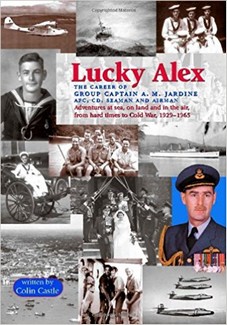
'Lucky Alex' is the biography of Group Captain Alex Jardine who was born in Vancouver, lived in Victoria and went to sea at 15, to give his mother fewer mouths to feed. His career included 5 years on Canadian and British merchant ships, 10 years in the RAF - during which he flew Catalinas against Japan out of Singapore and spent years as a POW in Java, and 20 years in the RCAF. His flying went from Tiger Moths to jets. His singular personality makes the story a good one, right to the bitter end, when he loathed being an air attaché on the cocktail circuit in Prague.
Alex Jardine was different from most career airmen in that he combined a deep seriousness about doing the best possible job at all times with a love of fun and jokes which enabled him to make light of the most desperate assignment. Consequently his story is never dull even when he is flying a desk. He has not a pompous bone in his body.
His career contained enough action for several lifetimes and he found himself in some crucial historical spots. For example, he was a sailor on shore-leave in Hamburg when Hitler was conducting Germany's last election for 12 years in 1933; he flew anti-submarine patrol for the Prince of Wales and the Repulse the day before those two ships were sunk by the Japanese - and was sent out to confirm the awful truth when this was thought to have happened; he escaped from a Japanese POW camp in Java and, having failed to find or build a boat, managed to be recaptured with no harm done to himself or his companions - no mean feat; he survived 3.5 years in the same POW camp as Laurens van der Post, with two guards who were subsequently executed for warcrimes; he was commanding CF100 jets at RCAF St Hubert in October 1956, when the Suez and Hungarian crises made WW3 seem imminent; and he was Canadian air attaché in Prague - and insisted on keeping on drinking with the Russians - during the darkest days of the Cuba Missile Crisis.
Alex was once declared the most eligible bachelor in Singapore, yet he remained unmarried until he was 44. One of the book's themes is this personal journey. He had an extraordinary ability to direct his own life and to avoid the pitfalls of love and marriage - when those delights would have detracted from his being able to do the job assigned or, more importantly, when the job assigned would not have allowed him to be responsible for a possible wife's welfare. He watched other men, as doomed as himself, marry before the bullets started to fly. But that was not for him - not until his future seemed predictable again. And that only happened when he became a base commander in the RCAF.
Excerpt
At 0100 on Monday the 8th of December 1941, minutes earlier than the attack on Pearl Harbor, Alex was woken by the CO: "Better get dressed, Jardine! Attack on the way!" Indeed it was; the first bombs caught him still struggling into his pants. Flying high and in the dark, the Japanese did well actually to hit the airfield. Alex's dressing was punctuated by a huge clump of dirt landing on his verandah. Dishevelled and half dressed, he jumped into a trench outside the door and waited. The bombers made another pass, dropped more bombs and then disappeared. The All Clear siren sounded and some rather stunned officers gathered in the mess. Most of them were astonished. It seemed almost unbelievable that the Japanese had had the nerve to carry out such an action. As Alex was to tell Agnes when reflecting on this event a month later: " I think the normal reaction was: 'Well, I'm damned, the cheeky little so-and-so's!' "
Professional Reviews
Airforce magazine (Canada)
This biography takes the reader through the remarkable life of Alex Jardine from hard times to Cold War, 1929 to 1965, initially as a boy seaman, then in the RAF, incarcerated by Japanese forces in the Far East for the war period, and following WWII, a jump into the RCAF for a 20-year stint, to his retirement in Victoria in 1965.
Author Castle has successfully woven an engaging biography of one of Canada
Times-Colonist (Victoria, BC)
• Victoria has supplied more than its share of military officers, but few
had as distinguished a career as Group Captain A.M. Jardine, AFC, CD.
Merchant seaman, courageous pilot awarded the Air Force Cross,
prisoner-of-war, senior base commander and aide-de-camp to a governor
general, Jardine's exciting life story is told in Lucky Alex, by Colin
Castle (Fighting Fit Publishers/Trafford.) As is often the case, this
impartial biography written by a second party reads better than it might
have as an autobiography, when modesty could have held back details of
valiant conduct. Castle is a clear writer and evidently a masterful
interviewer, as he brings out a wealth of detail about his subject. In our
conversation, Castle described Alex Jardine as "a joy to work with," which
certainly must have helped the process.
Though of a good family, Jardine grew up in near-poverty on Niagara Street,
Victoria. At age 15, he helped his un-businesslike father and gentle mother
make ends meet by leaving home to go to sea. Starting as a lowly deck
messenger aboard passenger liners, he roved the Far East and Europe for five
years. Having developed a love of flying in Britain, he obtained a
short-service commission in the RAF, a near-miraculous feat in 1935. A
natural-born pilot, he was posted to Singapore, where he became part of the
woefully small defence force of Britain's largest naval base in the Far
East. The base's planners were so fatuously confident no invader could
penetrate the Malayan jungle across the Strait, that none of its powerful
naval guns were sited to fire inland. The book tells us a great deal about
colonial conditions there in the final pre-war years.
Young Jardine was rapidly promoted to squadron leader with 205 Squadron,
which became equipped with flying-boats (Catalinas again.) After Japan
attacked in 1941, he flew long reconnaissance missions, including a search
to confirm the battleship HMS Repulse was sunk by dive-bombers. After
Singapore's surrender, Jardine carried on the fight in Java, but was
eventually captured by Japanese forces. He and many other Allied
prisoners-of-war spent the next three years in hellish captivity by brutal
Japanese guards, two of whom were subsequently executed for war crimes.
Jardine escaped a nasty death when the rest of 205 Squadron and 1,800 other
PoWs were sent on the infamous Sandakan death-march, which only six men
survived.
Dropping of the atomic bombs in September 1945 forced Japanese surrender and
brought deliverance for thousands of Allied prisoners throughout the Far
East. Jardine telegraphed his mother in Victoria with news of his release,
then spent 33 days travelling home, arriving after an absence of 10
adventurous years. Many more were to follow, during his second service
career and senior rank in the Royal Canadian Air Force, a stint as air
attaché in Prague, and a happy marriage in mid-life. Lucky Alex is a moving
testament to yet another of the genuine heroes who live quietly in our
midst.
Want to review or comment on this book?
Need a FREE Reader Membership?
Reviews for "Lucky Alex, the career of G/C A. M. Jardine, AFC, CD, seaman and airman."
Reviewed by Sidney Allinson
12/18/2002
I see that you have published the book review I wrote about "Lucky Alex," by
Alex Jardine.
I'm curious to know why you printed it without any attribution to me as its author. It also looks a bit odd that you display my review with lines scored through every word.
-- Sidney Allinson,
Victoria, BC
My memories as an immigrant professional woman in Ottawa, Canada 47 years ago. A new life after having survived the liberal war of a new country Bangladesh on December 16, 1971.