Click here to buy this book!
Lulu
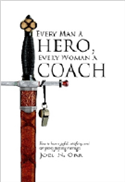
Every Man a Hero, Every Wife a Coach
Lulu.com
Category:
Relationships
Publisher: Solomon & Siegel
ISBN-10: 0977324206
Type: Non-Fiction
Pages: 220
Copyright: September 17, 2005
How to have the marriage you always wanted!
Every Man
a Hero,
Every Woman
a Coach
Joel N. Orr
Other books by Joel N. Orr
S tructure is Destiny:
The Dandelion Principle
[revised 2005]
T he Victorious Engineer
T houghts on Engineering Automation
T he CIM Handbook
with Eric Teicholz
T he CAD/CAM Anthology
T he Computer Graphics for Management Anthology
Fall 2005
T he Even More Victorious Engineer
Summer 2006
M anage by Respect
Every Man
a Hero,
Every Woman
a Coach
Joel N. Orr
Every Man a Hero, Every Woman a Coach
www.EveryManaHero.com
Copyright © 2005 by Joel N. Orr
www.JoelOrr.com; joel.EveryManaHero.com
All rights reserved.
ISBN: 0-9773242-0-6
Cover design and art: Russell Barr
www.BarrGraphics.com
Back cover photo: Carole Janet Oste
fotofish.cox.ne t
Editing and layout: The Instant Editor
www.TheInstantEditor.com; n.JoelOrr.com
Grateful acknowledgement is made for permission to reprint the following in its entirety:
"Feminism is Mugged by Reality," by Phyllis Schlafly. Reproduced by permission of Eagle Forum, 2005
Solomon & Siegel Publishers
New York, New York
Printed in the United States of America
WARNING!
This book DOES NOT say that women are inferior to men. Far from it! It says men cannot really be fully men without taking advantage of their wives’ world-building skills.
Gold-medal winners owe their achievements to their coaches—the ones who had a vision of what their athlete could achieve, and then helped them move beyond their natural tendencies into greatness.
Athletes need a proper relationship with their coaches. Without a close relationship with the one who has the vision of what they can achieve, their athletic potential remains just that: potential, not achievement.
This book DOES say that without respecting the enormous world-building skills of his woman, a man cannot achieve his full potential. He may achieve great things, but he’ll be limping along at a much lower level of achievement than was his potential.
This book also says that without a proper coaching relationship with her husband, a woman is handicapped in her search for personal fulfillment. She may achieve great things, but she’ll be limping up to get her gold medal.
Yes, a woman occasionally needs coaching from her husband. But until he has made her truly part of himself in his heart of hearts, he can’t see her well enough to advise her.
BOTTOM LINE: Whatever else a woman does, she needs to coach her husband into his own greatness so he can encourage her into her own greatness. It’s enlightened self-interest!
Would you like a FREE weekly email message from me on Hero/Coach issues? Write me at joel.everymanahero.com with "subscribe" in the subject line.
To N’omi,
My dear Coach, without whom I could not have become myself.
ACKNOWLEDGEMENTS
Thank you to the many people who generously commented, and who insightfully read and marked up the pre-publication manuscript—pointing out many ways to make this a better book.
It’s interesting that no two people offered the same suggestions. I implemented them all. I think. If I missed anything, it’s my fault, not the fault of the wonderful readers.
And my most especially heartfelt thanks to:
Vicki Bentley
Geoffrey Butlin
Christine Chukabarah
Jason Cooper
Florence Feldman
Jerry Filler
Kati Grow
Drew Kennedy
Fredric and Adrienne Lorenzen
Jeff and Anne Miller
John J. Miller
Mary Jo Nutting
John and Patricia Orr
Diane Ross
Amy Rowell
Jon Ruthven
David Sherman
Ramon and Antoinette Williamson
Terry Wohlers
IF YOU AGREE with at least two of these statements, you’ll get a lot out of this book:
1. My mate doesn’t listen to me.
2. Our love life is routine or non-existent.
3. My mate constantly nags, complains, criticizes, and reminds me of every thing I ever did that they didn’t like.
4. Money issues are ruining our marriage.
5. I’m thinking of leaving, but…
6. We’re incompatible.
7. I’m not appreciated, no matter how hard I try.
8. I wish I knew how to reach my mate.
9. The romance is gone.
10. We argue all the time.
11. We don’t have the same life goals.
12. We can’t both work and have a good relationship.
13. My mate’s family doesn’t like me.
14. Our children are driving us apart.
15. My mate doesn’t really love me.
16. I think I may have married the wrong person.
Dr. Laura speaks to world-building women:
"Contrary to what a good forty years of feminist propaganda has claimed, it is not oppression, subjugation, or abdication of any feminine quality-of-life potential to marry a man, be proud of your bonding, rejoice in your gifts and sacrifices for your marriage and family, and derive pleasure and sustenance from your role as a wife and mother."
Dr. Laura Schlessinger, in
The Proper Care and Feeding of Husbands
What is a "hero"?
Some definitions from www.dictionary.com
hero
n. pl. heroes
1. In mythology and legend, a man, often of divine ancestry, who is endowed with great courage and strength, celebrated for his bold exploits, and favored by the gods.
2. A person noted for feats of courage or nobility of purpose, especially one who has risked or sacrificed his or her life: soldiers and nurses who were heroes in an unpopular war.
3. A person noted for special achievement in a particular field: the heroes of medicine. See Synonyms at celebrity.
4. The principal male character in a novel, poem, or dramatic presentation.
5. Principally in New York City, a sandwich made on Italian bread cut lengthwise, and filled with meats, cheeses, salad vegetables, and condiments.
What this book is about,
and why you should read it
You can be happily married. Your marriage can be a source of joy, growth, and fulfillment unlike any other in your life. Here’s a little purple pill. Just take it every morning…
Oops! Sorry; I don’t have such a pill to offer you. And frankly, I don’t think one exists.
What I am offering you is a new way to look at the very old truths about the relationship between a man and a woman. It’s a new model for marriage that will work like the imaginary "little purple pill," if you start to put it to use in your life.
My own experience—and that of the many couples my wife, N’omi, and I have spoken with—is that anyone who adopts this model and applies it consistently gets everything the imaginary little purple pill promises, and more.
So what’s the model?
The model, Part A: Every man is born to be a Hero, to be loyal and true and brave, to be accomplished in some way, and to overcome great challenges in his quest for the purpose of his life.
We men instinctively know this. In our heart there is always the question: Where is the challenge that justifies my life? What is the ennobling goal that lights my path?
The model, Part B: Every woman is born to be a Coach, to be loyal and true and brave, to be accomplished in some way, and to overcome great challenges in her quest for the purpose of her life.
A woman is born with innate world-building skills.
If she follows the biological imperative and gives birth to children, she is able to build a world for her family as she nurtures and coaches them into their individual greatness.
As she grows by building a world for her family, she cannot help but be heroic herself; it’s in the nature of being a mother. And she cannot help growing in her ability to understand and help her husband.
Using her instincts and gifts properly, she can help the man in her life achieve his own greatness.
If her husband receives her as the one who can help him achieve his best in every aspect of life, he becomes the Hero he was meant to be, and she becomes a heroic Coach. Her world-building skills enable her family to thrive.
By her choices of values and day-by-day routine, her children can be safe in a family world that nurtures them into full humanity. Her husband, as he is encouraged by her to be the heroic protector and provider the family needs, is also training to accomplish great things in his world away from home.
For mothers, coaching children is good training for coaching husbands. It teaches a woman to give the same helpful comments hundreds of times while maintaining a good attitude: "Put your socks in the hamper; brush your teeth; if you hit your brother, expect him to hit you back. This is a recorded announcement."
It’s also a fact that women often know things that are beyond the intuition of most men. They have special sensitivities, special capabilities for their coaching role. For most women, life’s biggest and most challenging project is coaching her Hero and building a world together with him: if he’ll let her.
The greatest joy a man can experience is to have a loving bond with his wife and children in which he sees himself as their natural protector from the dangers and evils of this world, and as their natural provider with the things necessary for their lives to thrive, materially, intellectually, and spiritually.
But we live in a time in which the understanding of how a family works has been lost. Most of our mothers and fathers were not able to be good models for us. They didn’t know how to mesh with one another, and didn’t know how to find the joy that comes with fulfilling our natural instincts and individual heroism.
Due to this loss, and many other social factors, a strong drive to socially and physically destroy men has arisen in the United States.
They’re fed soy milk, which is loaded with female hormones (Google "soy, dangers" to read more about this), and are trained to behave like little girls. Efforts begin in infancy to feminize boys and to disapprove of their manly traits.
They’re forced into school years before they’re ready—in many cases—to handle this kind of restraint. They’re ordered to sit quietly and work with their minds instead of their muscles, and if they can’t, they’re labeled "learning-disabled," and doped with Ritalin and other psychotropic drugs (Google "Ritalin, dangers").
Ritalin is called "kiddie cocaine," because it behaves like cocaine in the child’s brain. And it unfits the child to develop relationships or interests outside himself.
Most ADD or ADHD traits in boys appear to be caused by three main factors: diagnosing normal boyish behavior as abnormal; dietary reactions to an overabundance of sugars and starches in their diets; being kept in a constant state of anxiety due to constant arguing between the parents—especially over how to discipline or educate the boy.
None of these indicate any problem on the boy’s part, but he’s the one who gets drugged!
Also, these days, most schools teach lots of information, but little that will support young men in living up to the potential greatness inside each of them.
After graduation, boys go out into the world and find themselves penalized for being male—in college and job opportunities, and in most areas of life.
Even the military is no longer a place where men can learn to be men. Now they learn to live like rabbits, with about the same moral and intellectual climate. Many soldiers turn to religion to help them avoid "the near occasion of sin" in the midst of danger and boredom.
In our culture, men are now mocked and derided. And almost no one is telling men how to regain their manhood.
So we’ve been reduced to either following our feelings—which are seldom reliable long-term guides—or creating our own model upon which to base our behavior.
There are other models for male/female, husband/wife relationships besides the one I’m going to describe.
But this book is about the Hero/Coach model, because I know it works. I’ve lived it for over 30 years, and have seen it work for my grown children, and for countless others.
It will work for you, too—if you’ll "just take it every morning," and let it influence the day’s choices.
qqq
Would you like a free weekly email message from me on Hero/Coach issues? Write me at joel.everymanahero.com with "subscribe" in the subject line.
A WORD ABOUT the TABLE OF CONTENTS
How this book is arranged:
- Every chapter stands by itself—though they all support one theme: Marriage can be joy if we know what behaviors to choose.
- Each chapter deals with one aspect of the Hero/Coach model—one set of ideas that have helped men and women achieve fulfillment through understanding themselves and others in new ways.
- At the end of each chapter, there are three kinds of KEY POINTS: to think about, to discuss; and to take action on.
- Chapters are grouped into five sections:
- Your Self, Your Destiny, Your Relationships
- Married Life
- Family Life
- Your Child and Your Children
- "…And in Conclusion…"
TABLE OF CONTENTS
I. YOUR SELF, YOUR DESTINY, and YOUR RELATIONSHIPS
Equality versus Partnership:
The difference that makes all the difference! 3
Why Are We Here?
What can we know about the meaning of life? 7
When a Man Meets a Woman:
What happens when a man meets his mate? 9
When a Woman Meets a Man:
What happens when a woman meets her mate? 13
Being a Hero:
Men, take advantage of your wife’s special
abilities to help you achieve you dreams! 15
Keep Love Alive with
"The Five Love Languages":
What you don’t use, you lose. 19
Why Am I Here?
How the "hard-wiring" of our nervous systems affects our relationships. 23
My Choices Change My World:
How the way we process information affects our relationships. 33
Character:
What is it? How does it affect our relationships? 37
Responsibility:
How taking blame empowers you to change things. 41
Two Roads:
What if "something" tells you not to trust someone?
Or to take an umbrella? 46
Commitment:
How it makes or breaks relationships. 51
Integrity:
How to overcome adversity through integrity. 55
Respect is Your Unalienable Right:
How self-esteem, self-respect, and self-worth
affect relationships. 58
A Clear Path:
How doing your duty is a protected path through
life’s dangers. 63
Do the Right Thing:
Why should I "do the right thing" when no one
else does? 67
Destiny:
What is destiny? Can I tell what my destiny is? 72
Priorities:
Setting priorities is easy, when you know the trick . 76
Feelings:
The surprisingly simple giant step we can all take
toward emotional maturity. 80
II. MARRIED LIFE
Men and Women:
How to understand and take advantage of the
differences. 89
Love:
Just what is it? 93
Why Are There So Few Good Marriages?
The reasons are complex. The cure is simple. 95
The Purpose of Marriage:
Why get married at all? 97
Preparing for Marriage:
How partners can strengthen each other and create
a new world for their children and extended family. 105
Making Love:
Make the marriage bed a place of joy and fulfillment. 106
Communication:
Etiquette for the rough places in marriage. 110
Shutting Her Out:
How men destroy their own success and happiness. 113
Coaching Your Hero:
How to help him without hurting him. 116
The Moral High Ground:
What is it? And how do you attain it—and get
the Hero there too? 118
Coach: Require. Don’t Demand or Compel:
How to encourage cooperation and kind behavior. 121
Pitfalls in Coaching:
How to lose the moral high ground in a relationship,
and how to regain it. 129
Arguing:
How we handle it determines what happens next. 132
Money:
Tame the Money Monster instead of fighting it. 134
Criticism:
Can you take it? Can you give it? 137
Praise:
Can you take it? Can you give it? 140
Gifts:
What part does gift-giving play in marriage? 142
Courtesy:
Learn about courtesy in marriage—or else! 143
Change:
You can cope with the most stressful life influences
and keep your marriage humming. 149
III. FAMILY LIFE
Family—Society’s Building Block:
What does a successful family look like? 155
Family Life—Preparation for Growth:
The pattern for lifelong personal fulfillment. 164
IV. YOUR CHILD and YOUR CHILDREN
Children:
Training them to live up to their best selves—
a full-time job. 171
The Terrible Two’s:
How to avoid this most-dreaded phase—in
your child, and in yourself. 176
V. "…AND IN CONCLUSION…"
The Ground Rules:
Rules for the daily rough-and-tumble of the
typical marriage. 181
Pornography:
The thief of happy human relationships. 183
You Can Do This!
A brief summary of the Hero/Coach model
of marriage. 184
The God Thing:
Does the Hero/Coach model work if you
believe in God? Or if you don’t? 188
I. YOUR SELF,
YOUR DESTINY,
and YOUR RELATIONSHIPS
1.
Equality versus Partnership
The difference that makes all the difference
My wife N’omi is often asked if she doesn’t believe in equality for women, because some of the things she says sound odd to the modern ear. But she always replies:
Why should I give up superiority for mere equality? I have worked at developing my feminine traits and my human abilities. So as a woman, I am superior. But as a man, I’m a failure.
Why waste my time trying to be something I’m not? I can compete well with men in terms of some of my human abilities. But just as men can never compete with women in terms of feminine traits, I can never compete with men in terms of masculine traits.
And since I used to counsel a group of gay and lesbian people, I can say with authority that if you knew what female impersonators or sex-change people went through mentally, emotionally, and physically, you wouldn’t think it was so easy for men to compete with women at being female.
I’ll never be as strong as most men—they generally have 300% the upper-body strength of most women! And I’ll never have the masterful presence of a man, no matter how powerful a presence I present as a woman.
During the many years before I met Joel, I functioned as father and mother to five of my children. I was only able to fulfill the father role by telling my children stories of how wonderful their father was, and how much he loved them, and was proud of them. But I couldn’t BE a father to them; only a faithful mom.
Physically, beyond the obvious gender differences, men are jointed differently from women, which enables them to excel at certain activities that women find more difficult—though a woman’s special jointing enables her to do things well that a man finds more difficult.
Which makes my point: Each gender has gender-specific qualities, as well as human attributes.
In fact, if a pathologist finds a single human bone, he can tell whether it was from a male or a female. A geneticist examining a single human cell can tell whether it is male or a female.
So I believe in being the best of what I can be. That includes my feminine qualities, and it includes my human qualities. For this reason, I am a very strong woman, emotionally and mentally. I am not in conflict with myself or with the people around me.
I am busy being me, and getting happier and more fulfilled with each passing year.
N’omi is really that wonderful woman, powerful and focused on fulfilling her potential—in her own life, and in our life together.
So what do N’omi and I have? Are we equal? No, because equal means the same. Men and women are not the same.
The only way in which all people are "created equal" is that we all have the same 24 hours a day in which to make decisions about who we have decided to be.
Marriage is not 1 + 1 = 2. That would be equality. Marriage is a partnership, to which each partner brings a different assortment of qualities: character traits, aptitudes, attributes, opinions, beliefs, and other accumulated stuff that makes them who they are.
In fact, this means that no two humans, regardless of gender, are really "equal" when they meet.
But in marriage, you are joining two very different sets of qualities, and adding gender qualities to the equation. This is a volatile mix because marriage is a partnership of unequals, not an equality of two identical parties.
We need to discard the idea that "unequal" means one is superior and one inferior. That’s NOT what it means.
"Unequal" just means "not the same," or "different." And anyone can see that every human is different from every other human.
Furthermore, many studies—psychological and physiological—show that men have many traits in common with each other that they don’t share with women.
And many similar studies show that women have many traits in common with each other that they don’t share with men.
Bottom Line: Marriage is a partnership, but not an equality. As a partnership, it consists of two very different people who bring different qualities to the relationship.
These qualities are of two kinds: Personal and gender. Personal qualities are individual and not gender-specific. But there are gender-specific qualities that exist and must be recognized for what they are before true partnership can blossom.
This book deals with both kinds of traits, in both men and women.
Remember: Men and women are two races that share the same planet, but not much else! To get along happily, they have to learn about what’s unchangeable—in their own and in their mate’s nature—and what can be modified.
Then they will stop blaming, and start working together. That’s partnership!
qqq
At the end of each chapter, including this one, you will find a section called Key Points, and…
Here’s how to use the Key Points:
• These are things to think about, to talk about, and to act on.
• If you are serious about trying out my model for size, schedule a weekly Hero-Coach progress meeting. At the meeting, remind each other what you had said you were going to do at the last meeting. Then each of you evaluate how the week went in that light.
• Just remember to "stay on the same side of the table." This is not "hot seat" time; this is both Hero and Coach objectively evaluating progress:
"I was much more aware of responsibility issues this week, like when I was thinking why the lawn was not mowed," says the Hero. "Although I know I dropped the ball on that, I haven’t had a chance to pick it up yet. That’s my plan for tomorrow."
"Great!" says the Coach. "And don’t think I didn’t notice that you put your socks in the hamper every night this week! Thank you!"
• You can do them in any order, and you can take more than a week on one point.
• Keep a journal. It’s very encouraging to see your progress.
• Don’t try to do more than one or two sets of Key Points each week. These exercises are to help you clarify and practice a wide range of new behaviors. If you try to do too much at once, you may get overwhelmed and discouraged.
• Take it slow. Appreciate what’s going on—the intimacy and strength you are building, your growing ability to mesh.
• Also, many of the "Take action" points suggest that you make a list or write something. The reason is simple: When you are trying to change, the first thing you must do is notice the way things are.
Writing about yourself and your behavior requires you to notice things. It becomes a mirror, so that you can see yourself more clearly. It’s especially helpful in desensitizing areas in which you may feel defensive, and allows you to get more help from your spouse.
Now let’s get the benefit of this chapter into your life.
Key Points
Chapter 1. Equality versus Partnership
Think about:
Do I feel superior or inferior to my spouse in some ways? What ways?
Talk about:
What do we each mean by "partnership"?
What strengths and weaknesses do we each bring to our marriage?
Take action:
If you’ve found a point that seems out of balance, like "he’s good at math, but she does the checkbook," try a 30- or 60-day experiment with a different arrangement.
2.
Why are we here?
What can we know about the meaning of life?
When I was studying abstract math in graduate school, statements like the following would bother me—and challenge me: "Finding the answer to this question is left as an exercise for the reader."
I wanted to be given answers, or at least clear instructions on how to find them. Yet at the same time I felt, "I’m up to this; I can handle it."
But the "Why are we here?" question always threw me. What is the purpose of human life? Is there even a purpose?
Throughout time, people have pondered this matter, and come up with many answers. Even an attempt at a respectful consideration of this issue would carry us well beyond the scope of this book.
Yet I have to bring it up, because the Hero/Coach model I’m about to share with you rests on thoughts having to do with purpose.
Here’s my list of partial answers to the question, "Why are we here?"
• We each have a purpose, a mission to fulfill.
• We can get some indication of the mission by examining how we "come equipped": short or tall; fast or slow; observant or oblivious; dexterous or klutzy; male or female; and much more.
• Biologically, we’re equipped to reproduce, and to raise children.
• Emotionally, we’re equipped to live in family groups.
• Developmentally, we have a life-cycle that involves launching new family groups.
• In the course of fulfilling our mission, we build our character.
I have found that when we operate as if these are true, we seem to be supported, strengthened by our human
qualities. When we try to act on assumptions that conflict with these, nothing seems to work right for long.
I suggest you take an experimental approach to the Hero/Coach model and its underlying assumptions. Try them on for size. Give them a chance, and see if you like the outcomes of the decisions you base on them.
Now let’s put this information to work!
Key Points
Chapter 2. Why Are We Here?
Think about:
What do I believe about why we—that is, humans—are here on this planet, in this universe?
Talk about:
Compare your points of view on this issue.
Take action:
If your points of view are the same—great! If not, each of you write a few words about why you believe what you do. Then give your write-ups to each other, and commit to reading and thinking about them for a week, without discussing them. At the end of the week, have another discussion.
3.
When a man meets a woman…
What happens when a man meets his mate?
The Hero/Coach Model
Every man is looking for someone to understand and respect him. It’s what we see in all the movies about sports heroes—racers, runners, boxers, golf pros, jockeys: Whatever their sport, athletes sense their own potential, but need the right coach to help them get past their "blind spots."
When a potential Hero meets the right Coach, he learns that the Coach sees where the potential Hero is now, and where he could be—with the right encouragement and training. He earns the coach’s respect by applying himself to the training, just as in any coached sport.
In movies, the sports hero is drawn to a coach because he or she senses that this coach has the vision, the respect, the enthusiasm, and the commitment that can bring the hero to fulfillment of his or her potential.
But there is always a certain amount of tension between the hero and the coach because, after all, the coach is NOT someone who can do what the hero can do; the coach only has a plan, a vision of how to get from the way things are to the way things could be.
In some movies, the hero even starts to resent the coach, because the coach seems to be taking it easy while shouting instructions to the hero and demanding greater and greater sacrifice and more and more difficult accomplishments from him.
If the hero sticks with the coach, the movie will have a satisfying ending, as the hero attains his full potential, and gains the respect not only of his coach, but of many others.
If the movie hero doesn’t trust the coach, "crash and burn" will be the result. Think of the "Rocky" movies, or "Chariots of Fire," or any of the many movies about athletes and their relationships with their coaches.
Whether the movie sport is football, baseball, boxing, wrestling, swimming, golf, racing or showing horses, basketball, soccer, ice skating, bowling, fishing, or any of the many athletic events people participate in, the coach is the one who gets the athlete to the blue ribbon, the gold medal, or the championship.
And there’s usually a scene where the athlete rebels against the constant instruction of the coach, and they break up, or almost break up. (If they really break up, you know as you watch the movie that bad things are ahead for the athlete.)
Movie Lesson: Whiners are losers.
Just so with men and women: A man is attracted to a woman whose vision of who he can become meshes with his own dream of who he can become.
Why? Because all her advice seems to be aimed at making him look good and feel good.
This is the basic Hero/Coach model.
Problems
Problems begin when the Coach starts working on the Hero’s "blind spots"—areas where she sees potential or self-defeating habits…and he doesn’t. Then the temptation to reject her advice—to see it as criticism, contention, or competition rather than coaching—is strong.
This is because many a man has a lower opinion of himself than is accurate. It is often a result of a lack of encouragement in their upbringing.
If only boyish shortcomings were noted, and gifts and talents were overlooked, a man has been living with self-hatred and shame for a long time.
When he meets a woman who sees his potential and looks up to him, it makes him feel good. But he gets uncomfortable when she starts to locate the places where he isn’t living up to his potential.
What is he thinking? "Here it is again," he thinks, "criticism!" And he’ll either cringe away from her or criticize back: "So there!"
All this is understandable, but it’s based on a wrong perception of what she is doing. She is not doing what others did to him in his childhood or youth.
She is trying to help him achieve his greatest fulfillment, but right now, she has the clearer vision of who he is.
If he lets pride get in the way and shuts her out, or starts competing with her rather than cooperating with her, the relationship is skewed by his counter-productive behaviors. And his Coach is left with few options, all of them bad.
Overblown ego on the part of the man is always the reason for the downward spiral of diminishing affection and accomplishment in a relationship.
If the man is closing out his Coach’s advice, it’s always due to mistaken pride and competitiveness: "I’ll show her!"
And, though the man causes the downward trend of the relationship, the woman suffers from his choices.
This can backfire into the Coach getting sick and tired of being shut out, and saying, "I’ll show him!" And then things can get hot.
The truth is that the woman "lives in the man’s movie." He is the producer and director, and she can only act within the envelope that he allows her—unless she opts to leave the movie altogether, and sign on to another film.
Some women might not like to think of their role in marriage or male/female relationships this way, but this is the way it is: The man sets the scene, and the woman can only respond or react. She is not calling the shots.
Even when she seems dictatorial, it’s because he wants to make everything seem like her decision, so whatever happens then looks like her fault.
Even when it looks like she is setting the scene, if you think it through, you’ll see that her "scene-setting" behavior is happening in reaction to something he’s done.
To reverse the spiral, the man must understand the value of the woman’s vision and support. Only then can he incorporate her into his life fully, and allow her to be a whole person in her own right in the relationship.
Important tip for the Coach : N’omi has said for decades: The main way to help a man become his Heroic self is to always remember: Men need respect more than they need oxygen. The Coach must find a way to deliver what the Hero needs in a way that doesn’t destroy his self-respect.
In The Proper Care and Feeding of Husbands, Dr. Laura Schlessinger makes a similar point:
…your basic male is a decent creature with simple desires: to be his wife’s hero, to be his wife’s dream lover, to be the protector and provider for his family, to be respected, admired, and appreciated. Men live to make their women happy.
Important tip for the Hero: Remember: dealing with your blind spots is a heroic deed. And the sooner they’re dealt with, the more heroic you become.
Also, remember that your Coach is not perfect. (You knew that, right?) In fact, once you’re on the right track, you can coach her.
But for the rest of your life, it’s your job—in fact, your duty—to love her into perfection. If you are not actively loving her and cherishing her, you are limiting her growth, and cutting yourself off from the benefit of her coaching.
Let’s take a look at some suggestions for tailoring the concepts in this chapter to your unique life.
Key Points
Chapter 3. When a Man Meets a Woman…
Think about:
Does the Hero/Coach model make sense to me? Why or why not?
Talk about:
Are we both willing to give this model a try?
Take action:
If we adopt this model, what do we expect to be different in one week, in 30 days, in 60 days, and in 90 days, if we adopt this model? Make four lists.
Then mark your calendars to discuss on those milestone dates what has happened.
Would you like a FREE weekly email message from me on Hero/Coach issues? Write me at joel.everymanahero.com with "subscribe" in the subject line.
Excerpt
Marriage is not 1 + 1 = 2. That would be equality. Marriage is a partnership, to which each partner brings a different assortment of qualities: character traits, aptitudes, attributes, opinions, beliefs, and other accumulated stuff that makes them who they are.
In fact, this means that no two humans, regardless of gender, are really "equal" when they meet.
But in marriage, you are joining two very different sets of qualities, and adding gender qualities to the equation. This is a volatile mix because marriage is a partnership of unequals, not an equality of two identical parties.
We need to discard the idea that "unequal" means one is superior and one inferior. That’s NOT what it means.
"Unequal" just means "not the same," or "different." And anyone can see that every human is different from every other human.
Furthermore, many studies—psychological and physiological—show that men have many traits in common with each other that they don’t share with women.
And many similar studies show that women have many traits in common with each other that they don’t share with men.
Bottom Line: Marriage is a partnership, but not an equality. As a partnership, it consists of two very different people who bring different qualities to the relationship.
|