Category: Children Publisher: BRIDGEWATER/TROLL
ISBN-10: 0816737967
Type: Fiction
Pages: 32
Copyright: Jan 1 1996
CORETTA SCOTT KING ILLUSTRATION HONOR BOOK ABOUT 2 COUSINS OF THE SEA ISLANDS.
Essie is excited--her cousin Neeny is coming home to Daufuskie Island from the mainland for a visit. A lot has changed, especially Neeny, though Essie would like things to stay the same. Neeny's a fancy young lady now, no longer interested in the island way of life. But does anyone really forget their roots? Essie knows the answer. So she gives her cousin a special gift that will always keep the island by her side.
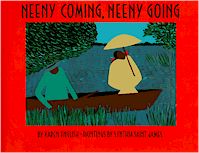
Colorful, dramatic illustrations by Synthia Saint James highlight Karen English's evocative tale of the ties that bind families--despite loss and change.
Excerpt
"Neeny coming--Neeny coming tomorrow!"
"Is that so?" Dada ask, teasing me. Our grandma know Neeny is coming. She smile at me and pull a sheet from her basket and give it a big shake. The wind lift it up and it flutter like the wing of a bird. Dada pin it to the line. Dada's sheets are the whitest on 'Fuskie Island. Everyone say so.
Professional Reviews
Early Childhood News
Neeny Coming, Neeny Going is a tender tale of the ties that bind family members-no matter how far apart they are. The story is uniquely told in the island dialect of young Essie, whose favorite cousin, Neeny, is returning for a visit after having moved to the South Carolina mainland. But Neeny has changed into a fancy young lady who is no longer interested in the island way of life. Essie knows that no one can ever forget their roots, so she gives her cousin a special gift that will always keep the island close to her.
Horn Book
Broad, flat forms and rich color depict Essie's island home...Essie's guileless narration provides the essence of the island language, a blend of African languages and English, without impeding the flow of the text. Illustration and text combine to creat a memorable portrayal of a universal situation while also giving the reader a glimpse into a specific experience of African-American life.
School Library Journal
The story is told in an imitation of Gullah speech patterns, not so faithful that it becomes an exercise in phonetic transliteration, but lilting in the verbs and inflections and occasional uses of island diction. The illustrations are done in what appear to be collages of bright, flat colors with faces expressive in their shapes, indicating attitude and motion, for there are no drawn facial features. Size, shape, and motion are all evident, as are the brilliant, deep, 'clashy' colors. But there are not collages,...A physically beautiful and memorable book.