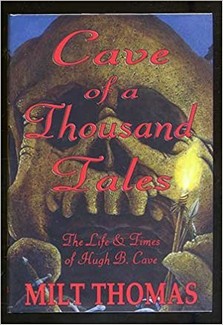
Category: Biography Publisher: Arkham House
ISBN-10: 0870541838
Type: Non-Fiction
Pages: 287
Copyright: June 2005
Authorized biography of legendary pulp fiction writer, Hugh B. Cave. Nominated for 2005 International Horror Guild Best Non-Fiction Book.
Hugh B. Cave is considered an icon to those who know him – pulp fiction fans, publishers, editors, and other writers. It is difficult to imagine any American over the age of 40 who has not read something by Hugh Cave. For instance, his short-short story, "Two Were Left," has been published 75 times since 1942, primarily in scholastic magazines and textbooks. You probably read it yourself in school.
However, Hugh Cave did not earn a reputation for writing one story published 100 times. He earned it first as one of our premier pulp fiction writers, then as a mainstay of the slick magazine fiction era, and finally, as a novelist. He would establish a well-deserved reputation in each of those fields, writing over 1,000 short stories and more than 40 books, works that have been published in 27 foreign countries.
For those too young to remember, pulp magazines were the immensely popular publications that dominated newsstands before World War II. For five or ten cents each, the reader could select from more than 100 different titles like Action Stories, Argosy, DimeDetective, ModernRomances, Strange Tales and Western Story. Their popularity waned with World War II paper shortages and the advent of popular radio, then television.
As a pulp fiction writer, Cave’s contemporaries included Robert Bloch (Psycho), Ray Bradbury, Edgar Rice Burroughs, John Dickson Carr, Erle Stanley Gardner, Dashiell Hammett, L. Ron Hubbard, MacKinley Kantor, Louis L’Amour, H. P. Lovecraft, John D. MacDonald, Clarence E. Mulford (Hopalong Cassidy), and Tennessee Williams.
Hugh Cave never achieved the celebrity status eventually accorded some of his pulp contemporaries; However, he was certainly one of the most prolific of his day. He wrote more than 800 stories in 90 popular fiction magazines during pulp fiction’s best years, from 1929-1942. His stories included every genre from romance to western to horror. He was so prolific, he used more than a dozen pen names. You could find as many as four Hugh Cave stories in one issue, under the pseudonyms Justin Case, C.H. Barnett, Allen Beck, and Geoffrey Vace, to name a few. During the depths of the Great Depression, when college graduates scraped by on $18 per week, Cave the writer made $5,000 a year, much of it earned at the going rate of a penny per word.
But his reputation wasn’t built on the number of stories he wrote. Popular fiction was truly ‘popular’ back then, before radio and TV. Cave’s South Pacific adventure stories, especially those surrounding a British outpost in Borneo called Tsiang House, earned a huge following among readers. His detective stories were in such demand, he hardly wrote anything else in the mid-to late‘30’s. He became best known for his ‘weird menace’ tales. Cave wrote them back before the days of slash and gore, when a writer conveyed real terror to a reader through tense dialogue and well-turned phrases.
Pulps all but disappeared after the war, and if he had never written another word, his legacy was secure. But "Hugh B. Cave, Writer," went wherever he found an opportunity to write.
During World War II, as pulp magazines were fading into history, he moved into the more lucrative ‘slick’ paper magazines. There, Hugh Cave adapted to a totally different market and style, connecting him with an eager new audience of fans. Cave published 350 fiction and non-fiction pieces, including 43 stories in The Saturday Evening Post alone. (One of those Saturday Evening Post features, "The Mission," is still considered one of that magazine’s most popular short stories of all time.)
The war also provided him with an opportunity to write full-length books about real-life soldier-heroes. With his success, he branched out into travel and fiction. Since then, he has authored more than 40 books, fiction and non-fiction, four of them best sellers. Haiti: High Road to Adventure remained in print for 16 years, considered by many to be the authoritative book on that troubled country. Four Paths toParadise revealed Jamaica in much the same way, earning him similar recognition. The Cross on theDrum, Cave’s novel set in a country remarkably similar to Haiti, was the recommended selection for two national book clubs in its day. Long Were the Nights, one of his true stories about bravery during World War II, remained on the Herald Tribune Bestseller list for six months. He wrote a string of supernatural thrillers in the 1980’s, and continues writing them. In July, 2001, his paperback novel, The Evil Returns, was released nationally on his 91st birthday.
Yes, Hugh B. Cave is a master at his craft. He is one of the last survivors from a generation whose written words helped millions survive the Great Depression and World War II. He has thrilled, scared, educated and comforted three generations of readers, stirred their imaginations and warmed their hearts. Anyone who loves books, who writes for a living, or hopes to do so, must pay homage to this man. Moreover, the fact he is alive to talk about it – and still writing for publication – is a hook to make for a compelling story.
"Hugh B. Cave, Writer." It is such a bland description for someone who has lived his life in front of a keyboard, most of those years using a manual typewriter. The wellspring of his creativity was not a keyboard though, it was his mind. That mind transported him to places most people can only imagine. It was just a matter of time before his body would follow.
This is where his story becomes an inspiration – to me, to his fans, and to anyone who seeks the meaning of life itself. Hugh Cave lived – and lives – to write. Yet, while his existence hangs on the very words he writes, he has also experienced a life of adventure, mystery, tragedy and romance that could be grist for an exciting story even if he had never put pen to paper.
"Hugh B. Cave, War Correspondent." After writing a series of successful books about American war heroes, Cave was invited to serve as a correspondent in the South Pacific Theater. He took part in the last major amphibious assault of the war. There he found himself under fire as the troops landed, later ambushed by snipers, and then living under the most hostile circumstances imaginable. All this occurred in Borneo and New Guinea, locales for some of his most famous pulp adventure stories of the ‘30’s. Now he was experiencing them rather than imagining what they might be like.
"Hugh B. Cave, Anthropologist." He went on to spent five years in Haiti, exploring the entire rugged country on foot and horseback. He learned to speak Creole, and his humble manner endeared him to the people. Cave became an acknowledged expert on Haitian culture, including the mysterious practice of voodoo. He was probably the first white man ever awarded full access to the most secret ceremonies. Haiti became the setting for many of his most successful novels. He fled the country during a revolution that brought Papa ‘Doc’ Duvalier to power.
"Hugh B. Cave, Coffee Baron." Jamaica became the next stop on his journey through life. There he purchased a ‘ruinate,’ 200-year old plantation, then learned how to plant, grow and harvest coffee. Hugh Cave ended up producing what is still regarded today as the world’s best coffee. He also single-handedly started the Jamaican timber industry. His 15-year plantation adventure ended at a dark time in Jamaican history, when a Marxist-leaning government chased away foreigners. His plantation overlooked a secret base where Fidel Castro and his troops came and went from Jamaica.
Unfortunately, where there’s a yin, there’s a yang. With all these accomplishments, Cave suffered his share of failure and tragedy. He endured the death of his son, a loveless and lonely marriage, the tragic fire that destroyed his life’s work, and financial setbacks surely devastating to most people. He narrowly escaped death himself on at least four occasions. Yet through it all, from the mountain tops to the chasms, he always maintained his humility, his zest for life – and his love affair with the written word.
Ironically, his humility may be responsible for keeping him under the radar screen of public consciousness. He is known and idolized by his fans around the world, but Hugh B. Cave is not a household name. If he had developed a talent for self-promotion, this book might be a capstone, not an introduction.
Fortunately, his body of work will always be here for us to enjoy. Just go to your local bookstore and ask for themed short story collections about vampires, ghosts or ghouls. You will find many of them include at least one Hugh Cave classic. Or log on to the Internet and search ‘Hugh Cave.’ At this date, the search engine, Google.com, lists 12,700 references to Hugh B. Cave, and the leading Internet bookseller, Amazon.com, offers 29 Hugh Cave selections.
Today he is enjoying a level of popularity that rivals his pulp days, thanks to collectors and anthologists. However, if you want to know the man behind the legend – the Cave of a Thousand Tales – you can find it all right here.
Margaret Kohel Evans invites her mother's grandchildren to a delightful visit with their grandmother, sharing charming memories of her across eighteen life themes.
A book for every Muslim and everyone wishing to know about their way of life. The Diary of the Camp Manager at Mundihar following the South Asian Earthquake - October 2005. An account of life after the Earthquake in one of the largest of the 161 camp
Sexuality is very misunderstood.What if the tornado dropped Dorothy not into Oz, but onto the shooting set of an X-rated film?
Eric Edwards makes sex films. Period... Sex-on-command. Sex-for-hire.... So begins the story of Eric Edwards, Mr.