Category: History Publisher: Taylor & Francis
ISBN-10: 0714656909
Type: Non-Fiction
Pages: 552
Copyright: 2005
ISBN-13: 9780415571340
Price: $17.86 (eBook)
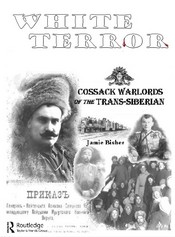
The Civil War in the Russian Far East lasted from the time of Lenin's November 1917 coup d'etat until 1922, yet has been neglected by Western historians. Bisher retraces all of the major events of this epic confrontation between Reds and Whites, and provides rare biographies and previously unpublished details about the foreign missions, volunteers and intervention armies.
Professional Reviews
Amazon
This is a groundbreaking study. The Russian Civil War was still fought in Siberia and the Far East long after it was officially "over" in the Russian heartland. The book is elegantly written and meticulously documented. The mastery of sources is remarkable, considering that many sources are in Russia and therefore can be notoriously hard to penetrate. I kept thinking - how did this guy with no prior academic credits manage to turn so many stones? Found all these extinct local newspapers - hadn't they all been burned upon reading (in woodstoves), torn up for smokes, or later destroyed as evidence?
I spotted just a couple of errors. On page 133 the Bolsheviks "converted Russia from the medieval Gregorian calendar to the modern Julian one". It was the other way around: old Julian out, modern Gregorian in. On page 151 Rumanians are listed among the "east European Slavs". Rumanians are not Slavic people, they speak a language of Romance (Latin) origin. These inaccuracies are peripheral to the story and can be easily fixed in the next edition.
For now, there is only one, and the price tag just kills you. Probably a limited publication, I don't know. That makes it hard to find even in academic libraries (I tried). Too bad, because this monograph is a reliable, unbiased source of knowledge, and great reading to boot.
Kritika
Of the four books reviewed here, Jamie Bisher’s provides the broadest overview of the general landscape, focusing on the “rule of the atamans” atamanshchina)
identified with Semenov’s power in the Trans-Baikal and the work of his
partners in Mongolia, Manchuria, and the Russian Far East, in particular
Ungern-Sternberg and Kalmykov. Bisher declares that his goal is to present
“a coherent and accurate picture” of “the Cossack warlords,” who have been
identified by historians as a “nasty lot” but otherwise insufficiently explained (xvi). He then sets out to do this in eleven chapters that cover the eastern war from Semenov’s takeover in the Trans-Baikal in November 1917 to “White Russia’s Last Spasms” in Vladivostok five years later, followed by a brief investigation of the White emigration in Manchuria, largely up to the time of Semenov’s arrest, trial, and execution in August 1946. Bisher makes some use of Russian memoirs and newspapers, but the bulk of his source material comes from the records of the American Expeditionary Force in Siberia and other U.S. institutions. The documents are a wonderful mishmash: intelligence reports, regional newspaper summaries, cables, and orders, which Bisher uses to relay “the drama, excitement, fear, and confusion of the moment” (xvii).
Slavic Military Studies
There is very little civility in civil wars, and the Russian Civil War was no exception, but in Siberia it was considerably exasperated by the number of interested parties which included the Reds and Whites as well as British, Czech, Japanese, American, Chinese, and Mongolian actors. Most of the actors involved shared a desire to defeat the Reds, but the divergence in their goals and the intramural rivalries finally led to the victory of the outnumbered Reds. The magnificent study by Jamie Bisher is mainly about the Cossack warlords, primarily Atamans I.P. Kalmykov, G.M. Semenov, and the more interesting Baron Ungern-Shternberg (Sternberg), but it is also a detailed history of the civil war in Siberia. The Cossacks had long been active in Siberia, and in Russia's drive to the east. Their leaders all shared a hatred of Bolsheviks, mitigated by infighting with other Whites and unquenchable avarice. Their antagonism towards the more moderate but irascible Admiral Kolchak played a major part in the White's defeat both at local and national levels. Their sadism, a voracious appetite for loot, and their pervasive corruption destroyed any goodwill that they might have once enjoyed among the mass of neutral population and the Western anti-Bolshevik forces in Siberia, which gave up in despair. The main Cossack leaders came to a sad end. Kalmykov was killed on the way to China, and Ungern was captured and executed by the Reds. Semenov escaped to Manchuria and led a shadowy existence as a Japanese agent, but was arrested, tried, and executed by the Soviets after the defeat of the Kwantung Army in August l945.
The stories about these individuals are woven into a detailed mosaic in this magnificent book that should serve as the standard historical guide to the subject. This reviewer disagrees with the author's statement that the book was not intended to be a "scholarly book," since it fits this description most admirably.
The heroic story of how a small group of people, few of them TB experts, found the cure for the greatest killer in human history. But the battle needed to be extended to all sufferers. Why have we failed to take the miracle to the developing world?