Amazon
Category:
History
Publisher: Schiffer Publishing
Type: Non-Fiction
Pages: 308
Copyright: Jun 28, 2023
ISBN-13: 9780764366468
Price: $19.99 (eBook)
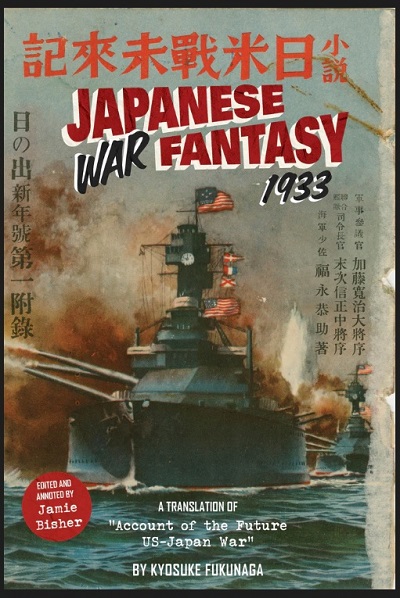
1933 techno-thriller written by a Japanese naval commander with forewords by 2 prominent Imperial Navy admirals, annotated and illustrated with period archival photos.
The book gave readers a foretaste of the strategy, tactics, and weaponry of the next world war and foretold roles of naval air power, submarines, radio communications, intelligence, civil affairs, propaganda, and racial unrest. The book foresees Japanese attacks on Guam, the Philippines and Hawaii. But Fukunaga’s most eye-opening revelations reveal Japanese strategists’ faulty expectations of an American enemy that supposedly lacked the will to fight.
After the book dropped onto Honolulu docks on December 7, 1933 (!), US Customs quietly confiscated Fukunaga's book—-prompted by concerned Japanese Americans, who thought the book might seduce impressionable young Hawaiian Nikkei to treason and poison race relations. Nevertheless, this unusual ban of a work of fiction ignited headlines around the world after US intelligence leaked a translation of the novel to a Hearst newspaper in Washington, DC. The incident faded from public memory, and the translation was tucked into a file in the military intelligence archives. In 1941, a slew of Japanese bombshells rained on Pearl Harbor and turned Fukunaga’s fantasy into reality. Japanese War Fantasy 1933 delves into the content, background, and impact of Fukunaga’s explosive novel and also examines other prewar Japanese propaganda efforts in the Americas. Using the contemporaneous translation of Fukunaga’s text by military intelligence linguist Maj. Edward J. Witsell, editor Jamie Bisher presents an annotated version of the controversial novel, illustrated with artwork and photographs from the Naval Historical Center, National Archives, Library of Congress, and Gordon W. Prange Papers at the University of Maryland.
Excerpt
The first Japanese bombshell dropped on Hawaii in late 1933. At first glance, it
appeared to be merely a crate of little comic books that were offloaded from SS
President Taft and addressed to George Kojima’s Honolulu bookstore. A second
consignment would be confiscated a few days later. To US customs agents, the
crates contained explosive material: a riveting techno-thriller outlining an imminent war between Japan and the United States—propaganda intended to seduce Hawaiian nikkei to treason. The book was written by a retired Japanese naval officer named Kyosuke Fukunaga, endorsed by admirals of the Imperial Japanese Navy (IJN), and distributed by a popular Tokyo magazine with a large domestic and international following. The provocative future war novelette was a bombshell that would reverberate from Honolulu to Washington and back to Tokyo.
|


