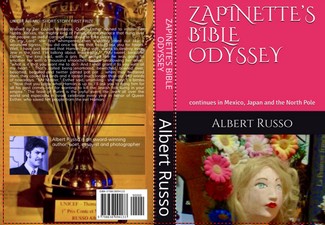
Zapinette lives with her mother, a staunch ‘felinist’ who owns a beauty parlor in Paris, as well as with her ‘Unky Berky’, in spite of the fact that he is “such a weirdo at times and can get on her bloomin nerves”. They will travel to four continents together and the trips promise to be quite bumpy. In this book, she investigates the BIBLE, and goes on to visit MEXICO, JAPAN and THE NORTH POLE.
Zapinette's Bible Odyssey continues in Japan, Mexico and the North Pole
WORLD LITERATURE TODAY:
“... This series is a great ramble, rather like a chapterless Montaigne popping from one subject to the next, drawing connections no one else would ever have thought of, but with Groucho Marx, say, passing on hints over the writer’s shoulder as to how to go about it. We readers chuckle along and even burst out laughing as we advance through this hilarious book, but we gather, we too willy-nilly, the serious messages underlying the frolicking bounce and jocular mode of the writing.”
THE LITERARY REVIEW:
“... Be warned, Zapinette's gems of insouciant wit tend to become infectious. This wise-child's deceptively worldly innocence takes the entire gamut of human endeavor in its compass. Hardly anyone or anything escapes unscathed, like the heroes of the Bible, from Abraham Moses and Noah, to Judith and Queen Esther, among many others, all come under Zapinette's delightfully zany fire as she "zaps" from topic to topic in an irrepressible flux. As the century of the double zeros is with us - 2020 -, we have seen the future and the future is sham. As a healthy dose of counter-sham, Zapinette should be on every brain-functional person's reading list.”
SMALL PRESS REVIEW:
“ ... The narrator of Albert Russo’s Zapinette series, is a little girl of our time, very knowledgeable about the outside world, but also enormously ignorant of the language commonly used about it, and, as a result, very funny. Her phonetic transcriptions of what she hears and her malapropisms make of her a powerfully distorting lens but, strangely enough, also a reliable witness. Albert Russo has thankfully spared us all the clichés of the genre, and what we read in his novel is a genuine portrait of a genuine child.”
The Gosh Zapinette series is published by Cyberwit.net, India, under the title GOSH ZAPINETTE! 6 episodes have appeared in his own French version and 8 episodes in Italian translation, all to be found on Amazon and other online bookstores. In 2018 it won the prestigious Book Excellence Award for Global Jewish Humor.
Excerpt
Warned by her cousin Mordecai, Queen Esther rushed to inform her hubby, Xerxes, the mighty king of Persia, of the menace that hung over her people: an awful carnage was about to take place.
Oh my Lord” she first whimpered, then suddenly cried out like a wounded tigress, “You did once tell me that I could ask you for favors. Well, I have just learned that Haman, your vizir, wants to destroy every Jew in the land. I’m talking about my people.” “My sweet, beautiful Esther,” the king said, with a grin that looked like he was going to smother her with a thousand smooches, before swallowing her alive; “what is it that you want me to do? And I shall grant it to you with all my heart.” That’s called being enamored, bewitched, bowled over, besotted, beguiled and twitter patted pat pat ... when they twittered then, they cooed like birds and it lasted much longer than our 140 words of nowadays. “My Master,” Esther said, unsmiling - she wasn’t a bimbo - “Now that you know what Haman is up to, I’ll ask you to hang him for all his past crimes and for wanting to kill the Jewish folk living in your empire.”
The feast of Purim is the joyful event the Jews all over the world and especially in Israel celebrate every year in honor of Queen Esther, who saved her people from the evil Haman.
Professional Reviews
David Alexander in THE LITERARY REVIEW
On the road to the 20thcentury the German poet Heinrich Heine wrote, "Give me a mask and I'll join the masquerade." At the turn of the 21st century, Albert Russo has written Zapinette Video, a novel that is an acerbically witty commentary on fin-de-siècle human foibles, which are dissected with clinical precision, diabolical humor and something of the grand satirical style of Voltaire or Montaigne. Russo's mask in this particular masquerade is the story's protagonist, a precocious preteen named Esmeralda McInnerny, who's been nicknamed "Zapinette" by the novel's other main character, her Uncle Alberic, called "Berky" by his inventive niece.
Voltaire wrote that to crush "the Infamy" of his time "it must first be rendered ridiculous." Our era's Infamy, like that of any age, is founded on hypocrisy. It is this that Russo ably attacks with Pasquinading relish from the first page to the last by donning his mask of a young Franco-American girl and commenting on the world she sees around her as she rambles through it in the company of her uncle.
The novel is not long on plot but doesn't need to be any more so than past novels of its kind, among which I would include Mailer's Why Are We in Vietnam? and Nabakov's Lolita. Nor have Russo's past works relied strongly on plot as engines to drive the narrative. On the contrary, Russo's approach has been to take simple situations and then dismantle them to see what turns the hidden gears. In the process the reader often has shocking peeks into the clockwork mechanisms that underlie much of what we take to be reality. Behind the face of the timepiece may lurk a clandestine listening device. Within the marble skin of the Greek statue, a Venusian praying mantis waits to devour. The bard behind the Zapinette mask strips the masks from other less noble forms of artifice and lays bare the sometimes ugly subterranean truth.
For those who would like a quick precis: Esmeralda is the favorite niece of her "Unky Berky” who works for the French post office in a not clearly defined capacity (we gather he is some type of supervisor with much free time on his hands). She has been dubbed "Zapinette" because of her fondness for zapping her way through televisual media, from Nintendo games to rock videos. In many ways Zapinette's narrative is a form of self-generated rock video, the stream of consciousness by which she perceives the world. This, of course, connects to the book's title and sums up the style in which the book is written, but it's also a commentary on the way we more and more tend to view the world around us as a pastiche of disconnected and ambiguous images and sound bites that flash past our minds in an ever-accelerating kaleidoscope that seems to simultaneously energize and enervate.
But back to the plot -- Uncle Alberic is a native of Monza, Italy, and although superficially Francofied from his years of living in Paris, he nevertheless remains Italianate below the waterline. Alberic's longing for home forms the basis for the middle part of the book, where Zapinette and her uncle leave Paris on a tour of Italy. This gives Alberic's young charge lavish opportunities to lampoon some of the bastions of Western cultural tradition, from the Vatican to art film.
The book's other two main characters are Zapinette's mother, Laura, and her live-in lover, Firmin, who has recently fathered a child by Laura. Laura, who is Berky's sister, owns and operates a Parisian beauty parlor. She is a staunch feminist (or "felinist" in Zapinette-speak, about which more momentarily) who has a don't-tread-on-me attitude when it comes to men. This attitude is one reason why Zapinette's father is not in the picture -- he was a casualty of Laura's wrath some years before, leaving the American-born daughter in the care of her Parisian mother while going off to seek his fortune in the Amazon.
One of the devices Russo uses to make his point and to carry the narrative is the unending stream of Malapropisms, or more properly, "Zap-apropisms," that emerge from the mouth of this not-so-innocent young girl. They come rapid-fire, like a hail of machinegun bullets; they come in neo-Joycean flashes that wriggle and jump in the narrative stream like darting fish from the thought-dreams of Leopold Bloom striding through an Icarian Dublin. Should you chance to hook one of these delicious little
minnows and roast it on the spit of your mind, you may never think the same again. My favorite Zap-apropism is "fonda-mentalist," which makes me think of Jane under an Ayatollah's turban, bearded and with eyes darkly ablaze.
Be warned, Zapinette's gems of insouciant wit tend to become infectious. This wise-child's deceptively worldly innocence takes the entire gamut of human endeavor in its compass. Hardly anyone or anything escapes unscathed. Michael Jackson, Vittorio de Sica, Freddy Mercury, Mao Zedong, Arnold Schwarzenegger, Bill and Hill, the Pope, Fidel Castro, and even Jesus of Nazareth all come under Zapinette's delightfully zany fire as she "zaps" from topic to topic in an irrepressible flux. Interspersed with Zapinette's first-person narrative and meta-portmanteau words are periodic Ripov stories, short-shorts that offer paradoxical and whimsical commentary on the rest of the book (Zapinette explains that Unky Berky pens these stories during slack time at La Poste).
Russo's command of the American idiom is always on the mark, as is his keen eye for sham in its many permutations.
As the century of the double zeros is with us, in its second decade, we have seen the future and the future is -- well, here's how Zapinette might put it: The frying pan is on the stove. This is the future. We hold two eggs over the frying pan. This is your brain. We smash the eggs together and drop the yolks into the frying pan. This is your brain in the future. What you need is a dose of reality, fast. This is Zapinette Video.
Reviewed in INSCRIPTIONS magazine
Pre-teen Esmeralda McInnerny lives in France with her Italian mother and sexually experimental uncle, Alberic. Unky Berky, as she calls him, has given her the nickname Zapinette. Zapinette spends her days obsessed with adult sexuality, which she does not completely correctly grasp. This does not stop her from drawing her own very strong conclusions about the adult world of sex.
The book is also sprinkled with short stories written by Unky Berky about a character named Ripov, who encounters many situations.
The plot of "Zapinette Video" is minimal. The action that takes place is merely a backdrop for Zapinette to paint her wacky conclusions on and for the character of Unky Berky to flit through.
Russo's characters make the book. Zapinette is wise beyond her years and yet is wildly ignorant about some things. As the narrator, her personalized language gives the book some wonderful humor. She refers to "sigh-kayak-trysts" (psychiatrists) and discusses with great fascination the fact that Unky Berky was once "heather setchual" and is now "homey." She also considers that he may be "bike" and is shocked to learn he is a "transvestit."
However, she is still a child and has many tantrums and childish outbursts towards her mother and uncle that reduce her to a low level in the reader's eyes. Unky Berky is fun to read about, but his Ripov stories may not enchant all readers. The other characters are minor, and provide some interesting humor.
Russo's writing style is extremely creative. His playfulness with language is one of the best aspects of the book. Skip this one if you are bothered by frank talk about sex and the use of taboo words. He shows no fear and brings forth the most shocking things from the mouth of Zapinette.
Beyond the enjoyable creativity, there is a deeper meaning to the story. Zapinette, who was abandoned by her father, clings to Unky Berky as her father figure and is plagued with worry that he will leave her. Her desperation is the somber current beneath the humor, and offsets it quite well. This is an excellent book and would be even better if the Ripov stories were minimized.
Review in WORLD LITERATURE TODAY:
In the world of creative art, nothing can be more exciting and at the same time rarer and riskier (for the creator as well as for that creator's audience) than when an artist, who has established and settled within certain well-defined artistic limits, suddenly takes off on a new tangent into a completely different subrealm of that same art. It happens more often in music than in literature. Bach dared embark on a Kaffee Kantate , Verdi turned from Otello to Falstaff , and Haydn relished surprises throughout his career, not only at the end of one syrnphony. On the other hand, Colette did whip off a libretto for Ravel's L’enfant et Les sortilèges , as did W. H. Auden and E. M. Forster (no less) for Benjamin Britten's Billy Budd ; but Sigmund Freud never wrote limericks, and Lewis Carroll, for sure, would never have dared attempt a sequel to Middlemarch .
Well, surprise, surprise! What have we here? World Literature Today has already noted in its pages (see WLT 70:1, pp. 79-82) that Albert Russo is uncategorizable, but still, from the heartrending seriousness of his previous novels, all concerned with Africa, with the inextricable and excruciating skeins of colonial racism versus individual lives and loves, here we have a light-as-a-feather comedy of a twelve-year-old petite Française reflecting on life as she continues constantly to be astonished to find it, what with its mysteries et boule de gomme (the latter term being argot for pastilles, a medication impossible to swallow whole, having to loll upon the tongue until dissolving (the entire phrase, an excellent metaphor for all that is incomprehensible), and nothing is more mysterious and incomprehensible to her than the human comedy relating to matters sessuelles , whether they are mot, bis, or météro . In short, Zapinette is prone to malapropisms. She even hears them, willy-nilly, and reports on them as well as she can.
Nevertheless, Russo is here still standing up for minorities and against the injustices inflicted upon them, in this case 1) children, whose thoughts and ideas, Russo maintains (and I think rightly), can be just as sophisticated as any adult's, even though they do not yet know how to articulate them in conventional terms adults or indeed other children might readily understand; and 2) sessuel deviants, who, whatever else might be said, are living human beings who have as much right to life, liberty, et cetera, as anybody else. At the same time he is 3) poking great ironic fun at that majoriry of the world's religions which seem to lead to more bloodshed than morality. Even the pope gets a lash of Russo's forked tongue. We readers chuckle along and even burst out laughing as we advance through this hilarious book, for it is very funny indeed; but we gather, we too willy-nilly, the serious messages underlying the frolicking bounce and jocular mode of the writing. From Sang Mêlé ou ton fils Léopold to Zapinette Vidéo , what an extraordinary evolution!
Actually, we ought not to be all that surprised. We have already caught glimpses of Russo's impish humor throughout his oeuvre, often in his most serious passages, not least as put into relief during sexual clinches. Focusing his attention on the most grotesque of human prejudices, Russo has always kept us aware of the farcical, misconceived absurdities shared within in-groups, all in-groups, only previously the contexts were so utterly serious and we as readers were so caught up by their dramatic contexts that we may not have been aware of the technique, as old as Shakespeare, Chaucer, and the Greeks, of heightening horror by contrasting it with comedy. In Zapinette Video , for the first time chez Russo, we find the humor outrunning the serious, thereby exposing for example homophobia as grotesque and hypocritical. In this connection I find the character of Uncle Alberic, un mot sessuel as I caught glimpses of him through the necessarily distorting lenses of Zapinette's childhood, a most intriguing personality, and even took to daydreaming about what a great tragic hero he might make in a perfectly straight-forward serious novel. As on so many topics Zapinette hits upon, one longs to hear more. What would she herself say about this novel we are to imagine she has written if she could view it herself some twenty or thirty years hence? We appreciate that Russo knows more than he is allowing Zapinette to tell.
I had better point out that there is not much plot as such, no more than necessary to pinpoint all the characters' stations in life and the directions of their movements within them. Her uncle rebaptizes her as Zapinette Video because she is constantly weighing the events life tosses her way in terms of what she has sat through or zapped, as the case may be, before the tiny screen known in anglophone countries as ‘the boob tube,’ and rest assured, Russo has his say on the image of the world that this technological miracle has inflicted upon today’s youth and the not-so-youthful too. Or rather, between the lines perhaps, the plot deals simply with the prepubescent Zapinette's transition to the portals of adolescence, where makeup suddenly interests her for reasons she cannot yet label. Eventually, glimmerings do come to her as to why adults make such a fuss about things sessuelles , along with a suspicion she will eventually be making just as much fuss herself. The book is a great ramble, rather like a chapterless Montaigne popping from one subject to the next, drawing connections no one else would ever have thought of, but with Groucho Marx, say, passing on hints over the writer's shoulder as to how to go about it. But trying to trace the line that motivates your sticking with a novel from its first to its last word is always idle work. I felt this idleness last year while reading Stevenson's Kidnapped and tried to analyze its unput-downableness, and concluded that only the word magic explained it. Some writers have it, some writers twist themselves into pretzels to approach it, other writers do not have it at all. Russo has it.
I read prepublication proofs of Russo's novel (although passages are already being read aloud in intello circles) and I have not yet seen any reviews, yet I predict not only popular but critical success. Inevitably, some smart-ass critic is going to call it the Zazie dans le métro of the nineties, but any resemblance between the two is surely fortuitous and any comparisons can only rebound to Russo's advantage. Incidentally, pages 9-15 of the book proper contain an excellent avant-propos by jean-Luc Breton, which certainly should whet your appetite if my words fail to do so. It is scholarly, warm, human, and incisive, and makes me feel humble indeed.
Initially, I found myself in a sea of confusion until I quickly allowed my mindset to enter into the upside-down world that is that of a preteen girl, Zapinette. Her use and twists on language then becomes hysterical. As an example, I have included two of my favorites: "setchual" and "sigh-kayak-trix" to provide you with a sampling of what to find throughout the book. "Zapinette's Bible Odyssey" begins with my favorite part (would love to read more) where Zapinette shares her opinion on many characters from the Bible. I might add that knowing your Bible can make reading this section easier to follow, but either way, the retelling of the stories are priceless. I laughed out loud at the suggestion that the "Barak" (son of Abinoam in Judges) was an ancestor of Obama. One quickly grasps an understanding of Zapinette's religious belief through her continued use of the phrase "Goddess Almighty" throughout the book. The storyline then switches to tales of her travels across the world with her quirky Uncle Berky, popping from one subject to physical description to the next beginning with the planting of an imagine of Uncle Berky standing in the airport in his underwear whenever asked to remove his belt causing his pants to fall. Beneath the humorous game of word association is a well-written novel containing some vivid location illustrations that transport the reader. Zapinette takes us past political correctness and religious hatred with the truthfulness of a child's innocence and she seems to have an opinion on every topic. Albert Russo has created a "genre" all of his own with the world of "Zapinette's Bible Odyssey" that uses comedy to convey many "nuggets of truth." This delightful novel is an entertaining, tongue-in-cheek collection of adventures that I highly recommend.
Is Justice Finally Overcoming the Ford Valley Corruption?
Judge Sherman Ford, the patriarch of the Ford family is continuing to control and corrupt Ford County. The newly elected sheriff, Todd Mercer, and friends are slowly taking control
Is Justice Finally Overcoming the Ford Valley Corruption?
Judge Sherman Ford, the patriarch of the Ford family is continuing to control and corrupt Ford County. The newly elected sheriff, Todd Mercer, and friends are slowly taking control