Click here to buy this book!
Kindle Edition
Download to your Nook (eBook)
Download from Smashwords (eBook)
Amazon
Lulu
Barnes & Noble.com
Category:
Travel
Publisher: Mark Plimsoll, LLC
ISBN-10: 0557133742
Type: Non-Fiction
Pages: 258
Copyright: Jul 20, 2009
ISBN-13: 9780557133741
Price: $2.99 (eBook)
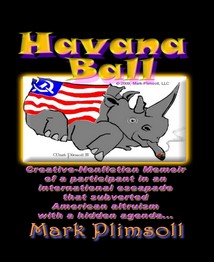
The bilingual author, the only one who speaks Spanish among all the North American volunteers who paid a "Christian" organization to bring aid to Cuba, shares this thorough recount of philanthropy gone awry, it's motivations and effects.
Come along with bilingual Yankee Mark Plimsoll to Havana, and feel his frustrated hilarity, caught between the blind realities on BOTH sides of the linguistic fence. Mr. Plimsoll joins a North-American 'Christian' philanthropic caravan of about three hundred people who come together in San Diego to deliver used computers to Cuba. The core group of about two hundred 'Caravanistas' from North America each donated computers, or paid around $1,000 to go to Cuba, ostensibly to help end the trade embargo, U.S. sanctions against the island nation, and quell U.S.-instigated accusations about Cuba's Human Rights violations. However, the 'religious' leadership advertises their illegal border crossing into Mexico to provoke a showdown with the Feds in the name of Civil Disobedience.
Of course, the Feds win, and take away all the computers.
The 'Caravanistas' hear words of encouragement- to sit it out in a hunger strike until they get the computers back. This does not sit well with everyone, especially not with the outspoken Mark Plimsoll.
The leadership decides to send Mr. Plimsoll and about seventy others who feel betrayed and cheated, on to Cuba without the computers. There, the Cuban Government chaperones take them to eco-tourism hotels, Historic Downtown Havana, the beach, the Cuban medical infrastructure, and board of directors, a private forum with the Cuban Secretary of State, Havana's premier Salsa Club, a Martin Luther King center, farming cooperatives, planned communities, Communists neighborhood associations, Santeria rituals, and more.
Mr. Plimsoll escapes with friends either Cuban or from the United States, and we benefit from his literate, street-level view of Cuban realities with gays, actors, whores, marijuana addicts, penniless and hungry young adults, grandparents renting bedrooms, etc. He also witnesses the rebirth of Havana's Mardi Gras 'Carnaval' after a lapse of six years, and introduces us to a fictitious middle-aged American named Richard, who hopes to have found a wife in a big-breasted Cuban entertainer named Wendy.
In this true account, we experience first-hand the shifting levels of interpersonal understanding among this "Friendshipment Caravan," lead by multi-denominational religious leaders and their followers (all with multiple and oblique agendas) trying to understand Cuba as Mr. Plimsoll adroitly describes the comedic confrontations with police, Feds and the FBI, professional protesters, star-crossed lovers, and U.S. Customs agents- and in Cuba, the sexual magnetism between people with money, and people with NONE.
Excerpt
Santeria Watches Over You
This evening The Government Chaperones invite us to a local CDR, a Committee for the Defense of the Revolution. The way they explain these street-level autonomous units of government, they sound like a Neighborhood Watch groups, full of concerned citizens that will write down the license plate numbers of suspicious activity, like your house guests.
Once inside the empty one-room house, the task list, a large poster displayed on one side of the small stage, dispelled that notion. A poster, labeled Community Organization for the Defense of the Revolution, listed the tasks, crudely hand lettered, but very legible. Work that one could do for the neighborhood, such as clean the streets, help older citizens, go on a work detail, organize the communal properties, etc. earns a standard number of points. Each month the person with the most points earns a special prize, either "metal" which means something metallic (money), or a trip to the beach.
It struck me that the same go-getter might win every time, and rob the incentive for others to try.
More people come in. The meeting starts, the excited crowd of Cubans settle down. We hear from a ten year old boy with other sentence by sentence translation as he tells us the story of how he cut his fingers with his machete while on a work assignment, cleaning the tombs of the war heroes. This touching story serves to dramatize Cuba's free medical system.
Ellen compliments him on his "poise and leadership," and I hear 'Poison leadership'.
Our leaders coax us outside to witness a Yoruban Folk Dance.. The drummers pound oversize congas, and out of the crowd bolts a young barefoot boy, dressed in red long sleeve shirt and tight red calf-length pants, a red kerchief tied across his hair, low on his forehead. He scowls, smokes a cigar, and somersaults randomly across the open area in the middle of the crowd, then stands arms akimbo to intimidate someone then roll away again.
A torrential downpour forces everyone back into the meeting hall. The Cubans let us work our way to the front near a small open area in the center of the room. I walk along the back of a small, dark stage where earlier a pile of drums of various sized lay among the cushioned embrace of some blankets. The drummers and singers wear normal street clothes, difficult to know who is who. One of the female vocalists motions me over to a seat on the front edge of the stage. Young and black, she takes her place among the other black faces in the choir and smiles along. The five drummers take the stage in front of the seven vocalists, and all start over. The red boy rolls and with perhaps more theatrical rudeness, forces his way between and under the seats of audience members, to much laughter from the surrounding crowd. The music swells with vocal chants, as drum rhythms change to accentuate the boy's strange impudent mood, He yells "Cak cak cak cak cak," like a jungle bird, from under a chair, behind someone, or nose to nose with a befuddled Caravanista.
After about fifteen minutes of shenanigans, a very pretty young woman sways out in a full white dress with colorful floral midriff. Another pretty mulatta ties a matching floral cloth around her hair. She dances, swirls and swirls, stops to stare impudently, arms akimbo, and launches a derisive laugh at the vocalists on stage, then stares over the heads of the crowd, as if some spiritual suitor perched in the rafters and begged for her approval.
The drumming and music changed, the complex and well-practiced pace kept us attentive, whether we knew why or not. No one appeared bored, but mystified, on edge. The final dancer, a young man dressed in white, goes through the motions of planting a field. His sedate performance carried none of the derisive intimidation of the boy and the young woman.
After the Yoruba folk dance, our leader Ellen made a speech of gratitude, translated sentence by sentence into Spanish, so that she could speak for us Gringos in our native tongue. She looked like a Saint on-stage, her frank and honest expression framed by that tremendous mane of brown hair, her sincere eyes dart about the audience from behind the twin portholes of her glasses while both her hands move in perfect symmetrical harmony. They bounce off her chest, as the house of her heart to implore with every expression of her face ad hands. her "fervent hope that the equanimity and good will of the Cuban society be carried back to the United States to perfect our society as well." She all but cries with sincerity, as if the profundity of her affection for her adopted Cuban people plummets far below a mere altruism to plumbs the depths of her very soul.
I talk to the musicians while they pack up their drums. Seems like the leader, I think- a tall slender black man whose face triangulates into the protrusion of his giant lips. With a demeanor serious as cancer, he looks like a Caribbean gangster,
I approach him as a fellow musician, and hope for the best.
After he packs most of the drums, he explains the symbols behind the three dancers. It doesn't ring true to my observations, but then he belongs to these beliefs, and whatever their origins, their meaning must now come from the practitioners. Unfortunately, the veracity of historic symbols suffers in the popular subconscious, when one considers that Easter now symbolizes the resurrection of Christ, and no longer speaks about fertility, even with such potent symbols as eggs and rabbits.
They practice their drumming, their religion, everyday from 6:00 PM to 9:00 PM.
That explains their excellence with such complex rhythm changes, the vocal stylings, and the practiced dancers. I wonder how many different songs, or song-cycles, they know, and how many hours worth comprise this one small group's repertoire.
Then we go outside for a street dance.
Black rectangular boxes of various size speakers, stacked into tall towers fill a porch area under the protective eaves, and behind some wire fencing. They boom and sizzle with good Salsa music.
All ages of Cubans start to dance. Some Cuban females corral the older solitary male caravanistas, who comically fail to mimic their Cuban partner's expert sexual writhing, even with bug-eyes lock onto rhythmic hips. Our gray haired countrymen look like zombie spirits lost in a purgatory of clumsiness alongside these integral spirits of pure dance. Cuban onlookers couple and join in with glances of mirth and friendship. The younger Cuban couples, exhibitionist and proud of their suppleness, practice intricate moves on the edges of the crowd, alongside our bus, or back by the knee-high white picket fence across this gravel lane.
Little four year old girls shock us Gringos. They dance with the same pelvic abandon as their mothers. Everyone grooves to the beat under the cloudy night sky. Streetlights illuminate the frozen lightning bolts of thin-leafed tropical tree branches overhead, while the thunderous salsa bass emphasizes the intricate syncopation of the instruments and vocal lines. The vocals often sound like extemporaneous ramblings, scat singing by deaf singer.
I notice people sing along.
Choruses of voices intersperse along the flow of the song undergo subtle changes that hint at a complex and evolved musical form, a classical music of rhythms that dominates the jazz harmonies.
No one drinks. People appear from the neighborhood, called by the music, as others gather the kids from the walk back to the house. This could last all night. I feel no sense of the urgent adage that time equals money, no sense that money equals time. Tomorrow comes, in a couple of hours.
Unfortunately, our chaperones control time, so we get back on the bus.
|