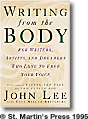
A book about spirit, creativity, and the inner life of the writer. Certain writing books go beyond questions of craft and art to explore the deepest wources of the creative impulse. Writing from the Body is not a "head book"; it's a heart book, a shoulder book, a hand book, a back book, and a soul book that liberates writers from the shackles of self-consciousness and doubt.
Inspiration: The Breath and the Word
Because I felt betrayed by my body, as I grew older I continued to dissociate myself from it . . . To my way of thinking, the life of the head was surely to be preferred to the life of the body . . . I had so little bodily awareness that I did not realize that, by cutting off my breathing, I was also cutting myself off from my sensations and feelings.
-- Kate Dawson, Leaving My Father's House
The Spanish poet Federico Garcia Lorca once explained that all true art must be produced out of the "energetic instinct" that Spaniards refer to as the duende, "the mystery, the roots that probe through the mire that we all know of and do not understand." In his essay on the duende, Lorca paints in a number of ways the necessity of the artist's intimacy with the Shadow Self, the "black sounds" that our words carry when, as writers, we have touched our own darkness and reemerged vulnerably awake, humbled, and even more alive. We must fully reclaim the breath, because without it the body withers and so does our writing. The message written by the tight chest, the stilted body, carries no duende, no darkness, no belly stretched wide by the breath. Such writing is a mere whistle. It rises up like a ghost, substanceless, with a mask for a face, and we do not believe it. What must we do to reclaim the body, the breath? We must address the fear that paralyzes us, the darknesses we have held back like stifled coughs and whispers. We must open ourselves, allowing the wind to enter and change us. Imagine you are going to the page right now, with the thought, "I'm going to write something." You may even want to go directly to your desk and sit in front of the blank page with pen in hand, to embrace the full experience of beginning to write.When you did this, what happened to your breath? Did you find yourself breathing deeply, the full and even rhythm of your inspiration moving naturally through you? Or did you tighten up, making shallow inhalations, perhaps even holding your breath? When we human beings are scared, excited, hurried, or anxious, we stop breathing. The sight and sound of a distressing scene, or the momentary flicker of a past trauma, causes us to hold our breath. Shallow breathing is a way of stopping short, of postponing full involvement in whatever is going on. By shutting down our air supply, we can alter our consciousness.We begin to feel lightheaded, our eyes glaze over, and our emotions recede into the distance. They recede; they don't disappear. To begin writing with the full power of our body's knowledge, we must welcome our life, our breath, and our emotions completely. We have only to begin breathing fully to show Life that we are serious about embracing her.
Excerpt
"The call to write is a call that's received in the body first. If we are to answer this call, we have to feel every part of our lives. In this book you'll learn the grammar of the gut, the syntax of the sinews, the language of the legs. For everyone who is tired of living life in the little closet between the ears, get ready."
Professional Reviews
From Library Journal
Much of this book is based on counselor Lee's workshop of the same name. It promotes his Zen-like approach to writing, using exercises and meditation to free the inner voice from inhibitions and seek out one's truths. Targeting those with writer's block, Lee argues that the call to write is felt first in the body, and his exercises seek to find that call. With chapter titles such as "Loving the Inner Artist," he aims to build the writer's self-esteem. This work is more about writing as therapy than about writing technique, and it is written with a level of zeal more often found in self-help books. Though Lee's counseling insight seems genuine, the content is thin; there may have been a breakdown in translating the workshop into a book. Still, this title might cure writer's block, and it's cheaper than a therapist. It could find a home in large writing collections.
Robert C. Moore, DuPont Merck Pharmaceutical Co. Information Svcs., N. Billerica, Mass.
Copyright 1994 Reed Business Information, Inc.
Personal journals are full of potential, waiting for you to add the color! Pages for you to fill in the blanks with tidbits and trivia about New Mexico
Personal journals are full of potential, waiting for you to add the color! Pages for you to fill in the blanks with tidbits and trivia about New Mexico