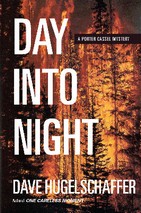
When a raging forest fire cannot suck in air quickly enough, smoke turns black, blotting out the sun and turning day into night. To a firefighter, this false dusk is a sign of conditions turning rapidly from bad to worse. But Cassel has more than just fires to contend with—he is a man with a tragedy in his past and the situation becomes more complex when he is framed for the murder of a suspect.
Excerpt
By the time I arrive, the fire has grown to an area the size of a small city. The view from the helicopter is impressive. Ten thousand acres of burning timber in a sea of green trees. A ragged rim of orange flickers at the crescent head of the fire and smoke rises like an erupting volcano in a column twisting miles into the sky, blotting out the sun, turning day into night. Aircraft glide silently around this conflagration like insects around a host. Some watch while others dump pitifully inadequate strings of water and red fire retardant in the path of the monster.
This monster will not be stopped. Not for weeks or months.
The helicopter banks, begins to descend toward a tiny clearing in the forest where men swarm like ants around tiny bulldozers and trucks. Base camp, but I’m not ready to deal with that chaos—my business lies at the heart of the fire. I may already be too late. I look at the pilot, shake my head, speak into the microphone which juts down from my headset.
“Not yet. I want to go for a few laps, take a good look.”
The pilot nods, swings back toward the fire. A young guy with red hair and freckled arms, his company is charging the Forest Service a thousand dollars an hour and he doesn’t care where he’s flying, just wants to keep the machine in the air as long as possible. A fire like this requires long hours and a lot of money. A million dollars a day for aircraft, manpower and supplies. I start to say something but the pilot cuts me off, calling base camp with our change of plans.
“...base, this is whisky-alpha-kilo, requesting entry into the fire zone.”
The reply is curt, metallic. We can do a few circuits at five thousand feet. Too busy, farther down. I’d hoped for a closer look, but at this stage anyone who isn’t moving equipment or dropping something on the fire is considered a tourist. We spend ten minutes floating high above the action. From up here, human effort is invisible and the fire continues on its appointed task of grinding up one generation of trees for replacement by another. There’s an eerie beauty to it, a serene single-mindedness on a staggering scale.
“You with the overhead team?” says the pilot.
“No. Fire investigation.”
There’s a pause as the pilot digests this. “They think someone started this?”
“It’s a possibility. The LLP didn’t pick up anything.”
“The what?”
Like any occupation, we have too much jargon, too many acronyms. “The lightning detection system. We’ve got lightning detectors spread across the province. They haven’t picked up anything here this spring. Still too early.”
A wry smile from the pilot. “I knew an Indian named Lightning once.”
I nod. “It’s happened before.” When it gets too quiet, the native employment program can kick in. But it’s not just the natives that get restless when there’s no work. The unofficial Forest Service definition of fire is a chemical reaction that converts biomass into overtime. “I heard of a pilot who used to drop White Owl cigars from his machine.”
The pilot’s grin widens. “Yeah, I heard that one too.”
We watch in silence for a few more minutes, staring down through the bubble windshield. The Ducks have arrived—two bright yellow planes that can skim water right off the surface of a lake, drop and return for more. Nothing better, if you have a lake close by, but this fire is on the slopes of the Caribou Mountains, a steep plateau rising out of the northern forest. They’ll have to skim off the Peace River, twenty miles away.
“So you’re going to figure out who started this?” says the pilot.
“That’s the idea.”
Looking down, he shakes his head. “You’ve got your work cut out for you.”
I agree. As usual, investigation is one of the last thoughts during the initial flurry of actioning the fire, hiring equipment and manpower, setting up camps. No one bothered to flag the area where the fire started when it was smaller and it’s grown another thousand acres since I’ve arrived. The bigger the fire and the more people working on it, the harder it will be for me to do my job—find the point of origin and protect what evidence might have survived.
The pilot is curious. “Where do you think it started?”
“Well...” I wait until we’ve done another half circuit, then point. “According to the weather report from the towers, the wind has been continuous from the northeast. The fire probably started over there and, if it was arson, from someplace with access—a cutline or road. With the dry conditions, the firebug would want to clear the area fairly quickly. You can see a group of cutblocks at the tail of the fire, a mile or so off a lease road. That would allow a bit of privacy and plenty of logging slash to get the fire rolling.”
“So you think it was arson?”
I chuckle. “Pretty hard to tell from up here. Could have been anything, like an old campfire or the hot exhaust from someone’s off-road vehicle. I had one fire started by a broken bottle.”
“A bottle?”
“The curve on the bottom acts just like a magnifying glass.”
Our conversation is interrupted by a call from base camp. Is Porter Cassel on board?
The pilot looks at me. I nod.
The two other members of the investigation team are at camp. I’m to report back for a briefing. The pilot looks at me and I mouth a question. How much fuel does he have left? The reply—two flashes of the hand—ten minutes. I consider, shake my head. The fire is growing, with men and heavy equipment being deployed at the rear, which will make my job exponentially more difficult. “Can you drop me in that cutblock over there?”
The pilot hesitates. “You got a radio?”
I nod; my gear is stowed on the rear seat. As we descend, the fire seems to grow rapidly in size. The pilot takes a few minutes to pick a safe landing spot and I climb out amid a rotorwash windstorm of ash and flinging bits of charcoal, hunker down with my eyes closed. A minute later the machine augers away toward base camp, leaving me alone in the black.
On the ground, the fire is no longer a serene abstraction. I’m in a wasteland at the rear of the battle, my strategic view replaced by a limited vista of charred stumps and tendrils of rising smoke. The air is hot, acrid and hazy, filled with the pungent scent of burned wood and moss. Visibility is down to several hundred yards. I slip on coveralls and a hardhat, check my radio, shoulder my pack and take a good look at the ground.
* * *
A fire is like an animal. It is born, feeds, travels and eventually perishes. And, like an animal, it can be tracked. The beast always travels outward from its point of origin, its behaviour modified by weather, fuels, and topography. As it travels, it leaves clues that can be read like a series of arrows that point to where it has been. One clue taken out of context can be meaningless but the indicators taken together are unmistakable.
The faint whine of approaching heavy equipment floats on the breeze. Cats on a flanking action cutting fire guard. Soon, dozers and men dragging hose will obliterate the finer clues. I must work quickly.
White ash imprints, like the chalk outlines of a crime scene, are all that remain of the logging slash in the cutblock. The fire here was very hot, indicating the origin is still some distance away. I underestimated the rate of spread and should have had the pilot drop me closer to the rear of the burn. But even here, there are clues. The smouldering stumps have deeper, bowl-shaped burns in the direction from which the fire has come.
I walk northeast across the cutblock. I’m wearing new work boots, trying to break them in; it’s working more the other way—my shins and arches already aching. There comes a not-so-distant thud of metal hitting wood, followed by a deep growl and the crash of falling trees. The Cats are closer and I begin to run, ash rising behind me in a powdery cloud like the wake of a truck travelling down a dusty road. Overhead, water bombers rumble and swoosh. At the edge of the cutblock I pause, check my mental map of the area.
It’s easy to become disoriented with a fire this size, but from what I remember there are a dozen more cutblocks in this direction, each separated by rectangles of uncut forest. The quickest route is through an uncut patch ahead of me but I’m not crazy about wandering through a stand of immense trees, roots burned out beneath them and balancing like some world record attempt. As if to underscore my concern, a tree topples, taking with it a dozen more as it falls.
I try not to think about it as I enter the stand.
The burn pattern in the tree tops and scorch marks on the trunks tell me I’m travelling in the right direction, getting closer to the origin. In the open safety of the next cutblock, I breathe easier and examine the ground as my boots stir ash as fine as talcum powder, crunch over blackened debris. The unburned shadow of logs lying on the ground and scorch patterns on exposed rock indicate a fast, wind driven fire. I cross a dusty logging road and all signs of fire direction are reversed. Here the fire backed into the wind. I’ve crossed the origin line.
I return to the road, look around.
Smoke drifts along the ground. Along one side of the road are a series of shallow depressions like bomb blasts, filled with fine grey ash—the remnants of brushpiles where loggers heaped together treetops and branches. The piles were probably burned this past winter and one of them wasn’t properly extinguished. A wind came up and a forest fire was born. I walk along the road, shaking my head at this carelessness. The timber company that allowed this sloppy work has learned the hard way. A good chunk of their forest is gone. For confirmation, I use my hand-held radio to call base camp.
“Where the hell are you?” comes the reply.
“I’m in the blocks—”
“—have been waiting for you for a goddamn hour.”
The problem with these radios—you have to wait for the other guy to stop swearing before you can talk. Etiquette is important so everyone gets a chance to communicate. Patience is a bonus; tempers tend to get short under pressure. “Were these piles burned last winter?”
An annoyed pause; other radios murmur in the background. “What?”
“The piles in these blocks, when were they burned?”
“Uhh... stand by one.”
I wait, walk along the road, inspect craters that used to be piles—the intensity of the fire burned the organic matter out of the soil. A group of firefighters trudge past, Natives carrying rolls of hose, their fresh orange coveralls streaked black. When I supervised these crews, it was easy to see who wasn’t working—just look for the guy with clean coveralls. Or black marks that looked suspiciously like handprints. The burn pattern on the ground catches my attention in one area and I spend some time using a stick to rake the ash in several craters.
Nothing. I move on. The ash in the craters is deep. At the fourth site the stick catches something, flipping it out of the ash like a fish rising from the surface of a pond. It’s a small square metal pan, like the type used for baking, but this one wasn’t used for brownies. In the past two years, I’ve seen a pan like this several times. Someone is lighting fires when the hazard is at its most extreme—someone we’ve been unable to identify. The arsonist is careful and the heat of the fire isn’t kind to what little evidence remains. Bootprints are wiped out by ground fire and the pan can’t be fingerprinted after it’s been scorched black by heat. To complicate matters, the other sites were hopelessly contaminated by firefighters. And it doesn’t help that I’ve flipped this pan over, knocking out any residue.
I call base camp again.
“What?” The voice on the other end has forgotten about me.
“The brush piles in the blocks?”
“Oh—right. Stand by one.”
A few minutes later, I get a response.
The piles were never burned.
* * *
The helicopter returns, raising a maelstrom of ash and grain-sized pieces of charcoal that blast my face, settle under my collar and drift down my back. At the edge of the cutblock, a large spruce snag, like an immense black bottlebrush, sways from the impact of rotorwash and surrenders to gravity. Three men exit the helicopter and run, crouching, toward me. A minute later, the helicopter is whap-whapping into the smoke and we blink away ash, tears running down our faces. One of the men—Phil Berton, the fire behaviour specialist on the team—I know. He introduces the others.
“Porter, this is Cam Huspiel, the Fire Boss—”
Huspiel is tall and so thin his yellow coveralls hang on him like a bedsheet over a cross. His equipment belt, with radio, water bottle and first aid kit, sags lopsided from his waist, despite having been cinched as tight as possible. He offers a sooty hand. “Well, used to be,” he says, looking around. “I was initial attack, but the Overhead Team has arrived.”
“Aagh,” I say, knowing how he feels. First on the fire, you call the shots, make the big decisions, get everything moving, then a team of more senior people arrive, take over and you’re relegated to some minor role. Like briefing the Fire Dicks. “My condolences.”
He grins. “It’s their screw-up now.”
Berton has been waiting politely. He interjects. “This is Darvon Malostic.”
I shake another hand, a much cleaner one.
“Darvon is the new investigator on the team.”
I smile. Malostic smiles back. He’s short, seems too young and disgustingly well-groomed with a sort of soap opera presence which doesn’t quite fit with the setting. Maybe it’s because he’s the only one out here not wearing grimy coveralls. Maybe it’s just because I’m not crazy about the change. “Really,” I say. “What happened to Bill?”
“Heart problems,” says Berton. “Doctor told him to stay away from stressful situations.”
“He’s got teenage kids,” I say. “He came here to relax.”
“Yeah, but the doc said to quit boozing and smoking. So he’s avoiding smoke.”
I nod, think about Bill Star; overweight, outspoken and a hell of a good guy. I can’t see myself having long, philosophical discussions at base camp over a pack of beers with Malostic. But maybe I’m just getting old, set in my ways. Never trust anyone over thirty has been replaced by never trust anyone under thirty. I’ve crossed the grand divide.
“So what’s the situation?” says Malostic.
I look around. “Well, we seem to have a process of rapid oxidation, accompanied by heat and light, compounded in severity by significant air movement.”
Malostic blinks, looks confused. I keep a straight face. Sometimes jargon is fun. He looks over at Berton, who tries not to smile.
“Porter is saying we have a fire, driven by wind.”
It takes Malostic a few more seconds to realize we’re poking fun at him, then he looks indignant. “What I meant was, do we have any indication how this started?”
“Follow me.”
I had the helicopter land a quarter mile from the origin, so the rotorwash wouldn’t further disturb the site. We walk along the road to the crater with the pan.
I point. “It started here.”
“Right here?” says Malostic.
“That’s the point of origin.”
Malostic frowns. “You disturbed it.”
“A little. I didn’t know it was there.”
“You’re not supposed to move anything until I get here.”
Not entirely true. Malostic’s job is questioning witnesses, liaison with the police, following up leads while Phil and I locate and document the origin, collect the evidence. But it’s standard operating procedure not to disturb anything until the evidence search and documentation is complete. “It was concealed by ash,” I say. “I needed to confirm it was the origin.”
Malostic sneezes, pulls a Kleenex from his pocket, blows his nose. “You really shouldn’t touch anything,” he says, shaking his head. “There might have been some residue in the pan we could have analysed. Next time, just wait. Or bring a metal detector.”
Berton and I exchange glances. “Good point,” says Berton. “We’ll add one to our kit.”
Malostic nods, looks vindicated. “So, why did he start it here?”
“He used the brush pile to assure ignition,” says Berton, staring at the crater and rubbing his chin. Berton is short, balding, trim and tidy. With his glasses, he looks like a high school math teacher. But he’s been on more fires than I’ll ever see. “He probably used an accelerant like diesel to start the pile. Once the heavy slash in the pile was burning, it threw embers into the block and ignited the logging slash. With a bit of wind, this would produce maximum fire intensity by the time it hit the standing timber, where it crowned out.”
“Crowned out?” says Malostic.
I’m not encouraged. “What do you know about wildfire?”
“I’ve done some research.”
“Research?” As usual, it looks like the Forest Service picked the lowest bidder.
Malostic looks injured. “There’s some excellent material available.”
“I hope so.”
“Crowning is when the fire gets into the tops of the trees,” Berton explains. “To crown the fire needs wind, ladder fuels and sufficiently dry conditions. When it gets rolling, a crown fire is the most difficult sort of fire to fight.”
Malostic is taking notes. “You think the perpetrator knew this?”
“He knew what he was doing.”
Malostic sneezes again, reaches for another Kleenex. “Sorry. Allergies.”
“You’re allergic to smoke?”
He ignores my question. “Why do you think he used diesel to start the fire?”
“Well, the cake pan was used for a reason,” says Berton. “Probably to contain a fluid. So the question has to be asked—why use a pan at all when he could have simply sloshed some gas on the pile, tossed a match and run like hell?”
“Time delay?” says Malostic.
“Exactly,” says Berton. “But you couldn’t use gasoline for any sort of time delay involving an open flame or spark, so he probably used diesel, which isn’t as volatile as gasoline and won’t ignite until it actually contacts a flame. He probably put a candle in the diesel, which would give him plenty of time to get away from the area before the fire started.”
“Makes sense,” says Malostic. “Except it wasn’t a candle.”
Berton and I look at each other. “Why not?”
“The diesel would dissolve the candle,” Malostic says. “You see, paraffin is a heavy fraction of crude oil. During the refining process the lighter components are distilled off, leaving behind the heavier components such as paraffin. When recombined, the diesel would act as a solvent.”
“A chemist in our midst.”
“It was just a minor,” Malostic says modestly.
“So it had to be something else,” says Berton.
“Sure,” says Malostic. “It could still be diesel, but with a different igniter.”
Malostic is scribbling in his little notebook. I reach over, use my fingers to smear a bit of soot on his cheek. Now he fits in better. He looks at me, alarmed.
“Mosquito,” I say.
He returns to taking notes. I unload my backpack, put on fresh gloves. Berton and I use string and pins to cover the origin area with a grid, then take pictures, make sketches and take notes of our own. We squat and sift through the ash, use magnets to look for metal debris, one section of the grid at a time. We make it to the cake pan without finding more evidence.
More pictures, then I carefully tip over the pan, right side up, examine ash I’ve inadvertently dumped out. Wood ash from the slash pile, but this time there’s something new. Because the pan was tipped over the residue at the bottom is now on top and there’s a small smooth black wafer the size of a dollar coin. I photograph and measure this, use tweezers to place the wafer in a plastic container padded inside with cotton. The remainder of the ash from the pan looks unremarkable and I turn my attention to the pan, black and warped, the bottom discolored by heat, hues of purple and blue visible through a coat of char. There’s no brand stamped on the pan but it’s the same type used in the other fires, which I remark to Berton.
“You’ve had this happen before?” says Malostic.
I pause, look at Berton, who shrugs. “Are you serious?”
Malostic frowns. “You didn’t read the files?” I ask, incredulous. “Or talk to Bill?”
Malostic’s frown deepens. “I came on short notice.”
“Well,” I say. “This fire is number five.”
* * *
Base camp is pandemonium. Helicopters land, refuel and take off. Piles of equipment—groceries, fire hose, chainsaws and pumps—are everywhere. Hastily erected wall tents occupy the forest along the edge of the clearing. A Caterpillar dozer is pushing over trees to make more room. Trucks and vans clog freshly scraped earth and men in orange coveralls and red hardhats scurry back and forth. Two office trailers have been dragged in for the Overhead Team. One of the trailer doors opens and a tall Ranger in uniform steps out, scans the chaos. He has grey hair, is wearing a green ball cap, and is looking for something. As soon as I recognize him, I swear.
Berton looks up from where we’re sitting at a picnic table, reviewing our notes. He looks past Malostic, who’s sitting at the other side of the table, then over at me. The man in the ball cap is coming our way, an intent look on his face.
Berton sighs heavily. “Uh-oh.”
Malostic looks up. “What?”
“You’re about to meet the new Fire Boss.”
By the time Malostic turns to look, the man in the ball cap is standing behind him, glaring at me. Malostic extends a hand.
“What the fuck are you doing here Cassel?”
Arthur Pirelli, fifty-five years old and Chief Ranger of the Fort Termination Ranger District, he used to be my boss back when I too was a full-time Ranger. We’ve had what you could euphemistically call a falling out since then. Right now, he’s dangerously close to a stroke.
“I’m investigating this little fire you have here, Arthur.”
Malostic finally gets the impression that his hand will not be shaken, and withdraws his offer.
Pirelli grinds his teeth. “You’ve got about two fucking minutes to get off my fire.”
I smile, as professionally as possible. “Well, we’re not quite done here, Arthur.”
“Two minutes,” he says. “Before I rip you a new asshole.”
Then he’s gone, stomping back to the trailer. Malostic looks like a fish pulled suddenly from deep water. “What was that all about?”
I don’t want to talk about it. “Arthur and I don’t get along.”
Malostic means to pry and asks why.
I swallow, look away. “He has this crazy idea I killed his daughter.”
Professional Reviews
Forest Rangers' CSI
“It was the Forest Rangers’ equivalent of CSI. I liked the realistic descriptions of the work and an interesting plot. A good read.” Nevada Barr, author of the Anna Pigeon series.
You can smell the smoke and hear the flames crackle
"Compelling characters, intricate plotting, sly wit and, most of all, authentic details....you can smell the smoke and hear the flames crackle." Paul Steensland, USFS Senior Special Agent (Retired)
Day into Night is a smokin’ read
“Fast-paced and filled with enough turbo-charged action to keep you reading to the very last page, Day into Night is a smokin’ read. And Dave Hugelschaffer, who writes with a unique style and voice, is an author to watch for.” Cheryl Kaye Tardif, author of Whale Song and Divine Intervention.
Willa Goodheart, honest and hard-working white collar worker finds herself connected to a police investigation for a serial killer; and she hasn't a clue why - that is, until she begins digging.
Following several murders, means, motive, and opportunity all point to out-of-work actresses Bootsie Kittredge and Babs Harrison. Their claims of righteousness and lack of guilt seem fabricated, thanks to a cheerfull announcement made to the patrons
During the Christmas Season, servants Jane Meyers and Alfie Dawkins search for missing persons from opposite sides of the social spectrum: a homeless man and the Duke's son.