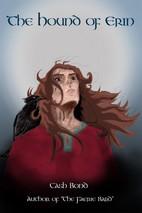
The Hound of Erin is one of two Celtic books that Cash Bond (Share Bond's father) wrote before he died in 2007. Share wanted to make sure that he lived on in his books. What a shame it would be if what he had worked on since his teens would never be published.
Any fan of Tolkien's popular books - The Hobbit, The Lord of the Rings Trilogy, etc. will love The Hound of Erin, and also The Faerie Bard.
The story delves into the ancient history of our world, primarily of Ireland and the Celts and the mystic lore of these people. So many historically-found lore and myths of these ancient people seem complex and hard to follow. This story fills in those gaps and softens the transition to such details in a colorful and epic event.
The Goidel had prospered and the wide green hills of Erin were theirs. These early Celtic invaders from Iberia in the southwest of Europe had conquered the faerie Túatha de Danaan at the battle of Teillte, and caused them to flee to the eldrich realm of their sidhe beneath the hills. The Goidel held them in an awe bordering on sanctity with many of the common people worshiping them as Gods. There was some inter-marriage between the ruling class of the Goidel and the people of the Danaan, and their remarkable offspring were among the greatest leaders of the land. They had overwhelmed all the native peoples of the country, and for over eight hundred years their kings had ruled. These people had abandoned many of the panoply of Gods they had previously worshipped while in Europe, and in this new country embraced the sun, moon, stars and the earth itself as their deities. Rivers, trees, wells and even stones were symbols of the supernatural forces they venerated. They adopted some of the beliefs of the Egyptians with whose country they had previous contact. They were deeply interested in their ancestry and, through their genealogists, could trace them back for many hundreds of years. Their history was recited to them regularly at gatherings so that it was deeply imbedded in the minds of all attending. In this land the druids would wield even more power than the kings, for they were the judges and the arbiters. Their monarchs sat on the thrones in their great dúnnum and passed them on to their sons. They collected the taxes, made the wars and fought the battles, but every move and every decision was made only after consulting with their druids, whose advice was always heeded. They were the interpreters of the will of the gods and none dared the risk of offending them, for excommunication from the rites of their religion was the worst punishment a person could receive. While many of these druids could write in Greek symbols, it was forbidden to put any of their lore in writing. It all had to be memorized and passed along generation by generation, and it took many years of study to learn all of this lore. They had no written language of their own other than primitive markings called ogham for simple messages. There were many kings in Erin, each owing fealty to a higher king, and on some occasions there was a high king over all, ruling often parts of Britain and mainland Europe as well, and each had a druid as his councilor. For the most part, these druids were goodly men, wise and dedicated to the service of their kingdoms and their gods. They were exempt from military service and paid no taxes, making membership desired by many, but difficult to achieve. In the druidic schools of medicine, the surgical skill of trepanning the skull was known, and their knowledge of healing herbs was vast. Camanachd, or hurley, was a very popular sport and warriors often carried their curved camans, or hurley sticks, along with their spears. It was known that on several occasions opposing armies settled the outcome of their conflict using their hurleys rather than their more fearsome weapons. To these vainglorious and boastful people war itself was sport. Often the outcome of a battle would be decided with each army choosing a single champion to represent them. The losing army would then usually accept the outcome. Warriors patrolled their kingdoms constantly on the lookout for raiders, for the stealing of cattle took place all the time. Not because of need, but it was done to harass their enemies, displaying their skill and valour. Forays were regularly made by groups called reavers to capture slaves, pillage and bring home loot that they could then brag about. Large numbers of men followed this practice, for it gave them one more outlet for their combative nature. In more general battles, often the leader of a number of men would challenge an enemy of equal rank to individual combat. The warriors of the fallen leader would then stay out of the battle. Thus, if the fallen leader led two hundred men, the victor could then boast that he had defeated two hundred men. Their word was sacred and rarely was their honor lost, for guile and deceit were almost completely foreign to them, and they were ever chivalrous. They respected their geis, which was a sacred ban, and under no circumstances would willingly violate it. They were straightforward and loved display that was made evident by their colorful clothing and jeweled armament. They would juggle their weapons before the enemy to show their skill and make great and lengthy boasts of their prowess and the champions they had slain in battle. In single combat they took the heads of their foe and carried them home as trophies and proof of victory. They feared not death, for their belief in an afterlife was so sincere that some were even known to make loans to be repaid in another life. They rarely rode on horseback in battle, as did their European counterparts, but their champions did battle from chariots with a driver. These machines often had scythes on the hubs of their wheels that wreaked havoc among warriors on foot. When a chariot was wheeled to the left, this meant a challenge to a warrior in another chariot. This move was called giving the ‘jaw.’ They used spears, swords, axes, clubs, javelins, sharp throwing shields, and slings as their weapons. The bow and arrow were strangely unknown to them. This land was divided into five provinces known as the coiceda, each with its own high king. They were Ulaid, Mumu, Lagin, Connachta and last was Midhe. Within these provinces were many villages and homesteads, but no cities as such. These warrior-led people rarely united, thought only of conflict, raiding and pillaging each other and the lands to the east without rest. If an enemy was not handy, they fought among themselves. Their Brehon Laws were as sophisticated as any in the world at the time, and covered every aspect of life in Erin such as fosterage, land transfer, rights of vassals, arbitration, penalties and many other coded laws to protect the rights of their subjects. They practiced justice and righteousness. Among the ruling aristocracy, marriages were rarely a love match, but more often made for reasons political. Marital fidelity was not expected and their wives mated with whom they pleased and often produced children by several mates. Once chided by a Roman matron about their lack of morals and free love, a Celtic lady replied, “We give our love freely to the very best of men and their sons become kings, while your women consort in secret with the worst of men and their sons are merely bastards. ”Their children were often placed in foster homes. This strengthened the bonds between families, diversified the children’s skills and removed the over-indulgence often practiced by parents. They mined salt, copper, iron and tin, with their skilled artisans creating fine works of bronze, silver and gold. Their enameled pieces were unmatched, being greatly desired throughout the world. They traded widely with other nations and their few ships plied all the seas of the known world. Their language was beautiful and evocative, much softer and lyrical than the speech of the other Celts, lending itself to a rich alliterative poetry at which they were masters. Poets and other men of learning were called fili and were members of a Druidic Order. These people had a rich mythic history, and this saga is about their greatest hero, CúChulaind, whose name was ever on the lips of the bards and poets, who flamed like a comet through the pages of the ancient manuscripts on Gaelic mythology. A Gaelic pronunciation guide, grammar, lineage charts of the characters, and a map of ancient Ireland showing the arena of action are in the back of this book for the convenience of those who wish to learn more of the these great people. May you enjoy reading this book as much as I did researching and writing it.
Excerpt
You can purchase a spiral-bound copy of the book now for $15.00 plus $5.95 S/H. Or you can pre-pay $20.00 plus $5.95 S/H for a softback book.
All book profits will go to support California Animal Rescue in Los Angeles, California. www.CARES.ProtectRWildlife.org
Want to review or comment on this book?
Need a FREE Reader Membership?
Reviews for "The Hound of Erin"
Reviewed by Suzy Chaffee
2/4/2008
This book has increased awareness of a distant race that human beings have had a great deal of interaction with in the past. Perhaps it will help those searching for a link to their Celtic history regain a sense of relatedness to a time long ago when the human race and the Fair Folk lived in relative harmony and with mutual respect.
This book also presents a relatively coherent view of the society of the Fair Folk which stands in contrast to the piecemeal and chaotic view offered by the mythology and folklore available from many sources today.
Marooned is the 1860's saga of Justin Radcliff, a young American, who is beaten and thrown overboard by his evil twin brother, Edward.
Kolya, a handsome Black man and new leader of the transplanted Zulu tribe there, finds Justin caught in hi