A book to read for those interested of cultural studies & comparative literature.
his Somali-English dictionary of Somali onomastics and proverbs is the result of a monumental effort on the part of the young Somali scholar, Mr. Anwar Maxamed Diiriye. It attempts to produce a reliable reference work that can serve not only the needs of any outsiders curious about Somali language and culture but also the crying needs of a new Somali generation in the diaspora who are either cut off or alienated from such culture.
This Somali-English dictionary of Somali onomastics and proverbs is the result of a monumental effort on the part of the young Somali scholar, Mr. Anwar Maxamed Diiriye. It attempts to produce a reliable reference work that can serve not only the needs of any outsiders curious about Somali language and culture but also the crying needs of a new Somali generation in the diaspora who are either cut off or alienated from such culture.
The work is divided into two parts: a straight-forward translation of Somali diction and a second part, which attempts to illuminate traditional proverbs; the foundation of all wisdom in any preliterate society. But before we proceed any farther, a word on the long and brilliant “Introduction” is in order. This section of the work is an excellent overview of Somali and Muslim cultures. Then, there is a very lucid and highly informative discourse on the practice of naming all things in the physical and natural world; beginning with “Prophet” Adam up to the present. This is where the intriguing title of the work comes from. According to Webster’s English Dictionary, Onomastics means: the study of the origin and history of proper names. Mr. Diiriye, citing sources, writes as follows:
A name is simply a word, phrase or sentence by which a human being is by it, he or she is identified, called, described, distinguished and classified. Nothing on earth and in much of the heavens exists without a name…A name conveys history, culture, heritage, language and a consciousness of self-image and pride. Onomastics (study of names) involves many disciplines such as history, geography, linguistics, literature, philosophy, anthropology, psychology, sociology, theology, and even the legal and medical sciences... In all, identity is the underlying feature and the principal one.
Professional Reviews
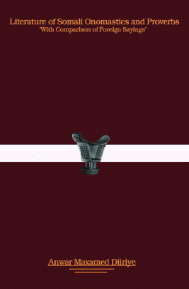
Literature of Somali Onomastics & Proverbs
Book Review: Literature of Somali Onomastics and Proverbs
Liban Ahmed
Feb. 11, 2007
The expression what is in name? and its Somali equivalent magac bilaash uma baxo(1), tell that a name is conferred on someone not solely for reasons of identification. Somali proper and common names are not only descriptive; they are imbued with meanings about seasons, conditions of birth (unrelated to disability or trait) and time of the year the child was born. For a society whose language acquired a written form only three and half decades ago, proper Somali names that have not been borrowed from Arabic language give us an insight into how ancient Somalis thought about life, their customs, creativity and unjust social hierarchies that still retain influence to discriminate members of the Somali society. Those thoughts revolved in mind as I was reading the interesting dictionary, Literature of Somali Onomastics and Proverbs . The title of the dictionary gave me the impression that it is a review of literature on Somali onomastics and proverbs.
Apart from the short introduction on Somalia and Somali language, the book contains four chapters on indigenous names, Arabic or Islamic Names, Somali proverbs and non-Somali proverbs.
Literature of Somali Onomastics and Proverbs
‘With Comparison of Foreign Sayings’232 pp. Gobaad Communications and Press
In the first chapter, the compiler listed Somali proper and common names and nicknames with their English translations alongside. It is the chapter that shows the challenges facing researcher interested in Somali Onomastics. According to Merriam-Webster Online Dictionary, “Onomasticsis the science or study of the origin and forms of proper names of persons or places.” Many Somali common names in the book—clan names, for example—once had proper name status. Some proper Somali names will acquire common name status in the future. This linguistic reality guides any researcher selecting names for inclusion in a dictionary of proper and common names. Anwar Maxamed Diiriye, the lexicographer of the dictionary under review, is alive to this challenge. Some common names are clan names, and their meanings are not easily understandable. To define them by the meanings they once had is a reasonable approach despite the obligation it places on the compiler to include all Somali clan names. If Anwar has included clan names such as Abgaal, Dududble Gaaljecel, Kaskiqabe, why didn’t clan or sub-clan names such as Fiqishinni, Bagadi and many more feature in the dictionary? This oversight is offset by the inclusion of clan and sub-clan names such as, Biciidyahan, Cawlyahan, and Ugaaryahan, three names that Anwar defines as hunters. Those three clan and sub-clan names demonstrate the cultural evolution of Somali society. Hunting has long been described --- albeit orally--as the calling of an oppressed Somali social group—the Madhibaan meaning “harmless; very decent one”—despite being a survival skill for which members of any social group will go great lengths to acquire it in a land beset by scarce resources and recurrent droughts. Those are issues for discussion that Literature of Somali Onomastics and Proverbs brings to light.
A word about trickiness involved in spelling some proper Somali names. Anwar paid sufficient attention to female proper names such as Baahila’( ‘hungerless’), Gefla’
( “errorless; righteous”) but the female proper name Duda’(“ pessimist) changes from a noun to verb for the mere drop of an apostrophe after the last letter( i. e. Duda’). Duda is verb used in an imperative context for more than one person, as the following example will show:
Duda oo dalka iskaga taga! ( get angry and leave the country!)
Unlike the proper names that metamorphosed into common names, some names have offensive connotations Two of those names are Hayin (‘docile; simple, tames’) and Heellan ( ‘loyal; obedient’). They are not names or nicknames that one can utter within the earshot of the persons to which they refer. Should one consider them as proper names?
In chapter two, Anwar lists names of ‘Arabic an Islamic root.’ The names in the chapter emphasise the strong link Somalia has with the Arabic speaking and Islamic world. As a matter of fact, the borrowed names are fast displacing indigenous names. One seldom comes across a Somali whose name and that of his /her father— Muuddey Gacal, Qamaan Bulxan, Dude Samatar, Bilan Odawaa, Madoobe Nuunoow, for example-- are pure Somali names let alone someone whose name, that of his/her father and his/her grandfather are all Somali names ( Xareed Duubi Deero and Diiriye Dalal Faahiye, for example). If this trend goes on, Somali names will disappear with all the cultural significance that brought them to life, and that will, I would argue, have an adverse impact on the self-esteem of future Somali generations.
Somali proverbs in the book (chapter 3) were rendered into clear and concise English. Translating proverbs is a hefty task. Some Somali proverbs reflect the level of thinking of ancient Somalis. One of my favourite proverbs – and fortunately it is this book, is Maan rag waa muducyo afkood. Anwar writes the same proverb except the first word which, according to his version, is male ( guesswork) as in male rag waa mudaciyo afkood( ‘ men’s thoughts can be as sharp as the point of a needle’) This translation does not capture the meaning of the proverb. It is a proverb that shows familiarity with psychological make-up of Somali men. Since Somalis are a patriarchal society, it is men who go to the war and adjudicate the disputes, to mention but few of the male dominated tasks within the Somali context. Their egos are likened to ‘the sharp point of needles’. It is difficult and time-consuming to stick the sharp ends of two needles to each other. It is compromise, patience and the will to move on that were placed on high pedestal rather the ego needs of few individuals. Arranging the Somali proverbs on alphabetical order could help the reader look up a given proverb in the dictionary.
The last chapter is about foreign proverbs. They show the cultural contexts of proverbs as well as shared outlook on aspects of life. Without explanatory notes, surface meaning of the many foreign proverbs cannot show the underlying meaning that proverbs generally have.
Literature of Somali Onomastics and Proverbs is a timely addition to the literature on Somali proper and common names. Anwar deserves credit for the energy and creativity he had put into compiling the dictionary from which young and old Somalis and non-Somalis interested in Somali onomastics will benefit
Liban Ahmad
E-Mail: libahm@gmail.com
(1) Literally name is not given without a purpose. It is also the title the first book on Somali Onomatsics by the linguist and lexicographer Abdirahman Farah Barwaaqo.
---------------------------------------------------------------------------------
We welcome the submission of all articles for possible publication on WardheerNews.com So please email your article today Opinions expressed in this article are those of the author and do not necessarily reflect the views of WardheerNews
Maqaalkani wuxuu ka turjumayaa aragtida Qoraaga loomana fasiran karo tan WardheerNews
Book Review: Literature of Somali Onomastics and Proverbs
‘With Comparison of Foreign Saying’ By Anwar Maxamed
Ahmed Ismail Yusuf
01 Feb, 2007
In 1994, Dr. Mohamed-Rashid Sheik Hassan dared to ask a very deserving question of whether the legendary Abdullahi Qarshe fathered the Somali music, in what possibly was one of the best and rare interviews of the hero, in which he responded with an emphatic “no” and went on to say: “There was always music: for weddings, lullabies, water [feeding] animals, working, dancing (shurbo), night dancing (sacab habeenkii la tumo), exorcism (saar). All these existed, so one can only say that there were no music instruments to accompany them. One cannot say, therefore, that I am the ‘Father of Somali Music.’ Even moderate music was in the air at the time of Abdi Sinimo, who is widely regarded as the genius who formulated and organized it into belwo and thus took well deserving credit and honor for it. Perhaps, I am the first Somali to set Somali songs to the music of the lute (Kaman).” See Bildhaan, Volume II, 2002.
What is so remarkable about this quote is that the legendary Abdullahi Qarshe did not only leave us with what we call Somali modern music of today of which he definitely was the father of (along with an unadulterated patriotic sense of Soomaalinimo songs, that we listen to even today in every region and everywhere that Somali is spoken, including the BBC, that are pregnant with a pride that we once Somalis shared), but also humility: humility to honor his colleagues as well as the people of his nation.
Thus, I was surprised to read a reference book, authored by a Somali (Anwar Maxamed Diiriye), published independently but attempted enlisting, though not all, great number of those who had made giant strides advancing our mother tongue, Somalis or none-Somalis of whom due respect is due. Yet this recognition would have been perfect had there been Muuse X. Ismaaciil Galaal, whose name is synonymous with the Somali orthography, in the honored list and a few others who also had been pillars in this ”troubled” tongue of ours! It would have been better as well, in terms of definition accuracy, if the author had the opportunity to reference another admirably authority figure in the Somali language, Cabdiraxmaan Faarax Barwaaqo and his book “Macag Bilaash Uma Baxo,” but the books is out of print and unavailable! And most important of all, it should be noted again and again that though this book is not written in Somali, the author is undoubtedly indebted to Somali language experts and the Somali language itself.
Thus it is apparent that the author, Anwar Maxamed Diiriye had tried to make sure that he does not follow the same path that has been wide open to many of self-published ‘writers’ mostly in the Somali language who as they had received a revelation from God, begin to pontificate but ended up barking. In another words, their whole claim comes a point: that they know it and know it all, yet learn from no one. Their mistakes however, pile up high, and their “books” contribute nothing to the preservations of the Somali language or its sole value. So in the process they (the so-called authors) not only dishonored their fellow country men/women and their nation but also themselves. Obviously Anwar Maxamed Diiriye avoided this treacherous water waste!
The book, “Literature of Somali Onomastics and Proverbs” though in a multiple facet (with also Somali proverbs as well as foreign ones) begins to tackle a topic that has been in-need of hospitalization for so long, possibly since the dawn day of the Somali orthography but most definitely from the day we all declared our motherland dead. The topic is the names that we Somali use. Somali names are soon going to be in the list of the endangered languages, now with a new title that will say, “Endangered Names!” Preferring Arabic ones, thinking that they are more sanctimonious than Somali origin names, was the problem we have known but ironically writing them nowadays, both the Arabic and the Somali origins, has become one of the newest enemies. Thus Awar Maxamed Diiriye is trying to shut light on all the names Somalis use for preservation. So as you may already gather from this tread ‘onomastics’ means knowledge based on names.
Anwar spells all Somali use names as they sound and a Somali would correctly write it in Somali language. For example Awar writes Cali, not Ali, Caraale, not Arale, Bootaan not Botan.
What is so significance about this, if you missed it, is that Somalis, particularly those claiming that they are writing in Somali are abusing their names, for one, not spelling it right. Either the double vowels are missing or the first letter is not capitalized. Or worse at times, you would see a first name Anglicized (written in English) but next the last name is in Somali, such as “Ali Cabdi.” Just take a look at any so-called Somali language websites, even those that brag about their prowess in Somali literature, trying to showcase everything in Somali, would at times offend you by misspelling the name Somali itself, as “Somali or soomaali.” What is wrong with that, one may asked?
Well, if you can’t tell, Somali is not Somali language when one is writing in Somali but Soomaali is (see the capital “S” as well as the double vowels of “oo”s and “aa”s). So if you are writing in Somali I expected you to spell it in Somali which means that you have to write “Soomaali,” as you pronounce it. Not “soomaali” or “Somali” but simply “Soomaali.” Like ways, when one is writing a regular name, such as Caraale or Axmed in Somali, I expected you to exactly spell it Caraale, Axmed, not Arale and not Ahmed.
The message in this book is loud and clear: that names Somalis use have integrity in both writing and root meaning. Thus it should be respected.
Another point of benefit in this book is that those young Somalis, who were raised or born in a foreign land, will be able to find their ancestral names, Arabic or Somali, in a universal language (English).
On the other hand, it’s definite for those who are versed in the Somali language to disagree with some of the name definitions in the book. And there are but a very few, minor errors in the introduction that could have been easily tackled by a diligent proofreader that would have as well purged minute name definition disharmonies. I hope the next edition will take care of that.
Be aware however, is Anwar Maxamed Diiriye warning us: that it’s advisable to write Diiriye or Caraale or Axmed as it sounds to you as a Somali even in English, but absolutely not Diriye or Arale or Ahmed when one is writing in Somali language. Where are the “ii”s, “x” and “aa”s? In other words Diriye, Somali, Ahmed, Arale are all Anglicized. Please be aware that there is no diriye, somali, ahmed, arale in the Latin alphabets as well. Capitalizing the first word of every name is sacred when one is using Latin alphabets. Therefore, in Somali language there should not be soomaali or soomaalia/ya. It should be Soomaali/Soomaaliya with a capital letter to start and double vowels to fortify. Please know the difference and again, again be aware that a Somali name has a meaning, history, integrity and attached sentimentality in writing, the author urges you to know!
Ahmed Ismail Yusuf
yusuf006@umn.edu
---------------------------
If you are interested in this book, can call (651) 797-4797 or Fax: (612) 377-1062) or email Gobaadpress@gmail.com.
---------------------------------------------------------------------------------
We welcome the submission of all articles for possible publication on WardheerNews.com So please email your article today Opinions expressed in this article are those of the author and do not necessarily reflect the views of WardheerNews
Maqaalkani wuxuu ka turjumayaa aragtida Qoraaga loomana fasiran karo tan WardheerNews
Yankee Doodle Daddy is a historical Appalachian Family Saga. The story follows a mother's reckoning as she struggles to survive and keep her four daughters alive.
Exploring the impact of literary icon Flannery O'Connor's noted legacy on the cultural realities of modern-day America, the world, and a certain author.