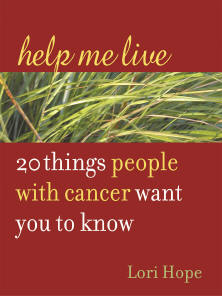
With compassion, good humor, and warmth, Help Me Live: 20 Things People with Cancer Want You to Know, reveals what matters most to people who have received a cancer diagnosis, and shows through poignant and sometimes humorous stories how to support anyone diagnosed with this disease.
Professional Reviews
Review of Help Me Live
Reviewed by Lauren John
“What happens here, stays here.” That’s the latest slogan on a series of ads enticing people to come to Las Vegas. Unfortunately, the same tagline could be applied to the destination known as “Cancerland.” We insiders know all too well about the range of emotions swirling around chemo suites, the hushed confessions at support group roundtables, and the high stakes involved in choosing experimental treatments.
But despite the medical books, and cancer memoirs and movies-of-the-week, do outsiders really know what we need? And what should we tell them? When we are sick and tired, and maybe just a bit angry, who has the strength to offer sensitivity training? What’s more, even if we do have the strength to say what we feel and need, some people are going to disappoint us.
Enter Lori Hope. In Help Me Live, Hope, a Bay Area documentary producer and journalist who was treated for lung cancer in 2002, offers an insider’s perspective to the social and emotional needs of people living with cancer. She does this by telling her own personal story and by interviewing women and men who have gone through all types of cancers and cancer treatments. What’s more, she said she wrote and distributed a survey “with the goal of finding out what helped and what hurt people who had survived cancer (as opposed to recording stories from medical and mental health professionals).” (page 203)
Hope clearly acknowledges the tight emotional boundaries around Cancerland. Consider the quotes she offers from Vicky Wells, co-founder of Cancer Support Community of San Francisco.
“Sooner or later you find out that almost everybody not actually faced with this problem on a day-to-day basis starts to find it boring or annoying if you keep talking about it. You may be perceived as a kind of chronic whiner, and people get tired of hearing the same old problem…Nobody is interested in chronic.” (page 186)
But chronic is fascinating in the hands of Hope—who first and foremost is a great storyteller. If you invited her to a dinner party, you would actually encourage her to share her observations on cancer as a catalyst for the best (and worst) in human behavior. And she would make your guests both laugh and cry. For example, she could tell the moving story of Virginia Mei, a woman trained as a medical doctor in China, who faced colon cancer after having moved to San Francisco’s Chinatown. At the time, Mei lived in a community in which people did not speak openly about cancer. But she was able to gradually recover her self esteem and confidence, as well as her health, when her pastor offered her a job as a community health counselor. The pastor was one of only three people that Mei told about her cancer.
Or Hope could share the fact that most people living with cancer hate the platitude, “You never know how much time any of us has; you could go outside tomorrow and get hit by a bus.” (page 157)
One young lymphoma patient that she interviewed replied, “OK, so then in addition to the fact that I could die from cancer, I might also get hit by a truck!”
More women tell their stories here than men, and most of the folks are from California, so keep this in mind if you are buying the book for, say, the friends and family of a conservative man from Maine.
However, the basic themes discussed here are universal: show compassion rather than pity, and ask people what they need instead of diving right in with unsolicited help and advice. In other words, try to listen to what people are feeling rather than telling them how they should feel, and at least try to hide your own insecurities and superstitions about cancer.
Instead of saying, “At least they caught it early,” practice saying, “I’m sorry you have to go through this. I’m here for you,” Hope advises.
And don’t offer any theories on why you think they got cancer and you didn’t. (Trust me on this one; people are actually callous enough to do this.)
My one concern is that this book won’t reach enough of the people that it should. The title alone ensures that people living with cancer and the people who take care of them and/or simply love them will check it out. But this book should also be read by employers, teachers, sports coaches and trainers, haircutters, the women at Macy’s cosmetics counters, the guys at the corner bar—or just maybe everyone.
TAKE ACTION:
* Check out BCA’s Factsheet, “What to Do When Someone You Know Has Been Diagnosed With Breast Cancer”.
* Log on to booksense.com to purchase this book from your local independent bookstore.
Hope Helps Those Who Know Women with Cancer
Lori Hope entered my Berkeley home on a sunny April afternoon buoyantly moving into the space, exclaiming over the house, the view, the pleasure of being together at last. We had met at a book reading a year earlier and talked briefly. We had written similar books, after having dealt with cancer. We wanted to talk more.
Hope arrived at my house with an assortment of cookies; I made the tea. She was on her way to pick up her galleys for her first book, Help Me Live: 20 Things People with Cancer Want You to Know. An award-winning video producer, writer, and editor, she had found another outlet for her creativity.
Hope wrote about her own experiences with cancer, both as a person who fought the great fight herself and as a friend and caregiver to several others. She wrote the book to help all of us feel more comfortable, whether as caretakers or people with an illness.
As she says in the book’s preface, “The purpose of this book is not to prescribe specific words or behaviors, but to open a world of possibilities, to give you pause for thought, to share stories that will at times inspire you, or make you chuckle, or scratch your head. The main objective of the book is to help people with cancer feel well and heal better. But another goal is make you, the ‘walking well,’ feel better, too.”
I read Hope’s book, Help Me Live, as though I had a loving sister on my shoulder, murmuring in my ear that what I have to offer is enough: Just slow down, listen and be kind. Hope draws from her experiences as a caregiver and patient to offer 20 clearly stated, manageable ideas to keep in mind around illness.
Hope’s humor and acceptance permeate the book. While my eyes filled with tears as I read the book, it was not from despair, fear or anxiety; rather, I was moved by the touching simple acts and stories she offered. So open is Hope in exploring her own experiences with us that she tells us when she felt she got it all wrong and had to apologize and try again.
In addition to the 20 main things people with cancer want us to know, the book addresses serious issues such as how to talk to children about cancer, how to handle difficult feelings, how to interact with your doctor, and even the funny movies she has enjoyed. It is a book that addresses those moments when we want to get it “right” with our friends and loved ones and we know they are more vulnerable, and perhaps more needy than usual.
Reading the book made me feel that the next time I hear a friend is ill, I will have a better sense of how to help, listen, and be conscious of what I am saying.
As I sat with Hope, I was drawn to ask her what she had been doing before joining the Bay Area BusinessWoman News in 2004 [where she is the managing editor]. I learned that before writing her book and dealing with cancer, she had, for 20 years after college, worked her way up in the television industry.
During the early years of her career she was producing, reporting, and writing medical stories for evening newscasts, and later began making documentaries. She has received numerous awards and recognition for her work. Best known are “How I Coped When Mommy Died,” “Help Me Die” and “Breaking the Cycle: Changing the World of a Child.” Hope was selected by both Stanford University’s John S. Knight Journalism Fellowship and Harvard University’s Nieman Journalism Fellowship Programs as one of 25 finalists nationwide.
Currently, Hope has two professional commitments. The one you know best is researching, selecting, and assigning stories for this monthly newspaper and online publication. She writes the restaurant, book, and film column, plus editor’s notes and occasional personal essays. This is not all. She is also president of Hope Communications, where she manages media campaigns, researches, produces, writes and edits broadcast and Internet materials, consults to nonprofit organizations and filmmakers, and presents media workshops. During these years of productivity, Hope has fallen in love, married, raised a child, and cared for her friends and relatives.
These endeavors are not enough for this joyous, creative soul; she manages to do all that, have tea with friends, and go on facing the world with her particular humility, grace, acceptance, and joy.
Susan Halpern is the author of The Etiquette of Illness: What to Say When You Can’t Find the Words, and a staff associate at the Commonweal Cancer Help Program.