
Kindle Edition
Amazon
Dr. Jerry W. Hulse - Author's Website
Category:
Religion
Publisher: Independently published
Type: Non-Fiction
Pages: 95
ISBN-13: 9798195097530
Price: $4.99 (eBook)
The concept of the "Keys of the Kingdom," as articulated in Matthew 16:19 and 18:18, embodies a profound theological intersection, highlighting both divine sovereignty and the Holy Spirit's work with consecrated believers through prayer.
Within church circles, you often hear phrases like “binding and loosing.” For some, this expression resembles a formula—a series of steps that, if executed correctly, will yield immediate and tangible results. However, Jesus was not offering us a rigid script for manipulating outcomes.
In the context of Matthew 18:18, Apostolic authority is understood as the power and responsibility bestowed upon believers, contingent upon their alignment with God's purpose and will.
When believers are in harmony with divine purpose, they are empowered to 'bind' and 'loose' on earth, reflecting what has already been decreed in the heavenly realm, encouraging believers to trust their spiritual authority.
This binding and loosing represent the authority to prohibit and permit, to declare what is true and what is false, with a heart of compassion that shapes spiritual environments according to heavenly standards.
The foundation for this authority lies in the completed work of Christ, which not only secures salvation but also grants believers access to the Kingdom's legislative power.
On the day of Pentecost, Peter declared to more than 80 nations that the heart of this foundation is Jesus Christ, the chief cornerstone—an essential element that supports and unifies the entire structure of faith.
Understanding the original Greek terms for 'bind' (deo) and 'loose' (lusai) clarifies the divine authority given to Believers and emphasizes the importance of biblical context in Matthew 18:18 for proper application of spiritual authority.
In summary, I believe you will find a different way to view and use Matthew 18:18 that could lead to more positive results from your efforts.
Excerpt
Using the Keys of the Kingdom Effectively
We often treat the keys of the Kingdom, often referred to in scripture using Matthew 18:18, as weapons of personal influence, but are we using them to open doors or to keep them shut?
In a world that confuses license with liberty, should not the biblical mandate to 'bind and loose' call us to a higher standard of discernment?
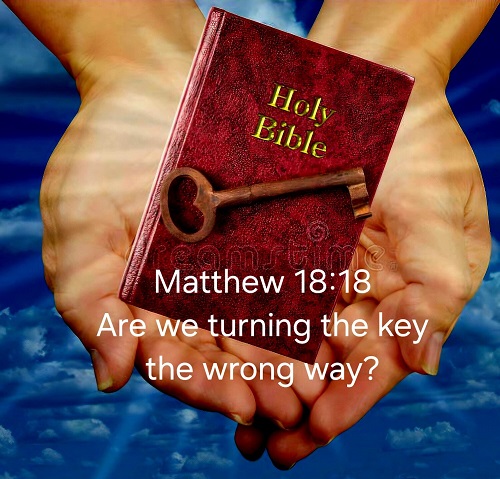
I want to pose an important question: Are we perhaps turning the keys of spiritual authority the wrong way?
When we speak of binding the devil in someone, we must consider the scripture found in Mark 3:27, which states, “No man can enter into a strong man's house and spoil his goods, except he first binds the strong man; and then he will spoil his house.”
This verse suggests that to effectively combat evil, the strong man, or the devil, must first be restrained.
While we generally agree that binding the strong man is necessary, I think it’s crucial to examine what happens next. Do we leave him bound?
I have a personal concern regarding this approach because Proverbs 3:3 advises us, “Let not mercy and truth forsake thee; bind them about thy neck; write them upon the table of thine heart.”
This verse emphasizes the importance of binding positive attributes—mercy and truth—rather than binding negativity or malice, and encourages believers to exercise their authority with confidence and discernment.
Furthermore, I can't help but reflect on the implications of binding the devil to ourselves. The Hebrew word for 'bind' suggests the idea of tying or attaching to something.
This raises the alarming question: do we inadvertently tie the devil to our lives when we choose to bind him in and to others?
I firmly believe that rather than holding onto negativity and resentment, we should actively choose to extend grace and mercy to one another.
In this context, the scripture found in Isaiah 58:6 poses a compelling and thought-provoking question: “Is not this the fast that I have chosen? To loose the bands of wickedness, to undo the heavy burdens, to let the oppressed go free, and that ye break every yoke?”
This passage challenges us to reconsider our understanding of fasting. It reveals that the purpose of this spiritual practice goes far beyond simply abstaining from food. Instead, it emphasizes our responsibility to address injustice and alleviate the suffering of those around us.
|