Kindle Edition
Amazon
Category:
Writing
Publisher: Genius Books
ISBN-10: 1947521780
Type: Non-Fiction
Pages: 162
Copyright: June 7, 2022
ISBN-13: 9781947521780
Price: $5.99 (eBook)
Arm Yourself. It’s Time to Kill Your Characters.
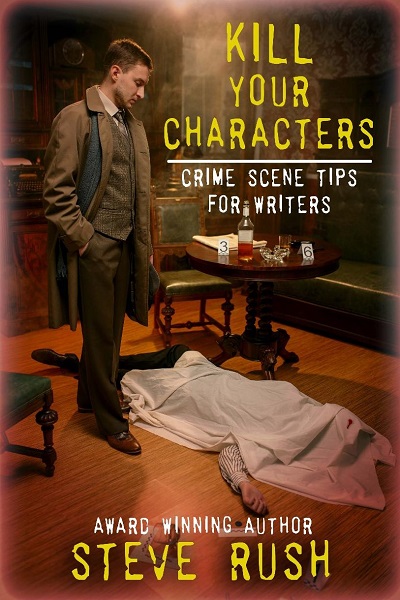
Kill Your Characters by former detective and forensic investigator Steve Rush gives you the tools you need to pass the inspection of all the armchair detectives (and more than a few real ones) out there. Discover your ultimate empowerment source for writing the page-turning inciting-incident you have always wanted to write. Become a master and save hours of research effort searching elsewhere for accurate information.
When plotting the next murder scene for your story, you may run into obstacles such as how the detectives determine time of death, or the forensic evidence left by a gunshot wound. Steve Rush’s extensive experience is accumulated in a series of writing tips that will significantly improve your story. Kill Your Characters is for any author looking to elevate their murder scenes with credible and authentic details.
Excerpt
Welcome to Homicide.
As fiction writers, we have unlimited control over the worlds of the killers, victims, forensic investigators, medical examiners, and detectives we write about. It is our responsibility to describe these worlds in an accurate way to give our readers the opportunity to follow along and stand over the shoulders of our investigators, watching to make sure they come to the right conclusions.
If we fail in this responsibility, we have robbed our readers of the joy of the story, no matter how well the rest of it is written.
This book is intended to help you get the facts right, whatever facts you choose to introduce.
As writers, we get insight into the actions and motivations of our murderer, confront other characters with no-way-out scenarios, take their lives, and choose to either leave their bodies where they fall, move them somewhere else, or pose them, as well as add or remove evidence, all to throw the investigation off our tracks so we can live—and kill—another day.
On behalf of the victim, we describe the sting of the knife, the burn of the bullet, the agony of the beating, the panic of suffocation, the crushing pressure of strangulation, or the hopelessness of being buried alive. That’s just a short list of the possible ends our victim could face.
When we compose the scene of the crime, we select what evidence to leave—and what evidence to take away. If the evidence points to the truth, we have introduced clues. We can also introduce misleading clues to send the investigation in the wrong direction. (These misleading clues are sometimes referred to as red herrings, from the practice of dragging smelly fish across the path of hunting dogs to distract them from the scent of their quarry).
And when the investigators arrive, it is our responsibility to secure the scene, find and record the evidence, identify the clues, examine the body, find the witnesses, ask insightful questions, and get it all right. Even if our characters are wrong in their interpretation of the clues, we as the author don’t have that luxury.
Regardless of how simple or convoluted we make the murder and the scene that’s left behind, we must get our story right—literally—no matter what the characters do with the evidence we give them.
This book is about getting it right.
|