|
Category:
Inspirational
Publisher: Nairobi: Paulines Africa
Type: Non-Fiction
Pages: 120
Copyright: 2006
ISBN-13: 9879966081275
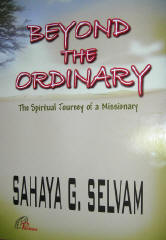
Beyond the Ordinary: Spiritual Journey of a Missionary is a moving example of a popular autobiographical literary genre: the personal spiritual journey. It is also an example of African narrative theology. As theology evolves around the world, narrative theology, or story theology, is gaining a stronger foothold in Africa. One can use narrative in personal stories, community stories, cultural stories and biblical stories.
A Matatu Theology
Matatu No.24 pulled out from the bus station.
My friend and I were pushed into the middle of that "manyanga".
Compelled by our religious discipline "to be in time",
we thought it better to be crushed among the crowd
than to wait in the queue.
The matatu which can hardly carry 45 people
now seems to be carrying 70 to 75 people.
I can hardly put both my feet down.
I can hardly keep my head up too.
I am a bit too tall for that "mathree".
I wonder, how some of my friends taller than me manage to travel
by these wretched vehicles.
My body has totally lost its equilibrium.
As my feet struggle to find their ground, my body is crushed.
Even the horses that are bred by the Wazungu in Karen,
and the dogs of Langata have better transport facilities.
Amidst the heat of the human bodies around me,
the smell of the sweat and the pain of the pressure
my mind can still reflect....
(In fact the easiest way to escape from the agonizing reality
is to think of something better.)
I observe the different people in the matatu, each in his/her own world.
The driver: he seems complacent
quite unaware of what it means to be in the crowd.
He reminds me of some of our church leaders.
He knows where he is going, where people want to go.
But the situation of the common-folk matters very little to him.
He is somehow responsible for the situation, however he himself is unaffected by it.
He even seems to have a good time, he's smoking away.
The touts: the rough and tough guys
pushing people in, ordering, commanding...
But they too are not among the rest of the crowd.
They are near the door and having a lot of fun, they laugh,
they swing themselves, and enjoy their job.
They are like some of our priests who command, order and preach
to the people to do things.
They themselves never know what it means to be in the shoes of the people.
And then those seated: the "Saved Christians".
Complacent and satisfied, looking scornfully at the standees!
They consider themselves the chosen few.
And some of them merciless, getting annoyed at those falling on them,
as the vehicle swings left to right and back.
And finally the Common folk:
(I am proud to be one of them, at least at this moment)
helpless, silent, struggling, trying to survive.
When will all this crowd get out, I wonder.
Nyayo Stadium, the touts only add two or more victims to the over-flowing vehicle.
Wilson Airport, no one gets down.
Barracks, no one moves.
Bomas of Kenya, 2 or 3 get down.
"Kuwinda!", the tout shouts out. Almost all of them alight.
There is some breathing space inside now.
And the matatu passes near Tangaza College, (Theological Centre of Religious)
- my alma mater.
But I shamefully wonder, in this "imported building",
am I not doing an "imported theology"?
Every day in Tangaza how comfortable am I amidst my books,
little aware of those people of Kuwinda in the neighbourhood,
much like the driver in the matatu. Or the touts!
How am I going to be relevant tomorrow when I stand at the pulpit
and preach to my fellow travellers in this matatu.
Would my beautiful language make any sense?
This guy, my neighbour in the matatu, when he comes to the church on a Sunday
after a week of struggle, matatu-travelling being only the least
(while for me this journey has been only an adventure,
for him it is part of his weltanschauung)
When I speak of "love of neighbour", "grace of God",
and all those jargons that Tangaza has brainwashed me with,
will it make any sense to him?
While he has to compete constantly with his neighbour for survival
- for a job, for a place in the matatu, and at the numerous queues -
when the other is a threat to his existence, can he love his neighbour?
When he works so hard to get so little, while others who don't work live in comfort,
(shamefully, I belong to the latter group)
with his sick wife on the one hand and his school-going children on the other...
can he understand the love of God?
Or what would he understand about salvation.
I am sure there would be no hell in the after-life for that guy,
for he has a lot of it already in this life.
My reflections became a prayer.
Lord, what sin did he commit to be struggling out there?
And what did I merit to be sitting here so comfortably?
Help me to be a little kind to him, when he stamps on my foot in the matatu.
Help me, when I am engrossed with my theology books
not to forget my fellow travellers in the matatu.
And Lord, forgive my indifference and complacency.
|