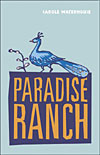
In this whimsical collection of short fiction about the relationship between people and animals, it's the animals who seem to have all the right answers.
The peacocks are missing their tail feathers and all the fur has been shaved off the goat's front leg. In fact the whole farm looks as though it's about to topple down a hillside. But when the owner, a man on the verge of losing his own sight, starts describing the purest, pinkest sunsets ever seen, he convinces a divorced woman she's about to enter paradise. In this collection of short fiction, it's the animals who serve as the best role models. Whether it's a flock of alienated people taking flight from city rooftops, a woman using her horse training techniques to teach a man how to love her, or a cat turning senile that changes the lives of the people around him, these are stories about the subtle ways animals mold our existence, offering their silent answers to our misdirected attempts at life and love.
Professional Reviews
Book Review Cafe
A collection of short stories that the author weaves both humans and animals into a patchwork of life and gives the reader an interesting outlook from both sides.
Each story has twists and humorous sides that never stray from the content or message that the author is trying to relate.
I found myself engrossed in the stories and enjoyed the excellent way the author presents them.
by Louise Riveiro-Mitchell author of Autumn Sky
Scribes World Reviews
Paradise Ranch, the new fiction collection by Carole Waterhouse, author of the wonderful novel, "Without Wings," consists of a novella and several short stories. The author sets an almost eerie ghostlike feel for the reader, showing us a landscape where men generally leave women, and animals seem to take the place of faithful companions and consolers to women who live tentatively on their own. In the novella, the title piece of this collection, the protagonist, Christa, a divorced woman, moves to an apartment on a run down farm at the suggestion of her boyfriend, Dale, who says it'll be closer for him to visit her. There Christa apparently has certain expectations about the young man, Dale, and is encouraged by the fact that he wants her to move closer to him. The disappointing reality of her so-called paradise, however, foreshadows the disappointment to come for Christa by the end of the story.
Horses, cats, and other animals play prominent roles in these stories, as do women searching in the distance for something, for someone. They never quite find what they're seeking, who discover that the man they thought standing across the road was really not a man at all but an inanimate object that their mind's eyes and hopes shaped to be a man.
Ms. Waterhouse is an expert at painting emotional settings with her words, and making the reader feel the echoes and cold breezes that surround her characters. All of them seem to be searching for more in their lives, and searching for that emotional connection that's almost in reach, but always seems to be just slipping out of their grasps. The animals in these stories seem so much more dependable and reliable than any of the male characters.
The story "The Blessing of the Horses" was a refreshing break from the rest of the stories, the only story told from the viewpoint of a male character -- a priest -- showing his inner mind at work. His little vanities that went along with his trek down the stalls of a stable, blessing the horses, with a group of horse owners and young girls following him about. This was an exceptional story.
In short, PARADISE RANCH exhibits, again, a very skilled writer who hones her craft well, focusing with great skill on small details that subtly expose the core of her stories. She exposes her characters' longings, weaknesses, hopes, and dreams, while doing a wonderful job of entertaining her readers along the way. This is a book you won't want to miss.—Mitchell Waldman
The Compulsive Reader
Carole Waterhouse presents a collection of short works which pivot around human relationships with animals and the effect they have on our lives. A writing professor at California University of Pennsylvania, Ms Waterhouse demonstrates skillful writing through using animals for studying the human psyche as effective foils. Ms waterhouse eschews the nostalgic sentimental, examining the harsh realities and issues of life from divorce to homelessness and sudden loss through death. She creates psychological tension through splicing past with present and contrasting reality with wishful thinking. Through the use of internal dialogue contrasted with actual dialogue, the reader slowly views a fragmented world which assembles to form a colorful mosaic.
The themes are ordinary, but the handling is exceptional. Nearly everyone has faced the problems of dislocation and moving at some point in life, but few can express the psychological anxiety and agony of relocation so aptly. Christa, a survivor of divorce, settles for the house rather than alimony support with the instinctive knowledge that payment is not forthcoming from the ex. However, her good planning is reversed by the highway coming to town when the house is boarded up for standing in the wrong place. Unemployed, a single mother, she has to move and takes up the suggestion of investigating Paradise Ranch as a future home.
Paradise Ranch has the bleakness of Mt. Aetna with a motley assortment of animals in which peacocks strut lacking their dignifying feathers and look like oversized chickens about to be cooked. Parasdise Ranch is the microcosm of dysfunctional American life, complete with patriarch, misfits and accompanying gossip. We do not meet the characters casually like hobnobbing at a cocktail party and assessing their personalities from the gaudy clothing; instead we are slowly initiated into the complexity of Christa's life through snatches of conversation and mundane details which define each character through actions rather than through a mass of verbiage hung on their names like clothes. We see them as through a grimy window that has taken on too much winter soot before the spring cleaning, recognizing them only afterwards as their identities are finally revealed. And although the animals seem to be incidental, by their casual introductions, they are pivotal, creating the tensions between the characters and reflecting their personalities.
Waterhouse is able to build psychological tension through the use of natural description, building expectations and then blowing them aside like the wind tearing apart a dandelion head:
Christa looked, as she already had several times that day, at geraniums she had planted that morning by the walk leading to her apartment, a cheery little row of pink heads she'd be able to watch bloom well into the autumn months. Already that morning she had fed Sunny's horse and turned her out…(39)
Life slips into the routine. Recognizing it, we expect to plod along through the story when the author suddenly makes a twist in the trail, throwing us from our seat. We wonder how it happened, because we know certainly that the story should end a different way and like the fallen rider, we are still dazed when she closes the chapter and begins a new narrative.
The stories are pertinent to the social upheaval present in America today. They carry he critical voice and pathos of Steinbeck of failing public institutions and crumbling social relations, or irrevocable social dilemmas. The skilful use of metaphor and symbol evoke complex thoughts that haunt the reader long after the book is left on the table. Where do people go when they are burned-out by overwork? Where can they escape the interminable pressure of a high-tech society. Ever since the beginning of time, man has yearned to fly, evident in the myth of Daedalus, but Waterhouse takes it into a different route, using the techniques of magical realism. We slide over the edge of our chairs into a different world with the same effectiveness that Lewis used when we were children, stepping through the wardrobe to enter Narnia and disposing of the Christian moralism.
For those who enjoy short fiction, then these are gems that should be collected and passed among friends for their mutual admiration. Each of the eight stories is unique in construction and tone. They take the normal, the ordinary and transform the incidental into something extremely unusual and memorable.
Celts and Kings: The story behind the mystifying disappearance of the Celtic Earls in 1607. The story of a lost love and Celtic Spirituality.
The story of a forbidden love going back 400 years.
The story steeped in Irish history, Ce
Celts and Kings: The story behind the mystifying disappearance of the Celtic Earls in 1607. The story of a lost love and Celtic Spirituality.
The story of a forbidden love going back 400 years.
The story steeped in Irish history, Ce