Category: Nature Publisher: St. Martin's Press
ISBN-10: 0312601093
Type: Non-Fiction
Pages: 304
Copyright: June 8, 2010
ISBN-13: 9780312601096
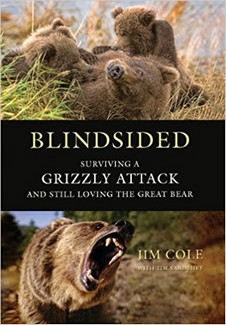
Jim Cole's account of surviving a 2007 mauling by a grizzly bear that left him without a face, blind and alone in the wilderness.
Jim Cole has spent years tramping into the depths of places like Alaska, Yellowstone National Park and Glacier National Park in search of grizzlies, seeing these magnificent, powerful and reclusive animals at their most unguarded—foraging, fishing, caring for cubs, or simply lying in the backcountry sunshine. At times, he’s been surrounded by dozens of bears deep in the wilderness, yet has never felt threatened by these incredible and misunderstood creatures. Even after being mauled by a grizzly in 1993, Jim eagerly trekked annually into the bears’ habitat, armed only with bear spray, his camera, and his knowledge of how to stay safe. But nothing could have prepared him for May 23, 2007, when he was attacked in Yellowstone by a mother grizzly who felt that his presence threatened her cub. The bear literally ripped off most of his face, blinded him in one eye, and savaged him nearly to the point of death. Jim was left sightless, bleeding, wounded and alone in the wilderness. He managed to find his way several miles through the wild country back to a main road, where passersby found him. In part, Blindsided is a gripping, detailed account of that fateful day—how Jim survived an assault by one of the most unstoppable predators on earth and managed to carry himself to safety despite his gruesome injuries. It’s also the story of how he recovered with the help and support of friends, family and a dedicated medical team, but perhaps most importantly, the book is a love story between and man and animal, a clear-eyed and affectionate look at the marvel that is the grizzly bear—its astonishing habits and intelligence, the threats it faces at the hand of man, and its hopes for the future.
Excerpt
It was May 23, 2007. Beautiful spring snow was steadily falling as I drove the Grand Loop Road through Yellowstone National Park's Hayden Valley in the early morning. I had just called my old pal Richard Berman at about 7 a.m. to say hello before his first tennis lesson of the day. I told him that it was a glorious snowy morning in Yellowstone, and it really was. I had just completed a thorough glassing all over Hayden Valley from various strategically chosen parking pullouts and the conditions looked fantastic for a day walking in this gorgeous wilderness. The only downer was that I had not spotted a single bear. But I hoped that later I would.
My next order of business was to drive to the Mary Bay/Fishing Bridge area, on the northern edge of Yellowstone Lake, to look for the mother grizzly and one first-year cub that I had seen in that vicinity two days before. My hope was that the mother bear would reunite with one or both of her missing cubs and that park visitors would subsequently have the thrill of observing them happily grazing the early green-up of roots and grasses in picturesque Mary Bay.
It might not happen that way; nature is under no obligation to script itself for the likes of Jim Cole or anyone else. I've seen as much of what humans call tragedy in my observations of grizzlies as I have joy. But of course, in the natural world what happens is neither tragic nor joyful; that's more of the dangerous anthropomorphizing that we humans sometimes do with wild creatures, especially bears. It's just nature playing out her drama. Sometimes she's red in tooth and claw, and sometimes she's gentle. The bottom line for me is to document what happens, no matter how I may feel about it. Nature's truth, happy ending or no, is my goal.
For over two weeks in October of 1999, I watched a wonderfully animated mother bear raise her three spring cubs. She was extremely cautious, protective, and predictable as they fished the mouth of the river every morning then patrolled the lakeshore before nursing and usually napping on the open beach, where she had a good view of potential danger. They were a joy to watch and I admit to an emotional attachment to this bear family.
One morning, these bears were nowhere to be seen. There was still no sign as the day warmed up and I instinctively knew something was wrong. My mind created numerous rationalizations with happy endings to explain why they didnt show up all morning but deep down, I knew the tale would not end happily. I was already dejected when a few hours later, I found the cubs huddled together without their mother. I could not imagine her abandoning them; I eventually pieced the story together. Sometime during the night, a big male grizzly had killed the mother bear, probably while she was trying to protect the cubs. Her body was stashed on an island in the river and even though salmon were plentiful, the male fed on her body for several days. Now the cub trio was on its own at a tender age. Their chances for survival were bleak.
Over the next few days, I saw the three cubs several times but they were extremely timid in this dense congregation of bears and werent getting much food. The dramatic turn of events made me very sad but I documented everything that I saw without interference. Nature can be cruel and I have learned the hard way to take the sweet with the bitter. Those were the rules when I signed on, and they will never change.
I worked my way from Fishing Bridge to Lake Butte Overlook and back again without spotting a single bruin. I prefer to spend my time in Yellowstone on foot rather than cruising in a vehicle, but the road system here lets me cover so much more ground that it's inevitable to log some car time. Whereas Glacier is a hiker's park, Yellowstone is really designed with drivers in mind. But I wasn't about to drive back and forth all day long; it was a great day in my book and I was aching to get out into open wilderness country.
However, the best hiking around the Yellowstone Lake area was seasonally closed to human-powered travel until July by bear management personnel so the grizzlies would not be not disturbed in their hunting of elk calves during this critical time of the year. I decided to drive back to Hayden Valley to walk the open landscape. My plan was to return later to search for this bear family from the comfort of my van, my home away from home.
Hayden Valley stretches about eight miles west from the park road into the backcountry, bounded by heavy woods and marked with low, undulating hills and ridges. The valley was overcast when I got back, and it had warmed up after the snowy daybreak. The landscape before me was mostly brown. The valley greens up in the spring according to the amount of precipitation, but we were in the ninth year of a regional drought, so any greening would likely be brief.
The skies were filled with high clouds and what spring snow had fallen earlier had quickly melted into the landscape, revealing itself to the careful ear as rivulets of trickling water that would eventually find their way into the valley's creek and river system. It would make for slow and marshy going, forcing me to stay higher on the ridgelines to avoid the mud.
The ground was sodden with water and droplets hung down from the abundant sagebrush bushes. A hundred years ago, sagebrush was known as cowboy cologne because the unwashed ranch hands (who typically only bathed on Saturday evening) would rub sage all over their faces to disguise their stink before they went into town on a Friday night to try their luck with the ladies. I stuck my face into a sagebrush bush and inhaled. The valley smelled like a cowboy cologne counter in the early morning damp.
I typically choose my routes through Hayden Valley at random. I've walked almost every corner of the valley over the years and I know it extremely well, so choosing paths randomly lets me explore terrain from a different perspective and create different routes each time I'm out there. No maintained human trails exist in this section of Yellowstone, except for the Mary Mountain Trail, which runs along the very northern edge of the valley. Today I was intent on a relatively short hike, a six to ten mile loop, so that I would have time to drive back to the Yellowstone Lake/Fishing Bridge area and look for the mother bear and her family. It was going to be a bit routine, my hike through this extremely familiar landscape. But my intimate knowledge of Hayden Valley would become the difference between life and death.
The hilly terrain sloped to the east as I trail blazed into the valley starting at about 8:30 a.m., and the track was muddy as I headed uphill to the west. To the north, the Washburn Range was cloaked in spring snow. I purposefully switched back often on this slippery slope to maintain my footing. On an established trail I wouldn't have had this problem, but if you've ever walked through wet grass, you know how treacherous it can be. It was worth the trouble. The hilltop offered a spectacular view of the valley in all directions. This allowed me to stop from time to time and thoroughly glass all around with the light, powerful binoculars I always carry within easy reach. I didnt spot a single bear. It was looking like a quiet morning in the valley, but that's the way it is sometimes. Every day offers something different. Luck and timing play a significant role in wildlife viewing and Ive certainly paid my dues with many bear-less days over the years.
I saw numerous bison, calmly grazing in small groups dotting the valley. The big ungulates are not anywhere near as common in the park as they once were, before fears that they would spread disease to cattle compelled authorities to thin their numbers when they step outside the park boundaries. Not long ago, I would likely have seen larger herds of the 2,000-pound mammals munching the low grasses. Now I typically see no more than 30 in a herd and more frequently just a few together. It makes me wonder what the plains and valleys of this region must have been like 200 years ago before the white man virtually exterminated this great animal for its hide. Herds in the hundreds of thousands thundered through the West. It must have been an incredible sight.
Just within the past week, the same grizzly that had chased the bison earlier in the spring took control of a cow elk carcass out in the open in Mary Bay. Witnesses described how wolves took down this elk, barely visible in the early morning light, just beyond the thermal smoke near the west edge of the bay. The young bruin was surrounded by ravens for two days and smaller predators constantly challenged his control of the carcass.
Bull bison often approached and the intimidated bear would flee, but he returned when the bison moved on. The bison were obviously not competing for the meat, but they dominated the scene with their sheer size whenever they chose to. Coyotes ambled by and cunningly stole scraps when the bear was looking the other way. A wolf lay nearby scoping out the situation. A few times when the bear temporarily left the carcass, the wolf would seize the opportunity to frantically feed, retreating with a meaty elk chunk in its mouth when the bear abruptly returned. When a lone coyote approached, the wolf gave chase. The scavenging canines fed only when the carcass was unguarded, but the grizzly consumed most of the meat and only shared when it had no choice. The carcass drew quite a crowd and was a pleasure to chronicle.
Further to the west I walked through a familiar flat sandy thermal area that reeked of sulfur and billowed with steam coming from holes in the ground. The area was visibly crisscrossed by grizzly bear tracks of various sizes. I stooped to examine the tracks more closely. The only recent prints were mine.
The short grassy areas nearby resembled manicured golf fairways so closely that Tim Rubbert and I have named the area the golf course and call the parts with the most perfectly mown turf the first hole and the second hole. Both greens showed evidence of divot-like grizzly diggings from earlier in the spring as the great bears foraged on the lush grasses, edible roots and tubers. The area is a popular corridor for grizzlies because the thermals melt the snow and green the vegetation earlier than the surrounding hills. But no bear sign that I saw this day was fresh. So far this spring, I had seen at least nine different grizzlies in this valley but there had been no bear sightings so far today.
My intended path for my brief hike continued to the west along the northern edge of a swampy meadow, which I carefully avoided to keep my hiking boots dry. Novices to wilderness hiking are often surprised at how much water there is and how wet boots can become, even if you're not forced to walk through a swamp or ford a stream. Even early morning dew can soak your feet. For this reason, I always pack a second pair of boots in my van to change into in case the ones I'm wearing become soaked. But it's an inconvenience I preferred to avoid if I could. I added miles to my hike in order both to avoid the marshy ground and stay on high contour where I could better observe any bears.
My circuitous route took me up and down several ridgelines that were wonderful for glassing this section of the valley. Plenty of bison, but not a bear in sight. I continued up a small hill toward a stand of fir trees, and my path led me by a small pond, where I saw some waterfowl as I circled around to the south.
Three weeks earlier, along this same route, I had spotted the silhouette of a massive body above the dry landscape. A big male grizzly fed alone on the meager remains of a bison carcass at the edge of a shallow creek. This likely was'nt his first feeding here: dirt partially covered the carrion, a sure sign that he had buried it after a previous feeding to mask the smell from other bears who would be ravenous competition after just emerging from their dens in the early spring.
Big male grizzlies are shy, secretive, and rarely seen by human eyes. Their secluded lifestyle and careful avoidance of people goes a long way toward explaining how they get big and old. The park road would open to motorized vehicles two days later; by that time, this big guy would likely be nowhere to be found. When the wind swirled and he picked up my scent, he turned tail and rambled uphill into the timber to the north. A flock of ravens followed and when he stopped running to look back, they all systematically landed close by. He paid them no mind, as the naked carcass lay far behind.
This day, an apparently easy path lay ahead for me as I made a beeline for a distinct notch between a series of rounded grassy knolls that form a natural partition along the southern part of the valley bisected by Trout Creek. On the other side of these knolls, my glassing ability would be challenged as I tried with my binoculars to spot bears far away in the vast southern reaches of the valley, near the tree line far beyond Trout Creek. To the south, toward the distant, dense woods, a line of thermals sent up steam like a row of campfires. Those woods, I knew, would shelter multiple grizzlies during the day, as the big animals traveled many miles to find safety in the deep forest, often reemerging in the shadows and cool of the evening.
While glassing just three days before in the early morning, I caught a brief glimpse of a big grizzly along this distant tree line just as he began to melt into the forest on the far southern edge of the valley. This could have been the same bear that I saw feeding on the carcass a couple of weeks prior, but he was so far away that I could not tell. The sighting lasted less than a minute before he disappeared.
I headed toward the southern woods, then began to circle back to the eastthe general direction where my van was parked. As I was headed up the knoll, I was thinking that it was time to end my bear-less day in Hayden Valley and get back to the van so I could go and look for the mother bear around Mary Bay/Fishing Bridge. There simply didn't seem to be any ursine activity around here, so greener pastures beckoned.
My greatest sin that morning was not making enough noise. My personal hiking strategy in grizzly country is to make plenty of noise in forested areas and dense cover, but generally not much in the open Yellowstone valleys. My preferred form of noise takes full advantage of my ample supply of hot air (or so my friends tell me) and involves random loud vocalizations such as Yo! Yo! fired off every 50 to 100 yards or so when I'm in selected topography where visibility is limited. Although I consider myself cautious and conservative when it comes to safety issues, overall I admit to not making enough intentional noise in grizzly country. I have hiked and camped for days, weeks, months out in the wilderness and its my goal to see wildlifeespecially grizzlies though certainly not via a point blank surprise, which is virtually the only time an experienced backcountry hiker will be in any danger.
To further my no surprise strategy, I don't wear camouflage. I want bears to see me so they can evaluate the situation while I do the same. In every instance when I see a grizzly and the bear sees me, I size up the scenario based on how the bear's body language reacts to my presence. Then, based on my experience, I decide where to position myself to maximize observation or photographic opportunities while disturbing or threatening the bears the least. As I've said, my goal is to document the animals behaving naturally, not their responses to my blundering presence.
So, with all my years of experience, my attitude might have been a bit complacent on that morning. I may have assumed that because I had not seen any sign of bears so far that there would not be any, which is always a mistake. My best recollection was that I was very alert (as always) but that perpetually overcrowded mind was thinking ahead for a change and mapping out plans for the afternoon. As a result, it's possible that I wasn't as aware of my surroundings as I might have been. I guess I'll never know, and does it really matter?
Everyone who shares the turf with the great bear must find his or her own comfort level. My recommendation to grizzly bear enthusiasts is to make noise when appropriate, but not enough to contaminate the experience. Each individual must find his or her own comfort level. I do know that as I crested that fateful knoll, my forward vision was momentarily blocked by a thin, distinct line of sagebrush bushes. As I headed down the south side of the knoll, I was convinced that this would be one more Hayden Valley trek without any bear sightings. It was hard to believe that such a meager open hillock with such low scrub could be concealing anything dangerous.
Though some details are foggy, I have the vivid recollection of descending the gentle sloping knoll and looking first to my left (the southeast), trying to determine the fastest and easiest return route back to my van. In hindsight some people suggested that a carcass may have been close by, but I did not see any scavenging birds like ravens, magpies, or eagles. I am always alert to any carcass sign because a carcass is an obvious draw for a foraging bear.
When I finally glanced back to my right, an angered mother grizzly burst seemingly out of nowhere across the hillside from the west, followed closely by at least one tiny cub. She never made a sound. She came at me at full throttle and at pointblank range, like a silent, furry locomotive. My best recollection is that she was no more than ten to fifteen feet away when I saw her. It all happened so unbelievably quickly that as I look back the scene felt absurdly like one of those western movie ambushes in a box canyon, although this occurred right out in a wide-open space devoid of any significant natural barriers to my vision. The only thing I can chalk it up to is that bears are intelligent creatures adept at making themselves hard to see when they do not want to be seen, and this one had done her job.
I will never possibly remember exactly what transpired in the next few seconds, but I have done the best I can to piece things together. I was blindsided and there was no time to be frightened. She was on me in an instant and there was nothing I could do except go down quickly, grab my bear spray, and cover my head. I did a poor job across the board. I don't know whether she knocked me down or I went down first, but I suspect that it was a combination of the two. Anyway, I hit the ground in a fight for my life.
Time stood still. I don't know how long the attack lasted. I never felt any pain.
Explore the mystery of how nature makes unexpected gifts of creative wonders to an unsuspecting caregiver one late night and early morning in southeastern Georgia, USA.