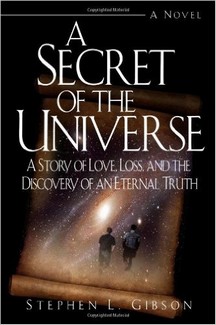
A Secret of the Universe
A Story of Love, Loss, and the Discovery of an Eternal Truth
Stephen L. Gibson
c. 2007
ISBN: 978-0-9793880-0-2
LCCN: 2007901906
Truth-Driven Strategies, L.L.C.
Kalamazoo, MI
$26.95, 563 pages
I have mixed opinions about “A Secret of the Universe.” I found it very informative, but I did not agree with the author’s conclusion. The book basically is the story of two lifelong friends: Ian and Mac. Both are seeking the ultimate meaning of life, and both are traveling divergent paths. The author uses these two men to present his opinions about the Judeo-Christian view of life and about a non-Biblical scientific view of life.
The main characters are Ian Keppler and Bill Vanderveen. Both get married in the novel; both have children. There are many characters: in-laws, parents, friends, and a study-group of scientists trying to discern what is really true in human traditions. Gibson does a good job of characterization. He describes some surprising conduct on the part of some characters, but, in the concluding chapters, he lets that conduct amplify his thesis.
A harder task is to bring in the opposing world views for Bill and Ian to discuss. Gibson does a good job here. I was surprised at some of the world views described, but Gibson provides ample references to show that these views are indeed held by real people, experts in their fields. A difficulty with lengthy technical material is that many writers will simply narrate the views instead of expressing the different views through dialog between characters. Gibson’s dialog, when he uses it, is good, but there are long sections of the book that are narrated.
Gibson presents some surprising information in his book. In support of the presumption that Christianity is not true, he quotes an Episcopalian bishop (a real person) claiming that Jesus Christ is essentially a myth, and Gibson quotes Carl Sagan saying that if Jesus Christ ascended into heaven at the speed of light (the fastest speed known to science), he, today (two thousand years later), would not yet have risen above our galaxy. In support of the Judeo-Christian view, Gibson quotes C. S. Lewis explanation that Christian altruism (inspired by God) is what motivates people to help others, sometimes at the risk of their own lives and to rejoice and be touched when observing goodness in others.
The first half of the book is an even handed discussion of the pros and cons of the Judeo-Christian view of life with many quotes from contemporary scholars. About halfway through the book, one of the characters opines that if someone could prove that there was no historical Jesus Christ, it would be like revealing a secret of the universe. It is here that I got a premonition of where this book is headed, and I began to wonder what the secret is.
Gibson has focused everything, even religion, on a scientific quest for truth using the scientific method. The scientific method is effective for physical objects that can be measured and experimented with, but it is not effective when dealing with spiritual objects, like God, that cannot be measured or experimented with, or even observed. Gibson focuses on the work that scriptural specialists have done in reconstructing ancient manuscripts, particularity Gnostic manuscripts. However, this is a study only of the manuscripts. The scientific method cannot measure beyond the manuscripts to determine the truth of the words in the manuscripts. In addition to lost Gnostic manuscripts, there is also an ongoing legacy of Christian writers whose manuscripts were not lost. To be fair to the Christian tradition, one would have to take into account both sources of information. The manuscripts that were lost and recently found might represent what earlier generations rejected. The traditions that were saved probably represent what previous generations thought was correct and worthy of preservation. Presuming that the lost manuscripts portrayed authentic Christianity and the information that was preserved portrayed a subverted Christianity goes well beyond science. Not taking this into account is a big flaw in Gibson’s arguments.
Gibson goes so far as to propose that there is no evidence of God, no revelation, nothing more than what humans can imagine. Gibson has Mac, one of the proponents of atheism, state that, since the earliest days of tribal conflict, distinctions between people have most commonly existed based upon their various religions. I disagree here also. Tribal conflict does not have its roots in religious views. Television documentaries (Animal Kingdom) (Planet Earth) show that meerkats, chimpanzees, and packs of wolves also have tribal conflicts. It is, therefore, obvious that tribal warfare stems from our animal nature and is not something peculiar to our spiritual nature.
Gibson wonders: “how our minds, the cells in our head, could absorb and process such concepts as Einstein’s relativity.” Does Gibson think that humans are entirely physical, no spirit—no soul? One would presume so reading the book. The secret, when Gibson finally reveals it, is very elementary. The secret is love. Everyone would agree with the secret. However, Gibson misses the point that, perhaps, God is the source of love.
Gibson also argues against emotion-driven thinking, proposing that truth-driven thinking is preferred. He’s absolutely correct. In his book, however, when Bill Vanderveen suddenly discovers the secret of the universe, the discovery is realized during very emotional circumstances. When Ian affirms the secret to his sons, it is also done at a moment when emotions are high. I think this is another flaw in his book. The secret of the universe should have been discovered during a truth-driven exercise devoid of emotion and the other impediments to clear thinking that Gibson had pointed out in his book.
Gibson’s book is exciting and entertaining fiction. It contains a lot of surprising information, with references that show that many eminent people hold the positions he describes. Read it for information and entertainment. If you do not agree with Gibson's conclusions, you are not alone.