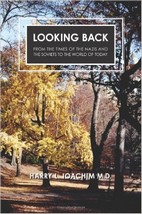
I am approximately the same age as Harry Ioachim, so I lived through many of the world events he experienced in his life. I enjoyed reading his book very much. Even though I lived my life half a world away in a different country and in a different culture, I’m surprised how the author views of what has happened to him would correspond to my own views if those things had happened to me. Ioachim lived his youth in Romania when his country came under the influenced of Nazism and then Communism. When he was about thirty-seven, he emigrated to the United States, where he pursued a career in medicine and spent about fifty years exposed to the same American culture I have been exposed to all my life. His book is not only a chronicle of his life: he discusses the same world events that I have witnessed but from a perspective of someone who was very much compromised by the Nazis and the Communists as they made their influence felt in his life. He also discusses world literature and the performing arts, and he adds much interesting detail about his medical career in cancer research. Ioachim states he doesn’t consider himself a writer and asked to be excused for his clumsy efforts in expressing himself in English, but I found his English grammatically correct and his writing elegant.
Iochim’s book is not merely a chronicle of what happened to him and his experiences as he travelled in Rumania and into the Soviet Union and when he lived in Paris before entering the USA. He adds much historical details on world events that helped shape his life. He discussed in some detail Rumania’s alliance with Germany when World War II broke out, and the decision of Rumania to abandon Germany and side with the West in 1944 before the war ended. Ioachim praised the bravery of the young Rumanian King Mihai who made this decision. Ioachim thinks Mihia’s decision avoided inevitable German occupation as the war drew to a close, which occupation would have cost many Rumanian lives.
Ioachim mentions the death of Josef Stalin in 1953 and Stalin’s replacement by Krushchev in 1956 and discussed how Krushchev’s policies of relaxing the cult of Stalin’s iron control of Communism led to the Hungarian revolt. I remember the Hungarian Freedom Fighters. Some of them spoke at the University I was attending in the late fifties. Ioachim also makes some personal comments about things he feels are not perfect in the world that give a deep insight into his personality, and I find that I agree with him.
For example, he is critical of the sexuality and violence in American movies and literature. He writes: Free speech is undoubtedly a priceless attribute in our free [American] society. But it should not excuse and protect the ever-increasing verbal violence and vulgarity that have inundated songs and literature. “You see it at work as much in the coarsening of pop culture and the increasingly vulgarization of formally polite society as you do in the frenzied sexualization of academic language in the humanities.” He also gives his take on American politically correct speech: A distortion of our normal communication is the ‘politically correct’ speech. I know it well because it was ingrained in the everyday relations under the Communist regime. The double speak was there in place of one’s true feelings and opinions. . . What an unpleasant surprise to reencounter the double talk of political correctness in our free speech society.”
He prefers the nostalgia of less permissive literature and movies of his youth: When I grew up and watched ‘Sleeping Beauty’, ‘Snow White’, and other Disney films, the princes were gallant and fearless, the princesses modest and lovely, characters that children could dream of. Not so in the present animated features where the positive characters are usually caricaturized, unattractive, and hard to love, while the smart remarks are more to the parents than to the children.”
Ioachim also mentions the Communist attitude toward marriage. “The women had to liberate themselves from household slavery and be entirely equal to men. The family in its present form was obsolete and unnecessary, since in the Communist society the children, the only reason for the existence of the family, were in fact the responsibility of the community, which would best take care of them and educate them. And relations between men and women, unburdened by the obligations of marriage, would be free, sexual relations like a glass of water in appeasing the thirst.”
It was refreshing to take another look at the world events that shaped my life through the eyes of Ioachim. The only risky thing for an author to write so candidly about himself is that some readers might be turned against him if they have a different response to the world that the author has. In my case that didn’t happen, even though I live in a different culture and adhere to a different religion.
I found the memoirs of Harry Iochim illuminating and interesting, not only the life story of a very interesting man, but also in his thought-provoking comments about what is going on in the world. Looking Back from the times of the Nazis and the Soviets to the World of Today should become a treasured memoir for all Iochim’s family and friends. I think this book can find an even wider audience.
Maurice A. Williams
http://www.geocities.ws/mauricewms2003
My memories as an immigrant professional woman in Ottawa, Canada 47 years ago. A new life after having survived the liberal war of a new country Bangladesh on December 16, 1971.