Amazon
Category:
Biography
Publisher: Regency Publishing Inc.
ISBN-10: 0895261405
Type: Non-Fiction
Pages: 256
Copyright: 2003
Price: $16.77 (eBook)
A soldier assigned to guard Bill Clinton is dissappointed in Clinton's conduct
Excerpt
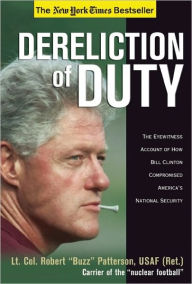
Dereliction of Duty:
The Eyewitness Account of How Bill Clinton Endangered America's Long-Term National Security
Robert Patterson, Lieutenant Colonel, USAF, (Ret.)
c. 2003
ISBN: 0895261405
Regency Publishing, Inc.
256 pages $16.77
In "Dereliction of Duty," Robert Patterson explains why he feels Bill Clinton endangered our national security. Patterson feels Clinton, more than once, failed to act decisively when action was required. Robert "Buzz" Paterson, an Air Force Lieutenant Colonel, now retired, was a military aide to Bill Clinton. Patterson was entrusted with the "football," the mechanism that launches a nuclear counterattack. Clinton carries the nuclear code cards. If a nuclear response is warranted, he gives Patterson the cards to activate the device and launch the missiles. Naturally, Patterson has to be near Clinton at all times.
Patterson's close proximity to Clinton has made him an eyewitness to situations he felt Clinton carelessly mishandled. Patterson's first disturbing experience occurred three months into his new position, September 13, 1996. Patterson was on a golf course while Clinton played golf. A military situation occurred that required Clinton's decision. Iraq had conquered the Kurdish city of Irbill, violating the cease fire agreement that ended the Gulf War. The military was put on alert for an appropriate response against Iraq's military arsenal. A suitable target found, the military scrambled planes and contacted Sandy Berger, Clinton's National Security Advisor, for a decision to strike or not strike. Sandy phoned Clinton on the golf course. Clinton refused to take the call. While the planes were in the air, the military phoned Berger two more times. Clinton refused those calls also. Finally, short on fuel, the military aborted the mission. Patterson felt Clinton's refusing the calls resulted in no response to this treaty violation. A military man himself, Patterson felt this inaction emboldened the Iraqis to further test American resolve.
Another disturbing experience involved Osama bin Laden. Clinton had been given intelligence reports in 1996 that Al Qaeda terrorists planned using commercial airplanes as bombing missiles. Sudan captured Osama bin Laden and offered him to Saudi Arabia. The Saudis didn't want him. Clinton could have requested bin Laden from Sudan, but didn't. We all know what Osama bin Laden did later. Clinton also carelessly misplaced the nuclear code cards. One set of lost cards was never found.
Patterson noticed sloppy White House security procedures and an overemphasis on public image. Most White House event scheduling was for Democratic Party fund raisers. Patterson watched Clinton make massive reductions in military personnel and armaments and increase oversees military deployment. Patterson felt this reduction of personnel and armaments and the increase of deployments stretched the military dangerously thin. Patterson wasn't the only military aid that felt that way. In May 1998, all five Clinton military aides, disgusted, considered an "en masse" resignation. The military reassigned Patterson as Air Force Academy instructor.
"Dereliction of Duty" features a forward by Al Santoli, author of "Everything We Had," which outlines how Clinton weakened our military. "Dereliction of Duty" also contains a long quote from Casper Weinberger's 2001 book "In The Arena: A Memoir of The Twentieth Century." If everything Patterson relates is factual, Clinton, really did neglect his duty as Commander-in-chief.
Maurice A. Williams
|