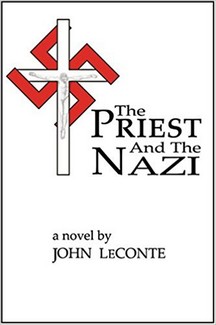
THE PRIEST AND THE NAZI, a story about the intricate and uneasy relationship between the Nazis and the Catholic Church.
It is the end of WWII, and the Americans are closing in on a small Bavarian town, where two men meet in a darkened chapel. One is a captain in the dreaded SS, the other a priest. The officer is seeking sanctuary, safe passage to Argentina, and redemption. For this he turns to a German priest, a man who has given his life to his faith and found it wanting, and who is hungry for his own form of salvation.
A battle of wills begins when the Nazi offers a vast amount of gold to the priest to arrange for his escape, money that the simple man believes will assure him a place in the Vatican hierarchy. The officer is determined to make the priest look at the connection between his church and Hitler’s regime. The priest remains unshakeable in his desire to see the murderer repent his sins. For two
desperate days, they wrestle with the vagaries of truth, then part ways to their new destinies, where one soul will be found and one lost forever.
John LeConte’s first novel is a startling saga of good and evil and ways in between, told against a backdrop of the last days of the war. It is part meditation on the nature of sin and what a man is capable of, part history, and all thriller.
While historically, many priests and nuns resisted Hitler and were cruelly persecuted for it, others actively or passively collaborated. The role of the Catholic Church itself remains hotly debated, and in LeConte’s interpretation, otherwise good men find themselves damned by compromise. This work is a haunting tale of unimaginable evil and the work of the soul in the quest for forgiveness.
Excerpt
The priest and the Nazi sat, facing each other, inside the priest’s sparse chancery. The priest gave rosary beads to the Nazi. “Herr, Hauptmann, you will need this bead in the future. You need to tell me your story, your side as you put it. I have told you mine, I have done my part, now it’s time for you to do yours.” It was the first time the priest had addressed the Nazi with his proper military title.
The Nazi SS officer pondered this, this gathering will of the priest. What does it mean?, he thought. In the world he came from a command like this usually portended something. Did the priest want him to leave? Was there a trap and was he going to be arrested by the Americans or the Russians? The sun was now beating hot on the church compound. This day would be hotter than usual. Tiny beads of sweat formed on his neck and throat. His body, dirty from days of the physicality of travel, started to smell of stale and dirty body fluids; a thickening film of grime coated it. His hair was dusty as were his clothes. The Nazi silently panicked. His eyes darted down to his left, to the floor and a sense of relief engulfed him as he saw his bag was still there.
He thought for a moment and said, “All right, but I don’t know where to begin or how to adequately explain myself to you.”
“Not to me, to Christ,” said the priest abruptly. I am but a conduit.”
“To Christ. Yes. I have thought about this moment, when I would begin to try to explain my,… my,… how did you put it yesterday, my erotic lust for violence. What I can confess to you right now is that I cannot come up with anything, any words that would make sense to you. They would be just words, words explaining things or telling you things that would horrify but would not adequately and fully explain the essence of what I’m telling you. But I can show you.”
“How, and how will that lead to contrition and your confession?”
“I’ll show you,” replied the Nazi. “Take me to that army corporal we supped with last night. The man, the monk, who sat directly on my left last night. He was easy to spot, priest. You see, he had the look of the beast in him. It’s nearly gone but it’s there. Can you not see it? Let’s go look at it now, together and I’ll show you how you can see it in him. You see, to see only one beast is merely a passive experience. To see two beasts is to see each of them interact, to see them under the instinct of their emotions. Together, this corporal and I can give you a perspective, a dimension to what I cannot explain to you in mere words.”
“I can see it in your eyes, Hauptmann. Why do I need to see it in his?”
“Because I want you to see this as revelation. Come, let’s go to him.” The Nazi captain rose and gestured to the priest to do the same. The priest stood up from his chair and they walked out of the priest’s room.
They walked first to the kitchen but the soldier was not there, then on out to the garden and then through trees to the barn where they found him inside sitting on a bench beside a tack table in a far corner; he was tending to oxen reins. The old and faded table was about three feet from the back wall of the barn. As they approached him, the corporal rose with a start, eyes apprehensive, he limped around to stand a few feet in front of the table, standing almost at attention.
“Ah corporal, good morning,” said the Nazi. Turning to the priest he said, “Priest, the corporal and I will reveal to you now how the beast comes forth in men. You will see.” The priest and the SS officer were standing only four or five feet from the Wehrmacht corporal. The Nazi bent down, lifted his left pant leg that sagged over his boot, and unstrapped the Luger from his left ankle. He then rose, pointed it at the corporal and pulled the trigger.
The priest, in shock, looked into the eyes of this predator. He turned and stared wide eyed at the corpse sprawled on the table. Something was stirring inside of him, his breathing became short and heavy. But curiously, he did not feel revulsion, or anger, or indignation. He would have to feign that, yes, but he did not feel that way. He had witnessed an act of will, the will to act and he was impressed. How someone could do such a thing? he thought. This was the kind of action he could never take, the courage to act on his own ambitions or his own desire. He could never do it. Never. But this man, this beast could. Fear, the Nazi had said, fear is what allowed him to do these things but I am not afraid, thought the priest. His mind fell into confusion, the creed, the weltanschauung of his entire life turned asunder.
Just then, several of the monks and the two boys rushed into the barn and saw the scene before them. They stopped suddenly just inside the barn door, eyes wide at the sight of the dead body laid prostrate and half headless on the tabletop. They stood mute and still, in utter disbelief. The Nazi turned to them, showed them the pistol, then bent down and strapped back to its ankle holster. The priest then stepped forward and told the monks, “Bury him. Clean up the floor and the wall, burn the table.” He started to turn away, but stopped himself and turned back toward them and said, “Your vows remain strictly in force.”
Professional Reviews
Euro-Reviews
At the end of the war, a lot of people try to escape Germany, so does this Nazi SS Officer. He flees to a church, where he comes in contact with a priest. They start talking and soon the priest understands that this man is searching for passage. He tells the priest that he has money and a Degas to pay the Church. The priest wants to help the Nazi, but only on one condition; the Nazi needs to confess his sins to the priest and do pennance.
The priest is a good man, having strong beliefs in God and His Church. But he feels trapped in his monastery and is longing for privileges, privileges that can only be found in the Vatican. The money and the Degas that the Nazi has with him to ensure him a safe passage, can help the priest too on his way to the Vatican. So they make a deal; and that's where they start talking.
The Nazi tells him that he killed a lot of people during the war; he shot many people, or helped kill them with gas. He felt no remorse at all. He tells the priest that he has had this feeling of rage his entire life, more explicit from the moment he saw his father kill his mother. Taking a life means nothing for the Nazi, and he shows this to the priest by shooting another Nazi. He also tells the priest about the Church's involvement in the war, something the priest has a hard time believing in.
The priest finds himself confessing his sins to the Nazi, although he doesn't want to admit that the Nazi is taking his confession. He tells the Nazi about his life before he became a priest, that he fought in World War I and that he is a homosexual, something that wasn't accepted at that time.
After the confession, they both go their own way; the Nazi gets his passage to South America and tries to start all over again in Argentina. The priest gets what he wanted for such a long time, and gets a seat in the Vatican. The Nazi really tries to do his pennance as the priest had told him to do, he finds himself commitiing sins, but feeling remorsefully afterwards. So after a while he sins no more, works, does his prayers and goes to mass every day.
The priest on the opposite finds himself sinning more and more. He studies Church history and discovers that the Nazi was right, the Church indeed was involved helping not only the peasants but also Nazis during the war. He feels betrayed by his Church. More and more he's trying to live his life like he wants to, more and more he's finding himself even more trapped as in his monastery.
I absolutely loved reading The Priest and the Nazi because John LeConte gives you a good insight between what's good and what's evil. I started reading this book with the thought that the Nazi will be "the bad guy," but on their journey the priest and the Nazi both show you that evil can take another course; you see they meet each other on the same levels of good and evil. The Priest and the Nazi gives you a lot to think about, not only about good and evil itself, but also about forgiveness and faith. John LeConte has put down two very strong characters; and this made The Priest and the Nazi a really thrilling novel to read.
TCM reviews
TCM Reviews
The Priest and the Nazi
John LeConte
Hopewell Publications
ISBN: 1-933435-04-6
Historical Fiction, Religion, Lifestyles
Reviewed by Dr. Tami Brady
The Priest and the Nazi is the raw tale of two characters who represent two of the most controversial issues in our recent past. The Nazi demands asylum from the church and a priest feels obligated to grant his request. Despite this, the priest feels a need to find out if this man can actually be saved. His underlying fear is that the Nazi killed Jews not because of pressure from the SS but because he actually enjoyed the feeling of killing. While uncovering the horrid truth, the priest’s own demons also surface.
The Priest and the Nazi is captivatingly dark. I really wanted to see some aspect of hope and light in these two characters so I kept on reading. Instead, I found the similarities in between what typically should have been two extreme character types to be very refreshing and not at all what I had expected. That the book also touches upon some very important questions about the role of the Catholic Church during the atrocities of World War II is also quite brave.
Midwest Book Review
The Priest And The Nazi
John LeConte
Hopewell Publications
PO Box11, Titusville, NJ 08560-0011
1933435046 $17.95 www.hopepubs.com
The Priest And The Nazi by John LeConte is a well crafted novel depicting the story of a highly ranked Nazi SS Officer and his encounter with a Bavarian Priest upon fleeing a defeated Germany. Engaging its readers in an original authorship and unique style, The Priest And The Nazi carries reader's full and complete attention through an intricate and unique tale in which fate and honor, human nature and truth are all interwoven elements. With its outstanding plot and artful storytelling, The Priest And The Nazi is a very highly recommended and entertaining read.
Autumn 1940. Germany invades Britain. Newport is blitzed. Danny O’Shea’s house is bombed, his wife is killed. While taking his young son Adam to neutral Ireland, they witness an attack on a German convoy. The result is brutal.
First Place Winner in historical fiction in the Purple Dragonfly Awards for excellence in children's literature, and named a U.P. Notable Classic.
Feel like you are in the moment nearly 100 years ago with a young girl, daughter of Finnish immigr
Autumn 1940. Germany invades Britain. Newport is blitzed. Danny O’Shea’s house is bombed, his wife is killed. While taking his young son Adam to neutral Ireland, they witness an attack on a German convoy. The result is brutal.