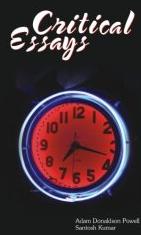
Author: Adam Donaldson Powell & Santosh Kumar Binding: Paperback (pp: 106) ISBN: 978-81-8253-110-9 Availability: In Stock (Ships within 1 to 2 days) Publisher: Cyberwit.net, Allahabad, India Pub. Date: 2008 Condition: New Description: Much has been written regarding the history and development of literary criticism, the present "crisis" precipitated by trends and practices in the areas of publishing, marketing and distribution, as well as challenges posed for literary criticism by electronic publishing ... including a renaissance of the age-old questions regarding which persons are qualified to write literary criticism, and the purposes and goals of good literary criticism.
— Santosh Kumar
All of these topics, themes and discussions are actual and important today. My main concern is to provide authors of literary works (poetry, short stories, novellas, essays, novels etc.) and independent presses and facilitators of self-published books of quality with a new form of literary criticism: which is informative, which incites debate, which challenges author and reader, and which provides entertainment, but which at the same time functions as a marketing tool and an opportunity for authors to consider their own development and accomplishments from the perspective of another literature enthusiast. I review both first-time authors and authors who have written dozens of books, assess individual books as well as compare several books by the same author, and sometimes follow a specific author’s development from book to book.
All literary criticism is subjective by definition. However, it can be helpful for both author and readers of literary criticism to discover new ways of perceiving their own writing, and writing in general. I am not an English professor, or even an English major. I am an author, and yet another who constantly struggles with the same questions, choices and challenges all authors confront. It is my experience that reviewing others’ writing gives me greater insight into my own. This is (for me) an ever-going process of personal and artistic development.
Lastly, I would like to say that I consider literary criticism to be an art form in itself – a form for expression that is constantly stretching and yawning, recollecting older traditions and recognising the contemporary and the visionary in authors, and sometimes making associations between diverse forms of artistic expression and artistic disciplines. However, reading a book review or a piece of literary criticism is no substitute for reading the book, and is not a prerequisite either. Literary criticism is only a personal guide and commentary ... a short essay containing the reviewer’s thoughts and reactions to having read a work (or works) of literature by another author.
— Adam Donaldson Powell
As a reviewer I always try to promote understanding and enjoyment of literature. A literary critic should always aim at reconstructing the mind of the creative artist as manifested in his or her manuscript. The vast field of an artist’s mind is revealed only when we discover ‘wisdom of the ages’ in his work. "The past is altered by the past as much as the present is directed by the past." In my critical review of the creative artists included in Critical Essays I have kept the attitude of a careful searcher or explorer. The main concern is to search the intrinsic and unique strength of the poet or short-story writer. An immortal poet always uses language "charged with meaning to the utmost possible degree" (Ezra Pound), and his poetry is "the storehouse of recorded values" (F. R. Leavis).