|
Amazon
Amazon
Category:
Spirituality
Publisher: Trafford Publishing
ISBN-10: 1412079608
Type: Non-Fiction
Pages: 99
Copyright: 2006
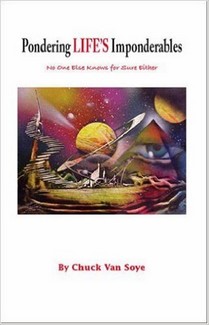
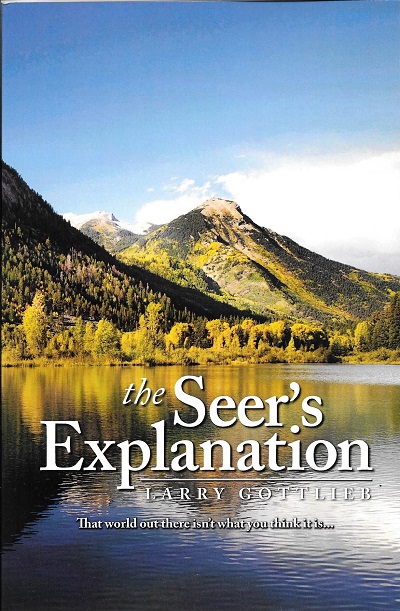
An engineer ponders aspects of life related to a hot news topic that keeps today's press and talking heads buzzing: The ever ongoing divergence between evolutionary and creationist viewpoints.
Written as a personal-thought narrative, this short nonfiction book was designed to stimulate readers to probe the deep recesses of their own minds, seeking to awaken an awareness of certain aspects of their existence and the world around them that they have probably never seriously considered. Once addressed, the reader's introspection will probably reveal some personal thought queries that have no definitive answers. Absolute answers about abstract topics such as "beauty," "infinity," "the origin of matter," "death and the afterlife," or "God" are hard to come by. They are truly imponderable. But faith does shed light.
A PEEK INSIDE:
Chapter 3 - Early in the chapter, the reader is led to realize his dependency on the modern wonder, the "chip," so essential to all the familiar electronic gadgets he enjoys. His thought train makes its next stop at the "Big Bang" theory, followed by multiple stops at such stations as NASA's Hubbell Telescope, the world of chemistry, the food chain and finally back at a facility for making the chips he must have. Along the way, he may come to realize need for unbiased consideration of the logic of intelligent design in the Universe.
Chapter 6 - Man finds it hard to think about infinity and eternity, as neither has an end, and both are in conflict with the perceived world. The writer, comparing his teenage thoughts about infinity with those in his seventh decade of life, grapples with these concepts, still pondering what. or who . . . resides at the far edge of the Universe.
Excerpt
There comes a time in each of our lives, usually in our teenage years, when we ask ourselves questions like: "What is "Life?" "Why is there Life?" and "Why am I here?" "Will I really die?"
"What is death?" "What happens after I die, if anything?" "Is there really a heaven or a hell?"
Death stares us in the face every time we turn on the TV these days. Whether watching nightly news programs about the bombings or assassinations by terrorists in Iraq and Israel, or in most satellite action movies, or even by commercials about "mature" computer games, death is vividly depicted in living color. We can hardly avoid casual contemplation about our own eventual deaths.
But do you intentionally think often about "death?" The likely answer, at least for most people, is "No." We don't like to think about death at all. We force fleeting thoughts about our own death out of our head. In fact, teenagers and even perhaps those that are twenty-something carry on as though they were immortal, or at least bulletproof. They take greater adventure risks, drive faster or wilder, experiment with deadly drugs, and generally tempt fate with greater abandon.
Even the very mention of the word "death" secretly frightens many of us. After all, death is the concern of "others," most of us like to believe. Death is the province of medical personnel in hospitals, or ambulance drivers, or funeral home directors. It certainly is the very valid concern of military personnel in wartime. Policemen and firemen have to think about it, sometimes daily. "But not me. I don't want to think about it," we are apt to say to ourselves, unless we have many decades of life behind us, or we have become gravely ill, and are starting to confront the certainty that lies fewer and fewer years, months or weeks ahead.
But why don't we want to think about death; why are we "afraid" of it? Actually, we are fearful of dying for many reasons, the strongest of which is instinct. Our instinct to survive reigns supreme in humans . . . we will do almost anything to save our lives when death threatens. Consider the recent news story of the man who cut off his own arm in order to free himself from beneath a huge boulder in an isolated area.
But there are other reasons as well, among them the fact that most of us derive great joy from living. We also have a sense of responsibility to continue caring for families who are dependent on us; we have an ingrained desire to complete projects or reach goals we have striven towards for significant periods of time; and perhaps for many, there is a fear of the unknown that lies behind death's door.
Nevertheless, death awaits every living thing. Death is merely the absence of life on Earth. All life eventually leads to death. From the microscopic bacterium to the centuries-old redwood tree, all plantlife eventually perishes. All insects and all reptiles, all sea creatures and land animals, and all of our feathered friends must ultimately cease to be. So we too, as humans, must face this most natural of all life's processes.
Yet, we ponder, death seems so final. And, it exerts such changes in the world. One minute, a happy bartender serves brew in the town pub, while a talented young lady serenades the chattering customers, one of whom is a philosopher that is scratching wonderful new ideas down on a napkin. The next minute, catastrophe occurs, and none in the pub survive. There are only corpses that are already starting the decay process leading ultimately into dust, as ultimately will be the destination of the giant redwood tree.
Where has the bartender's rollicking laughter gone, the singer's beautiful voice, and the philosopher's thoughts that might have reshaped civilization? They have passed into oblivion. Something called "Life" has disappeared.
No doubt about it, I'd much rather think about "Life." "Life" is a simple word that describes the imponderable mystery that makes a walking, talking, laughing, thinking human being somehow so dramatically different than a corpse. And "Life" is that quality that makes a tree different from a log. And that makes a beautiful fragrant flower different from dull-looking pot pourri. But what is the true essence of human life? What are its defined characteristics, and how does it start?
A few characteristics of human life immediately come to mind. We can breathe, freely move around, and are aware of our surroundings, owing to our senses. We can communicate. We have a conscience. We can modify our surroundings . . . that is, we can accomplish physical work. We can self-nourish so our physical bodies can grow and age. We can control fire and other energy forms. We can reproduce other humans. We can thus describe these characteristics by putting our "mind" in gear. . . that is, we have minds that think. With these minds we can visualize and we can generate original creations, like music, art or a new bridge design. And, because we are truly a unique life form, we can even ponder our existence and origin.
"Where did I come from?" Well, as adults we certainly know that the stork didn't bring us, nor did our parents unexpectedly find us one day in a head of cabbage brought home from the local grocery store. (That's what my parents told me when, as a very young child, I asked for an explanation for my origin.)
We know that our existence couldn't have "happened" unless a human male provided sperm that successfully fertilized a human female's egg. Then came cell division, over and over, followed by growth into a dependent fetus, and eventually a bursting forth from a confining fluid-filled womb into freedom and independence as a new breathing individual human being.
The question of when, during this process, "Life" actually starts is heatedly debated today, and probably will be for decades or centuries. But there is no debate over the fact that no chemist, no physicist, no microbiologist, no geneticist nor any philosopher can adequately describe and prove exactly how this whole process of life formation came into being. Not just for humans, but for other creatures and other life forms as well. To have been born, to be alive, to have life is incredible, but to fully comprehend the very essence of Life is imponderable.
|