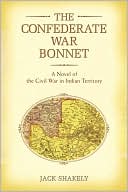
Jack Gaston is a mixed-blood Creek at Harvard when he is summoned back to his nation to become a chief in the House of Warriors. Loyal to his chief Daniel McIntosh, Jack also knows this means becoming an officer in the Confederacy. Conflicted between his anti-slavery feelings and his desire to support his people, Jack soon finds himself in a bloody and little-understood corner of the Civil War- Indian Territory. Jack also finds himself drawn into the internal civil war that has torn his beloved Creek Nation apart. With his friend Jim Tom Nokose, Jack struggles to unite his people while the world around him is crumbling.
Excerpt
On Jack's command, they came screaming out of the underbrush. Within moments, they had the unlucky soldiers and skinners surrounded.
"We yield, we yield," one of the soldiers shouted. "Please don't shoot us."
"Or scalp us," came a weak cry behind the first soldier.
The Prologue of Jack Shakely’s The Confederate War Bonnet poses an intriguing question about an elaborate Pawnee war bonnet donated by the Ford Foundation to the University of Oklahoma. Why, in its intricate beadwork, should there be the repeated motif of the Confederate flag? Was it a hoax, or a joke, or a political statement?
Why indeed? That war bonnet, now in the Smithsonian Institution, was not a hoax. It is real, and mentioning it at the outset of the book brilliantly and concisely illuminated to me how I, despite being a reasonably educated person and not unfamiliar with the Civil War, knew nothing at all about the war’s effects on American Indians.
The author, a fourth-generation Oklahoman of Creek descent, is a former journalist whose family owned newspapers in four small Oklahoman towns. His novel is an expertly fictionalized account of the plight, and the fate, of a number of Indian tribes during the unpleasantess between the states. The average person might expect that the Indians would not come to the defense of the Union, which after all had forced most of them off their ancestral lands and relegated them to strange lands, breaking treaty after treaty and dealing with them shabbily at best. And that would be true, for many Indians. But others did indeed cleave to the Union, and this difference often divided individual tribes. Unfortunately, many of those tribes were at odds with other tribes in the first place. The Civil War only served to subdivide them even further.
It was a very complex situation, and beyond the scope of this review to explain. Suffice it to say that the general reader will gain an appreciation of the complexity, sadness, and eventual glimmers of hope that emerged from this national disaster. The student of history will find a good deal more.
All readers will enjoy the highly readable narrative the author has laid over the historical record—the book is worth reading simply as a tale of the American west. Long term, however, it adds to our understanding of who we are as Americans, and what we have done and failed to do as a nation. To that end, readers will appreciate the author’s note at the end: all but a couple of the characters in the story are real. The battles and so forth are described as accurately as can be known.
That war bonnet figures into the story, beginning, middle, and end. I hope I visit the Smithsonian some day and see it, or stumble across a photograph. It will inevitably recall a flood of impressions made by The Confederate War Bonnet. How many books can you say that about?
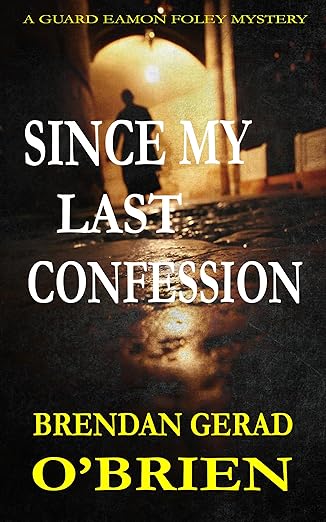
Tralee, Ireland. September 1948.
An arrogant, and highly agitated, priest arrives home after 40 years.
Days later he's dead. Suicide? Or did his past catch up with him?
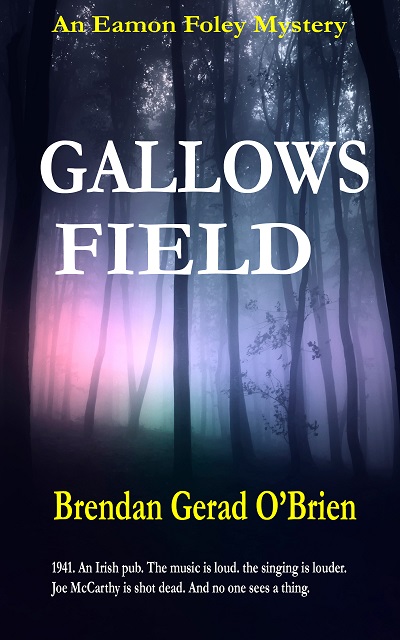
Dublin 1941. A brutal murder. Mistaken identity. And barman Eamon Foley is running for his life.
Nine months later Foley is in a crowded pub, and his brother-in-law is shot dead.