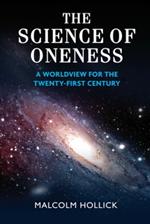
"The Science of Oneness" presents a scientifically valid vision of reality that is conscious, creative, loving, and purposeful. It provides a coherent worldview for everyone searching for meaning in our fragmented world. And it challenges us all to help guide the evolution of humanity and the Earth in positive directions.
For a longer summary visit my blog at malcolmhollick.gaia.com/blog
Joint winner of The Scientific and Medical Network book prize for 2006
Quotes from the many excellent reviews are given on the book's page on the O Books website (Link above)
This major work outlines the philosophy and methods of the new Science of Oneness. It takes a fresh look at the findings of modern science, including fringe fields such as parapsychology, and integrates them with insights from spiritual traditions. Weaving science together with experiential, spiritual and cultural knowledge, balancing openness to all sources with critical evaluation of their reliability, it presents a scientifically valid vision of reality that is conscious, creative, loving, and purposeful. It challenges us all to guide the evolution of humanity and the Earth in positive directions.
Each chapter offers activities, thought-provoking questions and guided meditations to stimulate intuitive understanding. "The Science of Oneness" provides a coherent world view for cultural creatives, the holism movement, and everyone searching for meaning in our fragmented world.
Part I aims to improve understanding of the nature and limitations of science, and the rich variety of other ways by which we gain knowledge. And it suggests some defining features of a more holistic science of oneness.
In Part II, attention focuses on the systems sciences that are revealing how seemingly independent objects are connected and interact to form coherent wholes that are creative, autonomous and evolving, and that display elementary purpose and will. Part III then travels explores what is being revealed about the fundamental nature of physical reality by quantum and relativity physics. These two Parts represent complementary approaches to a unified reality: the One underlying the Many, and the Many emerging from the One.
Current theories of the origins of the physical universe are described in Part IV, revealing a stunning ignorance behind adherence to the big bang theory. This leads to an excursion into more radical alternatives. First, the possibility is examined that the most fundamental reality is Mind or Consciousness rather than particles of matter or quanta of energy; and then the cases for and against cosmic design rather than chance evolution are analysed.
Part V moves on from the physical to the life sciences, addressing the questions: What is life? How did it start? How do complex organisms develop from a single cell? How do organisms evolve? And what is the nature of ecosystems and the living Earth? From here it is a natural step to explore the nature, origins and evolution of mind and consciousness in Part VI. Finally, Part VII faces the ultimate Mystery – why does anything exist rather than nothing? It explores the case for the existence and nature of a Cosmic Consciousness, often called Spirit or God. It then goes on to consider how the existence of this spiritual reality affects us, and the nature of our relationship to it.
In Part VIII, the book concludes with a guided meditation into the heart of the Universe that encapsulates its whole message.
The aim of his book is to engage the intuitive, imaginative mind as well as the intellect. And so the presentation of concepts and ideas is complemented by Review and Reflections sections at the end of each Part. The Reviews draw out the key points made in the preceding Part, and place them in the larger context of the journey thus far. They are an opportunity for the author to give his inner knowing and personal opinions freer rein than in the main chapters which are devoted to presenting the scientific information. It is recommended that the Review sections be read immediately following each Part, as concluding comments.
By contrast, the Reflections sections are designed to encourage inner knowing about the subject matter the reader. They contain some entertaining activities, challenging questions, and evocative quotations from spiritual, literary, poetic and scientific sources. These are intended to entice readers to pause and reflect on their deeper significance for their worldview and life. Some of the Reflections also include guided meditations designed to deepen the experience and inner knowledge of the subject. These are an opportunity to relax, let the subconscious take over after the hard mental travelling, and enjoy wherever the mind takes you.
Those who are unfamiliar with such inner work, or who do not feel comfortable with it, or who simply find it difficult to switch ways of thinking frequently may leave the Reflections out on a first reading. To make it easier to do this, they are distinguished by a border around the page. However, if they are skipped, readers are encouraged to return later to tap the power of their subconscious and deepen their understanding. It is recommend that the Reflections, particularly the meditations, are done when the reader will be undisturbed for at least 30 minutes and have the opportunity to relax.
Excerpt
PROLOGUE
I embarked on the journey of this book because I wanted to help make the world a better place. Along the way my life was changed by what I discovered.
After decades studying the issues of environmental destruction, poverty and war, I concluded that the foundations for a better future are missing. We are at a time in the history of civilization when the certainties of the old worldview have disintegrated, and the concrete of a new worldview has not yet set. A key task, it seems to me, is to lay new philosophical and spiritual foundations on which we can build our future. New technologies, policies and laws are vital, but they will fail without strong foundations. Nothing less than radical change in our understanding of the universe, and of the meaning and purpose of life will do.
That’s all very well, you may respond, but we can’t simply go out and invent a new worldview. Unlike technologies, the myths, the zeitgeist of an age cannot be invented but emerge from the process of history. But history can be helped along by ideas. And our personal choice of worldview can contribute to the larger social movement towards a new mythology for our age. So this book is not just another work of popular science. It also reflects my own search for understanding and meaning, and is my contribution to the emergence of a new worldview.
Over the last few centuries the scientific revolution has transformed our beliefs, values and ways of life. It has brought a new awareness that we live in a global village, a new understanding of the universe and our place within it, and magical technologies that have made us richer than the greatest emperors of old. And, in its arrogance and lack of wisdom, science has brought our planet to her knees, and replaced traditional religions with what is often called Scientism. Scientists are the new priesthood, the oracles consulted on every issue who are listened to with a respect bordering at times on awe. Scientific ideas have penetrated deeply into every area of thought and life, but, as we shall see, the worldview from which they flow is often that of the old gods Newton and Descartes. The insights of more modern scientific heroes demand of us a different way of seeing the universe, and a different understanding of the meaning and purpose of our lives.
The entrenchment of science means that the emerging worldview will be based on scientific ideas and methods, or at least will make sense in scientific terms. So I set out to explore what was happening at the cutting edges of science in order to create a coherent picture of the universe and our relationship to it that could form the basis of a more just, sustainable and peaceful future. What I found exceeded my wildest expectations, leading me on a personal journey that transformed my beliefs and life. Rather than the mechanical, alienating, meaningless vision of reality bequeathed to us by classical science, I found a living, conscious, interconnected, meaningful and purposeful universe of which we are co-creators. And I found a vision which resonates strongly with the beliefs and wisdom of many ancient spiritual traditions throughout the world.
Mainstream science denies the validity of knowledge based on faith, and yet science itself, like all worldviews, rests on unprovable beliefs and assumptions about the nature of reality and truth. The science of oneness is no different. As we shall see, its basic tenets include a belief, supported by much evidence, that ultimate Reality is Consciousness or Spirit, not matter or energy as science currently holds.
Scientists often claim that scientific knowledge is neutral and value free. By contrast, the science of oneness is unashamedly rooted in spiritual values such as love, compassion and wisdom. And it sees critical subjectivity as an essential complement to objectivity in the elucidation of inner aspects of reality. But unlike religions, the science of oneness is non-dogmatic. It draws inspiration from all disciplines and faiths, is open to any alternative idea supported by evidence and reason, and lays no claims to The Truth. Thus, the science of oneness steers a middle course between the opposing dogmatisms of religion and science.
In exploring the emerging worldview, I learned a lot about the nature of knowledge. My intellectualism became balanced by an appreciation of experiential, intuitive, spiritual and other ways of knowing. I began to understand the limitations of human knowledge, including science, and to look for ways to test the reliability of what we think we know that complement the scientific method. So the science of oneness is more than a coherent scientific portrait of reality; it is also a holistic way of knowing that comes from personal experience, intuition and an inner sense of rightness as well as from reason and modern science.
As already stated, my aim is not just to satisfy intellectual curiosity, but to change lives and the world. Hence, this book goes beyond clear, simple explanations of the findings of science to explore ways of perceiving and interpreting reality that have the potential to affect personal, community and planetary futures. If this book is to fulfil my aims, it is important that you, my readers, engage critically with the ideas presented. Many of the concepts may be new to you, and you may feel ill-equipped to evaluate them. But you have your own life experience, imagination, and conceptual frameworks by which you make sense of the universe. I encourage you to bring all these, to bring your whole self, to bear on the material. Question and challenge it, and reinterpret its meaning where appropriate. Seek what makes coherent sense of the whole of reality, not just its separate parts; and seek what makes sense physically, emotionally and spiritually as well as intellectually. Minimize your subjective biases and prejudices by discussing your reactions with your friends and peers, but in the end accept what makes sense to you, and reject what doesn’t. Trust your inner voice, not mine. Remodel your understanding of reality as necessary, and act out of what you learn.
The journey of this book began more than a decade ago. I am not the person I was when I set out. My ideas have evolved and developed in the process of writing, and are continuing to shift. No amount of editing and reworking can smoothly and seamlessly integrate this dynamic process into a fully consistent text. I am sure there are contradictions in places, and things that I would change now. This book is the story of an on-going journey, not the description of a final destination. It is not a set of ideas to be accepted or rejected, but an invitation to join me on this life-long voyage of discovery.
At times the terrain is dry, and the going hard and steep. We’ve a long way to go in a short time, and the pace may be fast. And often the beautiful woods for which we’re headed may be concealed by the myriad trees. I’ve focused on key concepts and avoided technical jargon as far as possible, but it’s still a rugged journey - one that I believe is necessary to reach the distant peaks of understanding for which we’re headed. The view from the summit is stupendous, giving us new and glorious insights into the nature of the universe, our planet and ourselves; and bringing a new sense of identity and purpose, and a new hope for the future.
Before we set off, let me sketch a rough map of where we’re going. Part I is preparation. It aims to improve our understanding of the nature and limitations of science, and the rich variety of other ways by which we gain knowledge. And arising from this discussion, it suggests some defining features of a more holistic science of oneness.
In Part II, attention focuses on the systems sciences that are revealing how seemingly independent objects are connected and interact to form coherent wholes that are creative, autonomous and evolving, and that display elementary purpose and will. Part III then takes us into the steep and rugged country of quantum and relativity physics, where we explore what is being revealed about the fundamental nature of physical reality. These two Parts represent opposite but complementary approaches to a unified reality: the One underlying the Many, and the Many emerging from the One.
Current theories of the origins of the physical universe are described in Part IV, revealing a stunning ignorance behind adherence to the big bang theory. This leads to an excursion into more radical alternatives. First, we examine the possibility that the most fundamental reality is Mind or Consciousness rather than particles of matter or quanta of energy; and then we look at the cases for and against cosmic design rather than chance evolution.
Part V moves on from the physical to the life sciences, addressing the questions: What is life? How did it start? How do complex organisms develop from a single cell? And how do organisms evolve? From here it is a natural step to explore the nature, origins and evolution of mind and consciousness in Part VI. Finally, in Part VII we face the ultimate Mystery – why does anything exist rather than nothing? We explore the case for the existence and nature of a Cosmic Consciousness, often called Spirit or God. We then go on to consider how the existence of this spiritual reality affects us, and our relationship to it. Our journey concludes with a guided meditation into the heart of the Universe in Part VIII.
Professional Reviews
David Lorimer, Programme Director, Scientific and Medical Network
Quote:
A comprehensive and multi-faceted guide to the emerging world view. Malcolm Hollick brilliantly guides the reader intellectually and intuitively through the varied terrains of the sciences, psychology, philosophy and religion and builds up a vibrant picture that amounts to a new vision of reality for the 21st century. A veritable tour de force.
Chris Clarke, Visiting Professor in Applied Mathematics, Southampton University, UK
Quote:
This is a landmark book. It succeeds in carrying out a careful, grounded and thoroughly accessible critique of science, of an immense scope, while at the same time carrying its readers forward in their intuitive and spiritual knowing, through a series of reflective practices. Not stopping there, in its final chapters it builds a powerful vision of a future spirituality which can worthily complement the scientific way of knowing. By presenting the current ferment of spiritual and scientific thought, organising it into a coherent scheme and making it comprehensible to the general reader, Malcolm Hollick makes a unique and vital contribution to the current pivotal epoch in human development.
Larry Dossey, MD, author of The Extraordinary Healing Power of Ordinary Things
Quote:
The Science of Oneness is an invitation to a participatory, intimate relationship with all others and with the natural world itself. Unless a oneness with the Earth is realized, we may not be capable of mustering either the wisdom or the desire required to insure our future as a species. Malcolm Hollick's vision is the right medicine, at the right time, for the right reasons. This compelling book should be widely read.
A story with original photography, digital art, and illustration, about Son of Waves, 12 Dolphins to save the planet, David The Visionary on the beach in Tel Aviv, a digital messiah, and an internet of Love. Free PDF download.